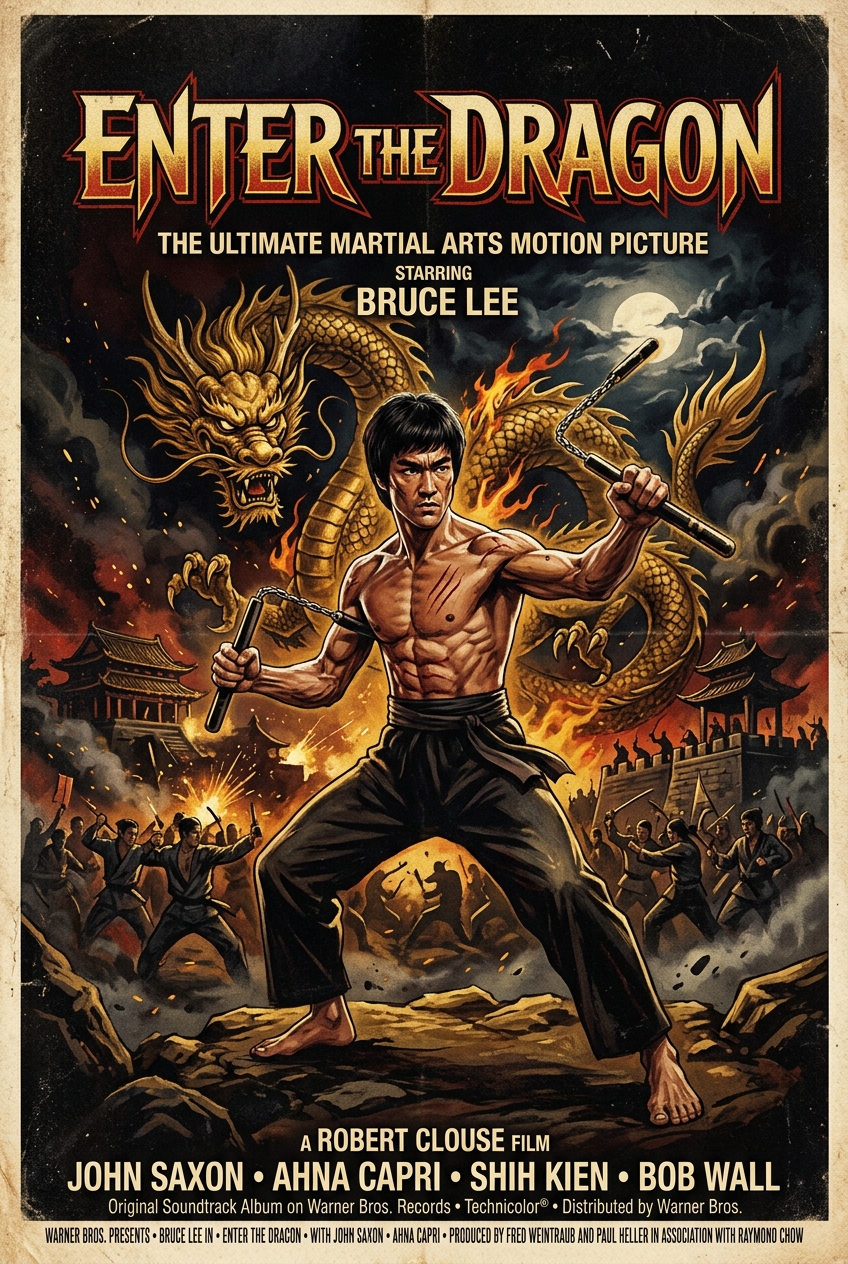
Enter the Dragon (1973)
Directed by: Robert Clouse | Produced by: Fred Weintraub, Paul Heller | Studio: Warner Bros. / Concord Productions | Runtime: 102 minutes
Enter the Dragon is the film that changed everything. Released in July 1973 – just six days after Bruce Lee’s tragic death – it became the highest-grossing martial arts film in history up to that point, earning over \ million worldwide against a budget of \,000. More than fifty years later, it remains the definitive Bruce Lee film and the template for every martial arts action movie that followed.
Plot Summary
A martial arts expert named Lee is recruited by British intelligence to infiltrate a crime lord’s island fortress. Han, the villain, hosts an exclusive martial arts tournament every three years as a cover for his heroin and prostitution empire. Lee enters the tournament alongside two other fighters – American Roper (John Saxon) and Williams (Jim Kelly) – each carrying personal motivations. What follows is a tightly plotted espionage thriller woven through with some of the most electrifying fight choreography ever committed to film.
The Production
Enter the Dragon was the first martial arts film produced by a major American studio. Warner Bros. financed the project after seeing the raw footage from The Big Boss and Fist of Fury. Bruce Lee was deeply involved in every aspect of production – the script, the fight choreography, even the philosophy embedded in the dialogue. The famous “don’t think, feel” speech to his young student in the opening minutes was written by Lee himself and reflects his core Jeet Kune Do principles.
Filming took place entirely in Hong Kong, primarily at the Golden Harvest studios and on location at various sites around the New Territories. The production was often tense, as explored in our account of the troubled behind-the-scenes production of Enter the Dragon, where Lee clashed with director Robert Clouse over creative control. Yet the final product was seamless. Lee’s physicality on screen was unlike anything Western audiences had seen: explosive, precise, and utterly real.
Iconic Scenes
- The Mirror Room: The climactic battle in Han’s hall of mirrors remains one of cinema’s greatest set pieces. Lee navigates a labyrinth of reflections, using each angle to locate his enemy. The sequence was partly improvised by Lee on set.
- The Underground Fight: Lee descends into Han’s dungeon and takes on dozens of guards armed with only his fists and a pair of nunchaku. The scene is rawly athletic and shows Lee’s speed at its absolute peak.
- The Opening Match: Lee’s bout with Sammo Hung (uncredited) in the film’s first minutes establishes tone immediately – restrained power, clinical efficiency, no wasted movement.
Cast
| Actor | Character |
|---|---|
| Bruce Lee | Lee |
| John Saxon | Roper |
| Jim Kelly | Williams |
| Shih Kien | Han |
| Ahna Capri | Tania |
| Bob Wall | Oharra |
| Angela Mao | Su Lin (Lee’s sister) |
Legacy
Enter the Dragon introduced Bruce Lee to a global mainstream audience that extended far beyond Hong Kong cinema fans. Its release transformed how Hollywood perceived Asian martial arts, Asian actors, and Asian storytelling (recounted in his life biography). The film directly inspired an entire generation of action films, video games, and cultural references that continue to this day. In 2004, the United States Library of Congress selected it for preservation in the National Film Registry as being “culturally, historically, or aesthetically significant.”
For anyone beginning their journey into Bruce Lee’s work, Enter the Dragon is the essential starting point.