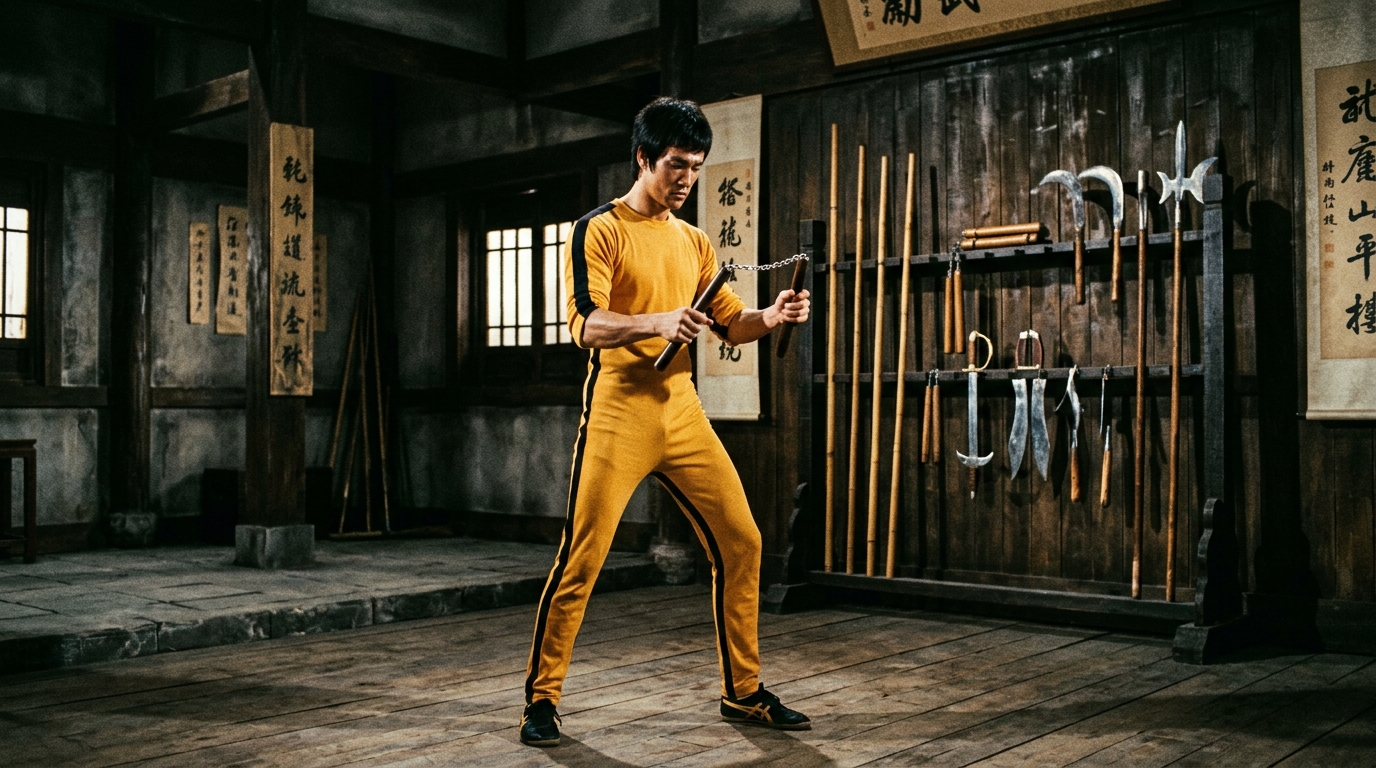
Bruce Lee trained with weapons, but he was selective about it. He understood that a weapon is an extension of the body, and that without correct body mechanics, the tool is useless. The equipment he studied, and that his students learned, came from a specific tradition: Chinese and Okinawan martial arts, filtered through the practical lens of Jeet Kune Do. This page covers the core martial arts supplies connected to his practice, along with guidance on choosing quality training equipment.
Nunchaku: The Weapon That Made a Generation Watch
No weapon is more associated with Bruce Lee than nunchaku. He used them in The Way of the Dragon and most memorably in Game of Death, where he worked through five floors of a pagoda against increasingly skilled opponents. The footage shot before his death in 1973 shows a man who had genuinely mastered the weapon, not just learned a choreographed routine.
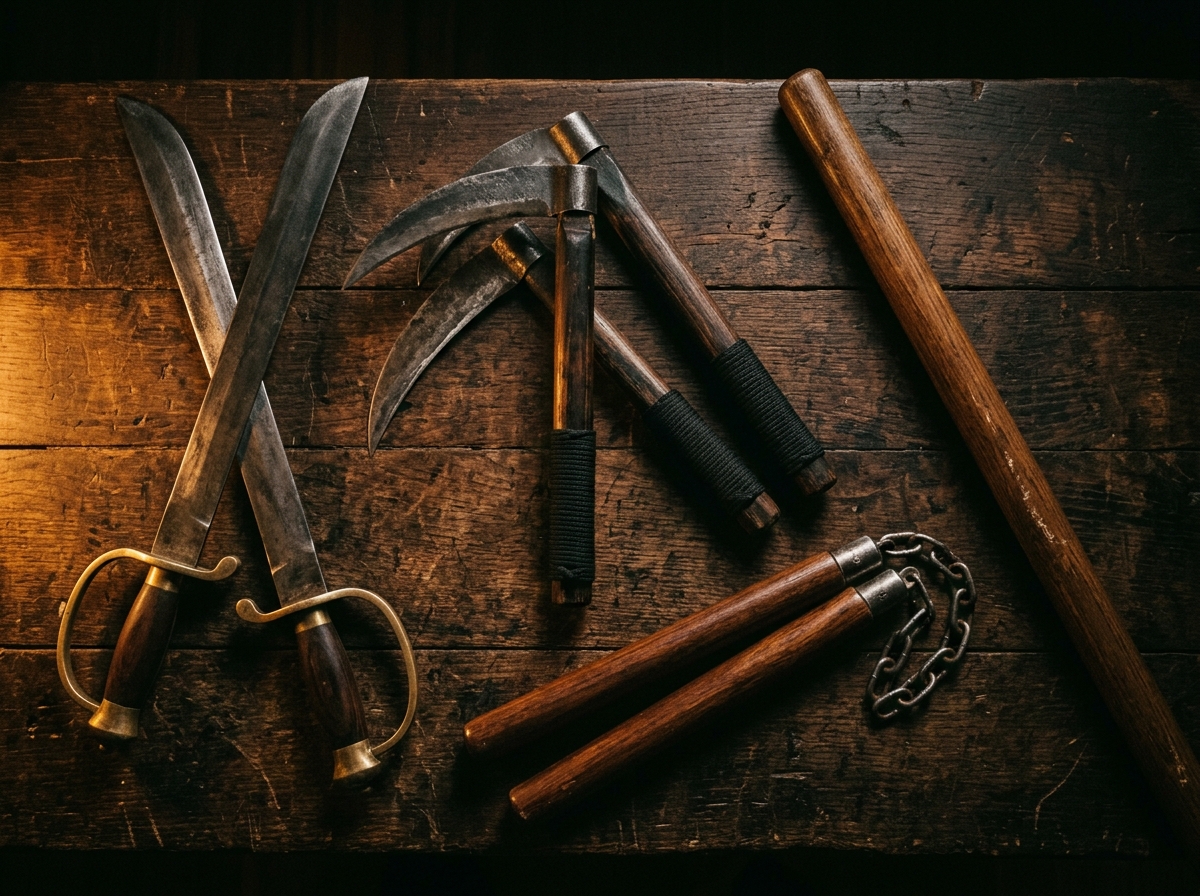
Nunchaku consist of two handles connected by a chain or cord. The rope version allows slightly more flexibility and is easier on wrists during early training. Chain versions tend to be heavier and are generally used by more experienced practitioners. For beginners, foam-padded or rubber training nunchaku reduce injury risk while still developing the right muscle memory.
Wood is the traditional material: hardwoods like red oak, hickory, or rattan are most common. Rattan is forgiving enough for full-contact practice and was widely used in Okinawan schools. Length matters more than most buyers realise: the handles should be roughly the length of your forearm. A pair that fits one person may be completely wrong for another.
Kamas: Short-Range Weapons With Old Roots
Kamas were originally farming tools, sickle-like implements used for harvesting rice. Okinawan peasants, who were prohibited from carrying conventional weapons under Japanese occupation, adapted farm tools into weapons of self-defence. The kama was one of these adaptations. It’s a short, curved blade mounted on a wooden handle, used in pairs, with a range of techniques built around hooking, slashing, and blocking.
In training contexts, kamas are almost always used in their blunted or wooden form. Full-contact sparring with sharpened kamas is rarely practiced outside of very specific traditional schools. Wooden training versions are the safe choice for developing technique, and they last considerably longer than metal equivalents when used against striking pads or with a partner.
Lee incorporated a range of Okinawan weapons into his curriculum, and his student Dan Inosanto, who later developed Jeet Kune Do concepts into the Filipino Martial Arts, was particularly thorough in teaching kali and arnis systems that include short blade and stick work. Anyone studying weapons seriously in the JKD lineage will eventually encounter kama-style training.
The Bo Staff: Range, Leverage, and Discipline
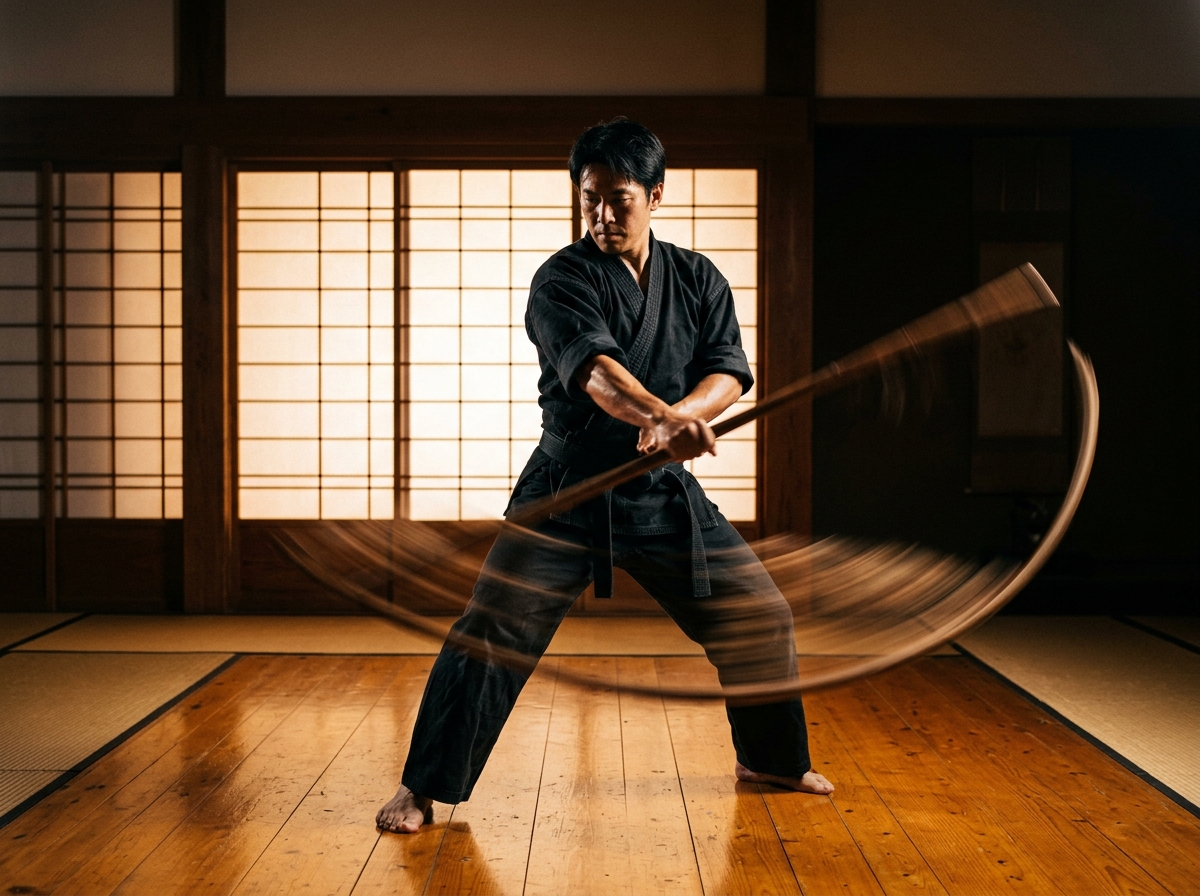
The bo is a six-foot hardwood staff, and it teaches things that shorter weapons cannot. Working with the bo develops full-body coordination, hip rotation, and an understanding of leverage that carries over to empty-hand techniques. It’s one of the first weapons taught in many Okinawan schools precisely because it demands correct posture and footwork from the start.
The jo is shorter, typically around four feet, and was developed in Japan. It’s associated with Shindo Muso-ryu and remains a core weapon in aikido and certain kenjutsu traditions. Both the bo and jo are grouped together in martial arts supply catalogues and training contexts because they share fundamental striking principles: strikes, blocks, thrusts, and sweeps.
Red oak is the most common material for both. It’s dense enough to feel like a real weapon and durable enough to survive thousands of partner drills without cracking. Rattan bo staves are lighter and better suited to speed training. Beginners are usually advised to start with red oak and move to rattan if and when speed becomes a specific training goal.
Wing Chun Wooden Dummy: Bruce Lee’s Foundational Tool
Before he developed Jeet Kune Do, Lee trained under Ip Man in Wing Chun, and the Muk Yan Jong, the wooden training dummy, was central to that practice. The dummy has a vertical trunk with three arms and a leg, mounted so it gives controlled resistance. Striking it develops structure, not just power: you learn to absorb and redirect force rather than simply hitting harder.
Lee installed a wooden dummy in his home gym and continued using it throughout his career. The 108 movements of the Wing Chun dummy form are still practiced by serious students of the style. Modern reproductions range from wall-mounted versions that can be set up in small spaces to freestanding dummies with adjustable heights. Wall-mounted versions are generally considered better for authentic training because the mount itself creates resistance feedback.
Training Gear: What Actually Matters
Beyond specific weapons, anyone training seriously in martial arts needs reliable protective gear. Sparring gloves for hand conditioning, shin guards for leg work, and a quality mouthguard are non-negotiable for partner training. Lee himself documented his conditioning routines in his personal notebooks, which were later published as The Tao of Jeet Kune Do. He trained with heavy bags, focus mitts, and resistance bands long before those tools became standard gym equipment.
The striking pads he used, and that his students worked with, were simple leather focus mitts. Nothing elaborate. The quality of your training comes from the quality of your practice, not from expensive equipment. That’s a principle Lee articulated directly in his writing, and it holds up. Start with fundamentals, buy tools that can take punishment, and prioritise repetition over novelty.
For those interested in the philosophy behind the training, our article on Jeet Kune Do covers Lee’s approach in depth, including why he rejected forms and rigid kata in favour of adaptive, pressure-tested technique. The weapons are tools. The principles underneath them are what he spent his life refining.