Bruce Lee’s Notes on Taoism: What the Tao Te Ching Meant to Him
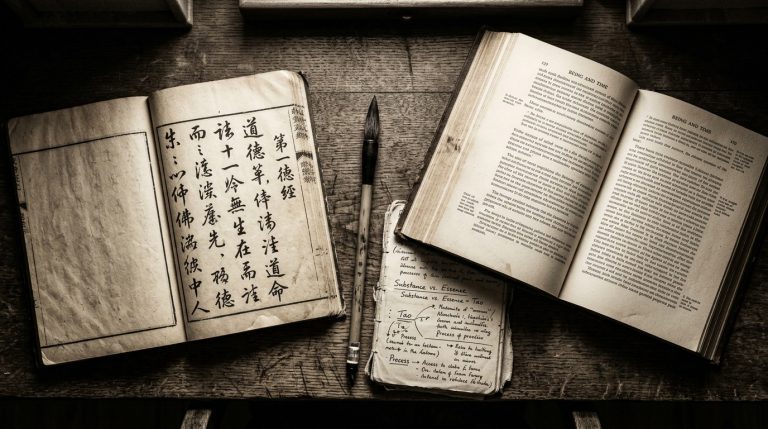
There are pages in Bruce Lee’s personal copy of the Tao Te Ching where the margins are so dense with notes that the original text is almost an afterthought. He wasn’t reading Laozi as casual enrichment. He was working through it the way he worked through everything: looking for what was useful, testing it against his own experience, and marking the passages where the ancient text said something his training had already taught him but hadn’t given him the language to express.
His engagement with Taoism is documented more concretely than his relationship with any other philosophical tradition. The annotated copies of texts, the quotes in his personal notebooks, the explicit connections he drew in his writing on Jeet Kune Do, all of it traces back to Taoist concepts in specific and traceable ways. This wasn’t ambient cultural influence from growing up in Hong Kong, though that was part of it. It was active intellectual engagement that shaped how he thought about movement, combat, and the relationship between training and spontaneous action.
The Text He Was Reading
The Tao Te Ching is attributed to Laozi, a semi-legendary Chinese philosopher whose dates are disputed but who is traditionally placed in the 6th century BCE. The text is short (81 short chapters, most running only a few lines) and famously resistant to single interpretation. Its central concept, the Tao (or Dao), is usually translated as “the Way” but the text itself immediately warns the reader that any Tao that can be defined is not the actual Tao. This is either a profound statement about the limits of conceptual thought or a sophisticated way of protecting the text from being falsified, or both.
Lee primarily worked from English translations, which is itself revealing: he was engaging with the ideas rather than with the classical Chinese literary form. The translations he used included the John C. H. Wu version (published 1961, which was widely available and academically respectable) and possibly the Gia-fu Feng and Jane English version, which appeared in 1972 and became influential partly through its pairing of text with photographs. His notes engage with the ideas philosophically rather than with translation accuracy, which suggests he was primarily interested in what Laozi was saying rather than in Taoist scholarship as such.
Wu Wei and What It Actually Means for Fighting
| Taoist Concept | Philosophical Principle | Bruce Lee’s Combat Application | Combat Outcome |
|---|---|---|---|
| Wu Wei (Non-Action) | Action without artificial effort or friction | Spontaneous, unforced response to opponent’s incoming line | Striking without premeditation or cognitive latency. |
| P’u (Uncarved Block) | Primal state of natural simplicity | Stripping away decorative katas and rigid classical stances | Direct, untelegraphed efficiency of motion. |
| Yin & Yang Polarity | Harmonious interplay of complementary forces | Soft yielding to aggressive force; hard striking into empty voids | Maintaining dynamic balance and fluidity under chaotic pressure. |
| The Pliant vs. Rigid (Ch. 76) | The flexible is alive; the rigid belongs to death | Bending with the incoming attack rather than bracing head-on | Absorbing kinetic energy and redirecting it back at the attacker. |
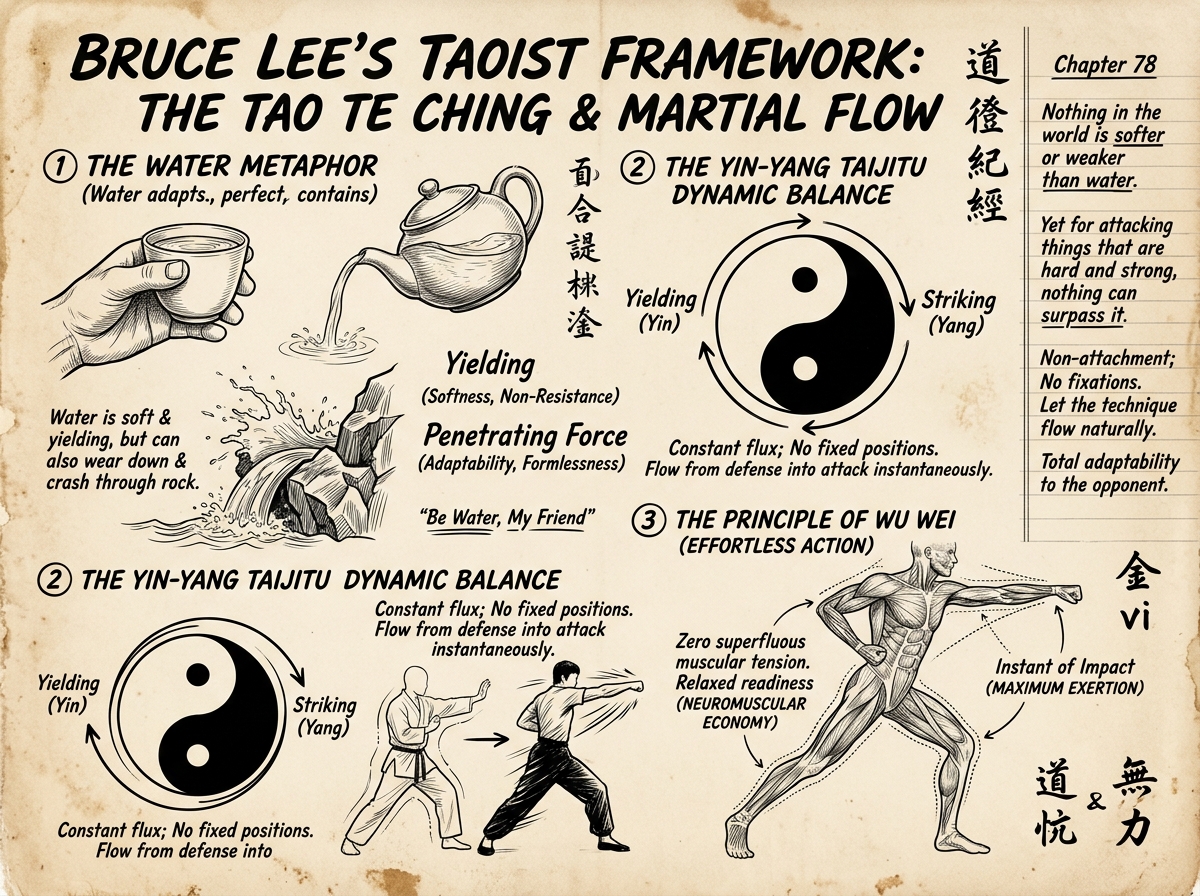
The Taoist concept that appears most consistently in Lee’s writing is wu wei, usually translated as “non-action” or “effortless action.” The translation is slightly misleading. Wu wei doesn’t mean doing nothing; it means acting in alignment with the natural flow of a situation rather than forcing it. A river doesn’t struggle to flow downhill. Water doesn’t fight the shape of the container it’s poured into. The action happens without resistance, without deliberate forcing, and the result is achieved with minimum wasted effort.
For Lee, this translated directly to how he understood optimal fighting performance. The deliberate, conscious control of each movement, the beginners’ experience of thinking “now I punch, now I block, now I step” is the opposite of wu wei. It’s slow, it’s stiff, and it’s vulnerable because the gap between perceiving and responding is filled with internal deliberation. The practitioner who has trained to the point of wu wei doesn’t deliberate. The response arises from the training the way water fills a crack: without decision, without effort in the sense of forcing, with maximum efficiency.
This is the same concept as the Zen mushin state that Lee also wrote about extensively, and he was aware of the overlap. The Taoist and Zen traditions converged on the same insight from different directions: conceptual thought, the internal monologue of the conscious self, is an obstacle to peak performance because it introduces delay between perception and action. Lee used both frameworks because each illuminated a different aspect of the same target.
The Uncarved Block and the Fighter’s Development
Another Taoist concept that recurs in Lee’s notes is pu, the “uncarved block” or “original simplicity.” In the Tao Te Ching, pu represents the state before conditioning and social shaping have imposed fixed patterns: the natural, undifferentiated potential from which specific forms emerge through experience. Laozi suggests that wisdom involves recovering something of this original openness, not through ignorance but through the transcendence of rigid, conditioned responses.
Lee applied this concept to JKD’s critique of fixed styles. A practitioner locked into a single martial art system has, in Taoist terms, become a carved block: the conditioning of the style has imposed fixed patterns that the practitioner can no longer see past. They respond to situations with the tools their system provides, even when those tools are wrong for the situation. The pu practitioner, by contrast, responds with whatever the situation actually requires because they haven’t predetermined the response through stylistic commitment.
This philosophical point explains why Lee’s training program included such a wide range of methods and why JKD explicitly rejected affiliation with any fixed style. It wasn’t eclecticism for its own sake. It was a Taoist argument: preserving functional openness by refusing to let any single conditioned form become dominant. The famous instruction “absorb what is useful, discard what is not, add what is essentially your own” is pu applied to martial arts development.
The stiff and unyielding is the disciple of death. The gentle and yielding is the disciple of life. A tree that is unbending easily breaks.
Lao Tzu, Tao Te Ching (Annotated in Bruce Lee’s personal copy)
Chapter 76: The Living and the Dead
One specific chapter of the Tao Te Ching appears in Lee’s notes with particular frequency. Chapter 76 contains the observation that living things are soft and yielding while the dead are hard and rigid; therefore the hard and rigid belong to death while the soft and yielding belong to life. A tree that bends in the wind survives; the rigid tree breaks. This is part of the same cluster of ideas as the famous water metaphor that Lee eventually made into his most recognized statement.
Lee returned to Chapter 76 in his training writing because it provided the philosophical grounding for a counterintuitive athletic principle: tension reduces speed and power. The punch thrown from a tense, contracted shoulder is slower and generates less force than the punch thrown from a relaxed shoulder that contracts only at the moment of impact. The martial artist who grips too hard, who muscling the technique rather than allowing it to express through relaxed structure, is being rigid in exactly the sense Chapter 76 warns against.
His training emphasis on relaxation, specifically the deliberate practice of releasing shoulder tension before generating striking power, is a direct application of this Taoist principle. He wasn’t being philosophical in the training hall. He was applying a practical insight that Laozi had expressed with uncommon clarity two and a half thousand years earlier.
Where Taoism and His Practice Diverged
Lee’s engagement with Taoism was selective. He was interested in what the tradition had to say about performance, spontaneity, and the relationship between training and natural action. He was less interested in the political philosophy in the Tao Te Ching (which addresses governance, social organization, and the problems of institutional power in ways that have no obvious application to martial arts development) and essentially uninterested in the religious dimensions that Taoist practice developed in later centuries through ritual, liturgy, and institutional structures.
He also approached Taoism alongside other traditions rather than treating it as definitive. His notebooks contain Taoist observations, Zen analysis, Krishnamurti’s secular psychological framework, Western existentialism, and practical sports science within the same pages, sometimes on the same problem. He wasn’t a Taoist in the sense of having made a philosophical commitment to the tradition. He was a practical philosopher using the tradition as a source of insight, taking what worked and not feeling obligated to take the rest.
The Annotation Pattern
What’s most revealing about Lee’s relationship with the Tao Te Ching isn’t which passages he marked but how he marked them. Students who have seen his personal copies (which are now held in the Bruce Lee Foundation archives and have been partially reproduced in documentary materials) describe annotations that translate abstract philosophical language into specific physical applications. Next to a passage about yielding, a note about shoulder relaxation. Next to a passage about the valley that receives all things without forcing them, a note about the receiving qualities of defensive movement.
This translation process, from abstract philosophy to specific physical instruction, is the work of someone who has understood a text deeply enough to see through it to the physical reality it’s describing. Laozi was writing about Taoism. Lee was reading a training manual in philosophical language, and recognizing it as such because his training had given him the direct experience that the text was pointing toward.
That recognition across 2,500 years and multiple cultural contexts is what makes his engagement with Taoism interesting beyond the biographical fact of it. He didn’t find the Tao Te Ching because he was looking for Asian philosophy to add depth to a martial art. He found it because it described something his body already knew from training, and he wanted a language for it that was precise enough to teach.