Bruce Lee’s Five Ways of Attack: The Complete Tactical System
Bruce Lee spent years reducing fighting down to what he called the essentials. Everything that was ceremonial or stylistic or inherited from tradition without a functional justification got cut. What remained was a system he could actually use, test, and teach. The Five Ways of Attack is one of the clearest examples of that reduction process: a complete taxonomy of how any offensive action can be initiated, organized into five distinct categories.
The framework didn’t appear fully formed. Lee developed it gradually through his study of Western fencing (particularly the work of Aldo Nadi and the classical European texts on initiative and attack), his Wing Chun background, his own sparring experience, and his extensive reading across multiple combat disciplines. By the time he was teaching his small core group in Los Angeles in the late 1960s and early 1970s, the Five Ways had become the organizing structure for how JKD students understood offense.
There are essentially only five ways to launch an attack in combat. Master the transitions between them, and your opponent is always defending the move you just finished.
Bruce Lee, The Tao of Jeet Kune Do
Why a System of Categories?
The point of the Five Ways isn’t memorization. Lee was skeptical of rigid systems, and anyone who reads his writing on JKD’s core philosophy knows he considered most martial arts too attached to classification. The Five Ways work differently: they describe how attacks happen in sparring and real fighting, which means a practitioner who understands the categories can recognize them when an opponent uses them and can train each one deliberately rather than hoping to develop them through repetition alone.
Each category has a different underlying logic. Different entries into combat require different timing, different preparation, and different tactical setups. Training one doesn’t automatically develop the others. That’s the practical argument for why the framework matters.
Single Direct Attack (SDA)
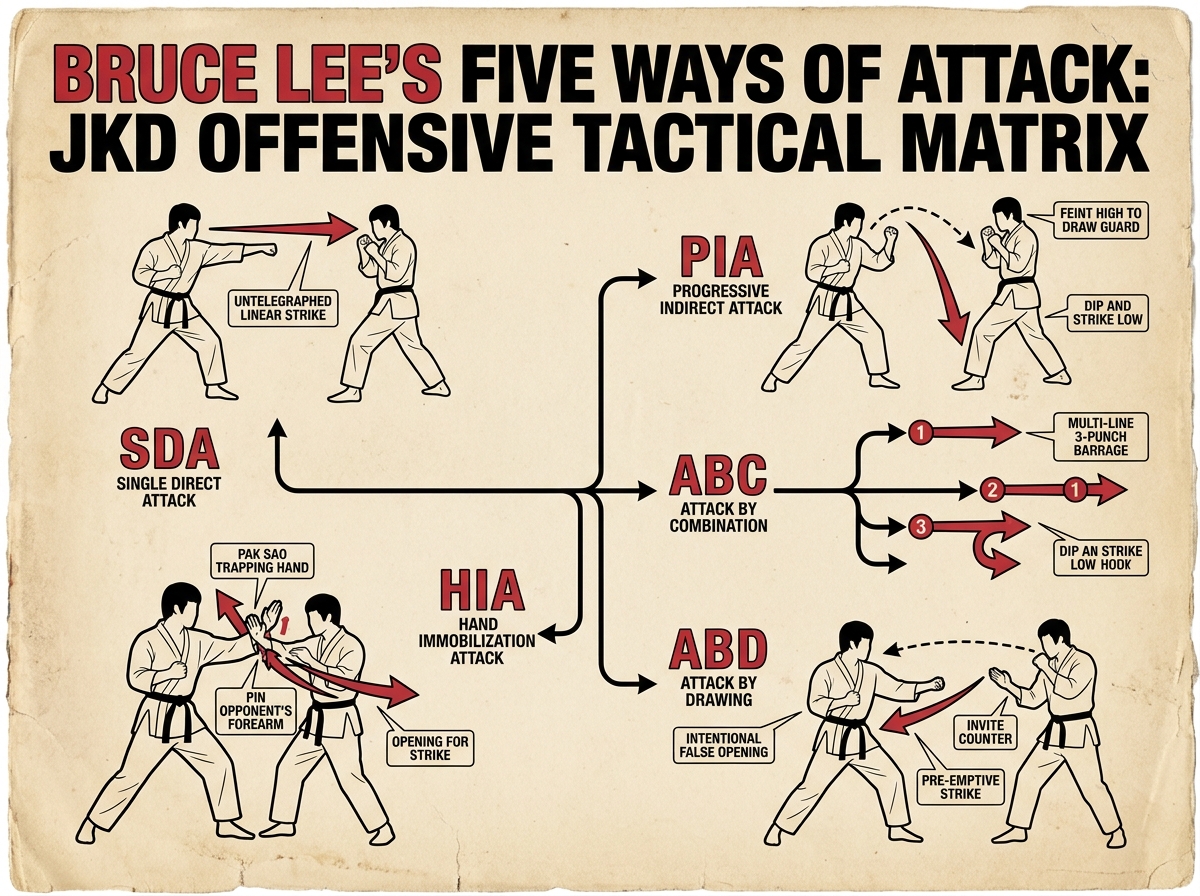
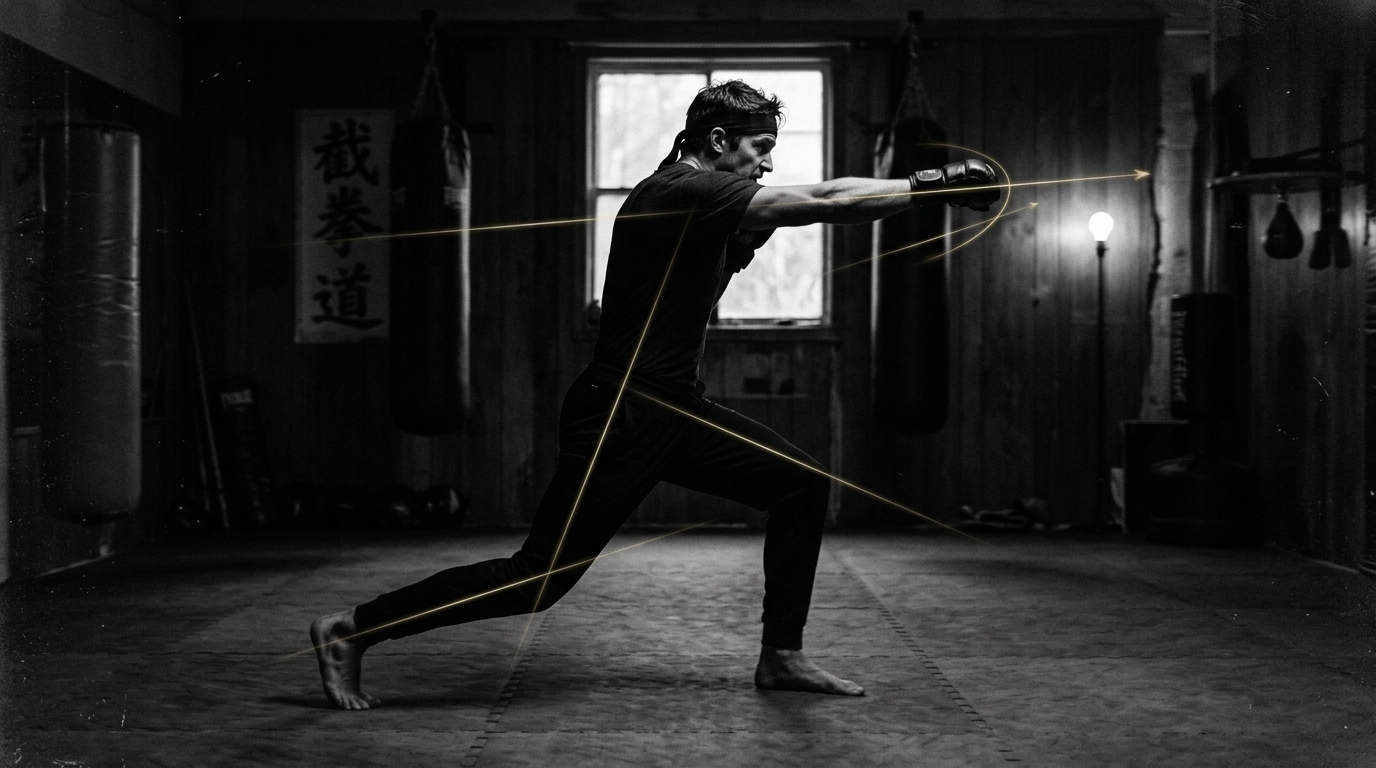
The simplest category. A single direct attack is one technique delivered in a straight line to the closest available target, without feinting or combination setup. A jab to the nose when the opponent drops their guard. A side kick to the knee when they shift weight to their rear foot. The defining quality is directness: no deception, no setup, just recognizing an opening and filling it before it closes.
It sounds simple. In practice, it’s the hardest thing to actually land in sparring against a competent opponent, because their guard exists specifically to close those openings. Lee’s approach to the SDA drew heavily from fencing’s concept of the direct thrust: the fastest possible path to the target. His own jab, thrown from a relaxed shoulder with no telegraphing shoulder dip or weight shift, was his most-used SDA. Former students describe it as genuinely difficult to see coming even when they knew it was coming.
Training the SDA means drilling the entry points: where does the opening appear, for how long, and what’s the fastest technique that reaches it? Lee was specific about eliminating any preparatory movement that reduces the element of surprise. Pulling the hand back before punching, raising the shoulder, tensing visibly before committing — all of these give an alert opponent time to respond. The SDA depends on the opponent seeing the technique after it’s already in motion.
Attack by Combination (ABC)
Where the SDA relies on speed and timing to land a single technique, the ABC chains techniques together so that the first creates the opening for the second. The combination itself is the tactic. If the jab draws the hands up, the cross finds the body. If the body shot drops the guard, the hook finds the head. Each technique in the chain does a job beyond simply trying to land damage.
Lee studied combinations from boxing more extensively than from any other art, and Western boxing’s tradition of multi-punch combinations informed how he taught the ABC. His reading notes from his training years include detailed analysis of how specific boxing combinations worked mechanically: why a left hook sets up a right uppercut, why a double jab changes the timing expectation before a cross. He wasn’t borrowing boxing sequences; he was extracting the underlying logic of how successive techniques interact.
The distinction between a combination and a flurry matters here. A flurry is a burst of techniques hoping that one lands. A combination is a sequence where each technique serves the next. Lee was clear about this in his teaching: if you’re throwing three punches hoping one gets through, that’s not an ABC, it’s panic. The ABC requires understanding which opening each technique creates before you’ve thrown it.
Progressive Indirect Attack (PIA)
The PIA introduces deception. The attack begins toward one target to draw a defensive response, then changes direction to the target that defense creates. A low feint to the body draws the hands down; the real attack goes high. A hand feint draws the guard across; the kick goes to the exposed side.
This is where fencing’s tradition of the feint-and-thrust enters the framework directly. European classical fencing had developed the feint as a core tactical tool over centuries, and Lee’s study of fencing masters gave him a vocabulary for the PIA that most martial arts of his era hadn’t articulated. The fencing feint works when it’s committed enough to provoke a genuine defensive response but not so committed that it can’t redirect quickly. The same quality applies in JKD.
Lee’s teaching emphasized the difference between a realistic feint and a fake. A fake doesn’t threaten anything and won’t draw a genuine response from an experienced opponent. A feint has to look and feel like the real thing long enough that the opponent commits to defending it. The PIA is therefore more physically demanding than the SDA or ABC: it requires the practitioner to make a threatening motion without committing to it, then redirect before the opponent can adjust. The timing window is tight.
Hand Immobilization Attack (HIA)
The HIA is the most distinctly Wing Chun-influenced category. Instead of going around the opponent’s guard or drawing it out of position, the HIA controls the guard directly. One hand traps or pins the opponent’s limb while the other attacks through the opening created by that immobilization.
This is the fighting logic behind trapping range, the close-quarters distance where Wing Chun specializes. At trapping range, strikes are too close to gain full power but limb control becomes feasible. A pak sao (slapping block) that deflects and pins the opponent’s lead hand creates a direct line to their face for a fraction of a second. That’s the HIA in its most basic form.
Lee modified the Wing Chun trapping game considerably in developing the HIA as a JKD category. Pure Wing Chun trapping relies on chi sao (sticky hands) sensitivity developed through extensive partner drilling. Lee’s JKD version emphasized simpler, higher-percentage traps that could be integrated with the other four attack categories rather than requiring a separate dedicated practice. He was interested in what trapping could add to a broader game, not in Wing Chun as a complete system.
Dan Inosanto, who documented Lee’s teaching more systematically than anyone else, notes that Lee considered the HIA the category most dependent on proper training range. You can’t practice immobilization attacks at the same distance as kicking techniques. That specificity made the HIA the category JKD students often spent least time on, which Lee viewed as a tactical gap worth correcting.
Attack by Drawing (ABD)
The ABD reverses the usual attacker-defender relationship. Instead of creating an opening through feinting or speed, the ABD creates an opening by making the opponent attack first. The practitioner deliberately presents a target or signal that invites a specific response, then counters that response with a prepared technique.
This is the “trap” category in its most literal sense. Lower the lead hand slightly to invite a jab, then slip the jab and fire a counter. Show a slight drop in stance to invite a leg attack, then intercept it. The ABD requires knowing what your opponent is likely to do when they see a specific vulnerability, and having a counter for it ready before you show the bait.
Lee connected the ABD explicitly to the JKD concept of interception, the “stop-hit” from fencing adapted to all fighting ranges. The interception in the ABD isn’t reactive in the usual sense: you’ve already decided where the opponent’s attack will come from before you’ve invited it. The counter lands before their technique can complete because you set up that exact situation on purpose. When it works, it looks like precognition. It’s actually preparation and observation.
The ABD has an obvious risk: if you misread the opponent, or if they recognize the invitation as a trap, you’ve deliberately exposed a target. Lee’s teaching on the ABD emphasized that it should be drawn from observation during a match, not deployed as a first-round tactic against an unknown opponent. You need to know what a specific person tends to do before you invite them to do it.
| Method | Acronym | Tactical Principle | Prime Execution Example | Psychological Trigger |
|---|---|---|---|---|
| Single Direct Attack | SDA | Direct, untelegraphed strike traveling the shortest geometric line | Lead straight punch to jaw or intercepting shin kick | Striking instantly upon opponent’s preparatory twitch. |
| Attack by Combination | ABC | Sequential multi-line barrage overwhelming opponent’s guard | Lead punch followed by rear cross, ending in low roundhouse | Forcing opponent to commit defense to one line while striking another. |
| Progressive Indirect Attack | PIA | Feint or deceptive movement inducing a false reaction to open a path | High lead feint to draw guard up, dipping low into deep side kick | Exploiting visual flinch and defensive over-commitment. |
| Hand Immobilization Attack | HIA | Trapping or pinning an opponent’s limb to clear a barrier to the target | Pak Sao (slap trap) or Lop Sao (pulling hand) into spinning backfist | Neutralizing defensive guard before delivering concussive impact. |
| Attack by Drawing | ABD | Deliberately exposing a false target to invite and counter incoming attack | Dropping lead guard slightly to invite straight punch, parrying into stop-hit | Turning opponent’s offensive aggression into their own trap. |
How the Five Categories Work Together
The categories aren’t alternatives. They’re tools for different tactical situations, and an effective JKD practitioner should be able to use all five against the same opponent in the same sparring session. The SDA for obvious openings. The ABC when the SDA alone can’t get through. The PIA when the opponent’s defense closes too quickly for a direct approach. The HIA at close range. The ABD when you’ve identified a pattern you can exploit.
Lee’s writing describes the Five Ways as a diagnostic system as much as a training framework. When you watch a fighter, you can ask which categories they’re using and which they’re not. A boxer who only throws combinations (ABC) with no PIA is predictable once you’ve seen their sequences. A grappler who relies entirely on the ABD (drawing a striking attack before shooting for the takedown) is vulnerable if you recognize the pattern and refuse to engage it. The categories create a vocabulary for analyzing what’s happening in a fight.
Joe Lewis, who was one of the most successful American sport karate champions of the late 1960s and trained with Lee privately, later said that the Five Ways of Attack framework reorganized how he thought about fighting more than any specific technique Lee showed him. Lewis had already developed a formidable SDA through years of tournament competition. What Lee gave him was a language for the other four categories and a training methodology to develop them systematically.
Training Each Category
Lee’s approach to training the Five Ways was specific. Each category needs partner drilling with progressive resistance, not just shadow work. The SDA needs a partner who can actually close openings so you learn to recognize the real ones. The PIA needs a partner who genuinely responds to your feints. The ABD needs a partner who will actually commit to the invitation you’ve set.
Shadow drilling and heavy bag work build the physical execution of techniques. They don’t build the tactical judgment of when to use which category, because the bag doesn’t respond and your shadow doesn’t have a defensive game to read. Lee was explicit that the Five Ways only become functional through alive partner work where both people are trying.
His prescription for developing the less-used categories was simple: in sparring, impose constraints. Give yourself a round where you can only use the HIA. A round where everything must be ABD. The constraint forces development of categories that the practitioner would otherwise skip in favor of their strengths. That deliberate limitation is how gaps get closed rather than avoided.
The Framework’s Staying Power
Fifty years after Lee developed the Five Ways of Attack, MMA coaches use similar taxonomies without always knowing where the framework came from. The structural distinction between direct attacks, combination attacks, feint attacks, and counter-attack setups appears in how striking coaches organize training even when they’re not teaching JKD explicitly. The categories describe something real about how offensive initiative works in combat, which is why the taxonomy survived.
For anyone serious about understanding how Bruce Lee thought about fighting, the Five Ways of Attack is the clearest window into the analytical engine behind the physical performance. The impressive feats get most of the attention. The framework for organizing offense is what made those feats a teachable system rather than personal talent.