Bruce Lee’s Punching Bag Workout: The Heavy Bag Sessions Behind the Power
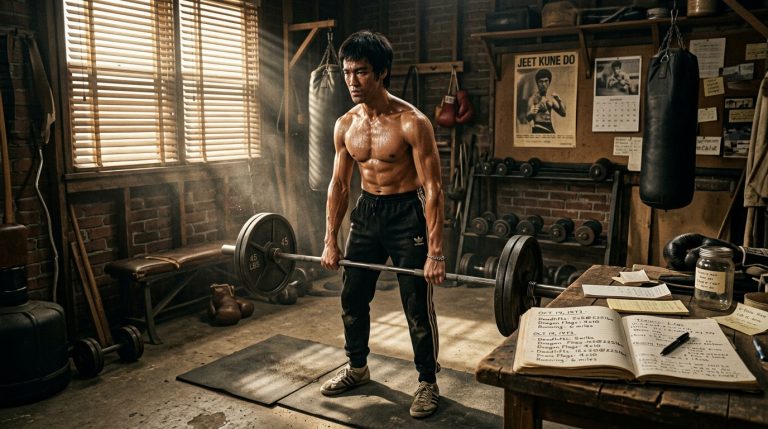
The heavy bag in Bruce Lee’s Bel Air home gym had a custom filler. Standard commercial bags of the era were packed with rags or sawdust, which compresses over time into a dead, unresponsive surface. Lee had his filled with a firmer compound that preserved the resistance he wanted: something that pushed back, that gave him real feedback on where the power was going and where it wasn’t. The bag wasn’t just a conditioning tool for him. It was a measuring instrument.
His daily workout routine included bag work on most training days, typically positioned after his early morning run and before technical drilling or sparring. The specific duration varied depending on what else was on the schedule, but 30-minute sessions were common, often with structured interval work rather than continuous hitting.
What He Was Actually Training For
There’s a distinction between bag work done for cardiovascular conditioning and bag work done for power and technique development. Lee used his bag sessions primarily for the second purpose, which required a different approach than simply hitting hard for as long as possible. He was interested in quality of force production, not volume of output.
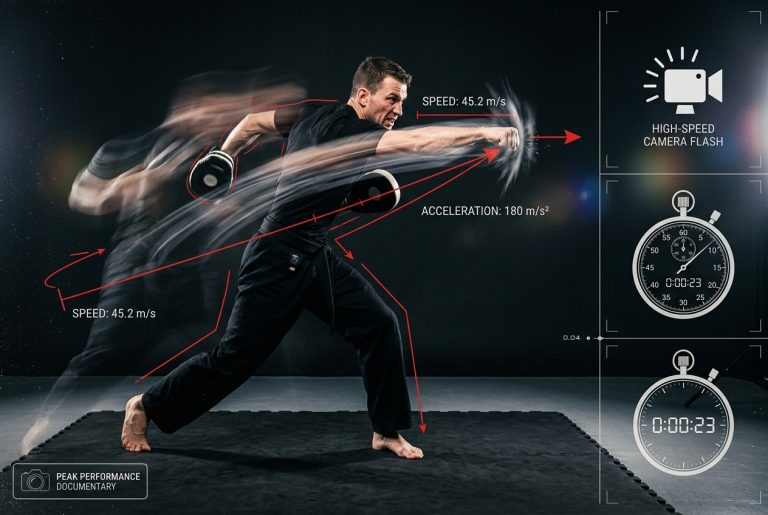
His approach to power generation had been shaped by his study of physics, specifically his reading in biomechanics and his conversations with people who had formal training in the physics of force transfer. He understood that power at impact is a product of mass, velocity, and the efficiency of the kinetic chain from ground contact through the striking surface. The bag let him test whether all three elements were actually coordinating the way he understood they should.
A punch that sounds impressive on the bag but leaves the practitioner’s feet in the air at impact has broken the kinetic chain at the ground contact point. A kick that swings the leg broadly generates visible motion but dissipates energy in the arc that should be concentrated at the target. The bag provides immediate feedback on these efficiency questions that shadow work can’t replicate, because there’s no resistance in shadow work to reveal where the force is leaking.
The Session Structure
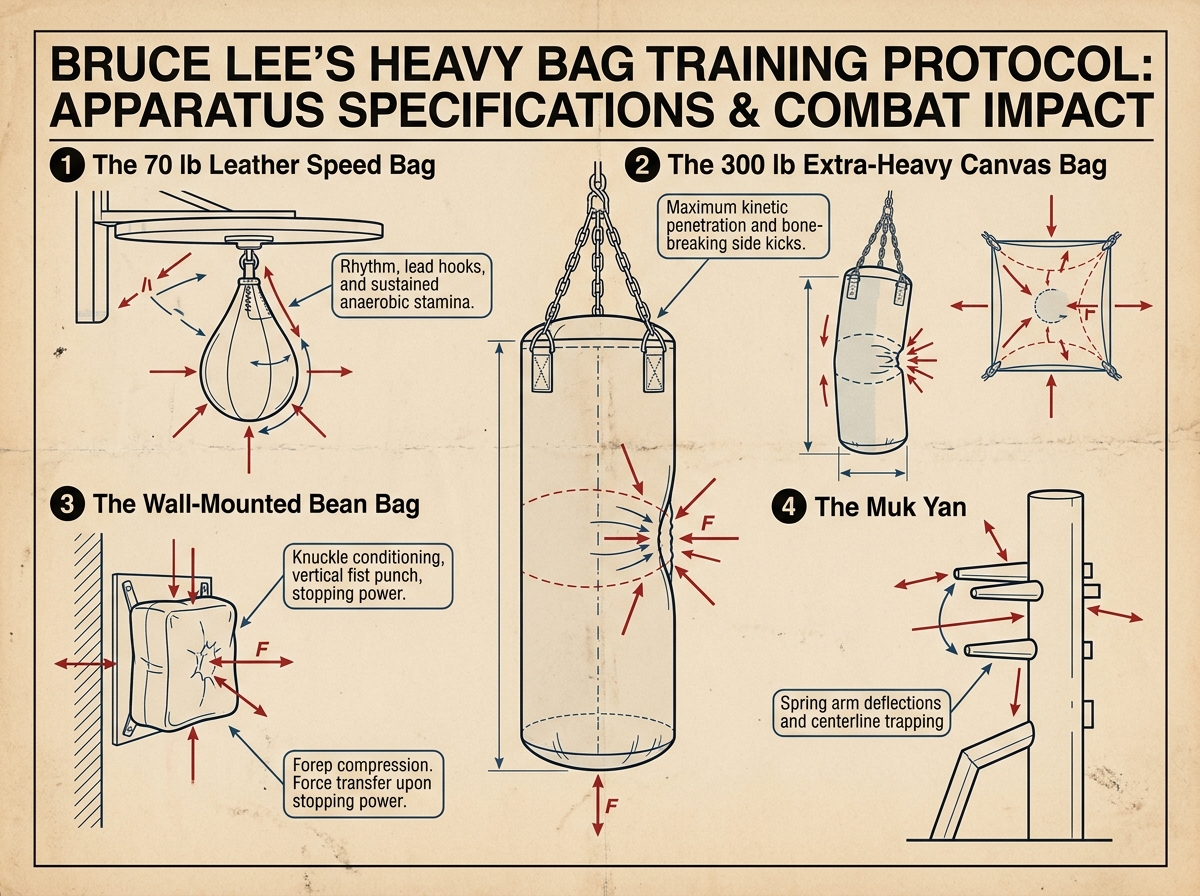
| Striking Apparatus | Apparatus Weight / Specs | Workout Volume & Cadence | Primary Combat Adaptation |
|---|---|---|---|
| Heavy Leather Punching Bag | 70–100 lbs (standard density) | 5 rounds × 3 min (lead jab, cross, hooks) | Building sustained anaerobic endurance and impact absorption in wrists. |
| Extra-Heavy Canvas Bag | 250–300 lbs (custom-weighted) | 50–100 repetitions of lead side kick | Developing bone-crushing concussive force and follow-through penetration. |
| Wall Mount Canvas Bag | Filled with mung beans and fine sand | 500–1,000 rapid vertical punches | Conditioning knuckles, wrist alignment, and short-range stopping power. |
| Wooden Dummy (Muk Yan Jong) | Modified with spring arms & neck | Daily formless trapping sequences (15–20 min) | Perfecting angles of deflection, limb immobilization, and centerline entry. |
Lee’s bag sessions typically moved through several distinct phases rather than a single undifferentiated period of hitting. The opening minutes were relatively light, warming the joints and establishing the rhythm before adding power. Students and training partners who observed his bag work describe a clear escalation pattern: technique building before intensity, structure before force.
The middle portion of the session involved his working combinations and specific techniques at near-full power. This is where the bag filled with firmer compound paid off: the resistance was high enough that he could feel whether a strike was landing with full structural alignment or slightly off. The bag work was essentially a diagnostic tool for his own technique, and the sensory feedback from a responsive surface was part of what he was looking for.
Interval work appeared regularly. Hard burst for one to two minutes, controlled pace for a similar period, hard burst again. This pattern mirrors the energy system demands of fighting better than continuous-pace hitting does, and Lee’s approach to conditioning was consistently specific to the demands of actual combat rather than general fitness. He had no interest in conditioning for its own sake.
The Kicks: Why He Spent More Time Than Expected
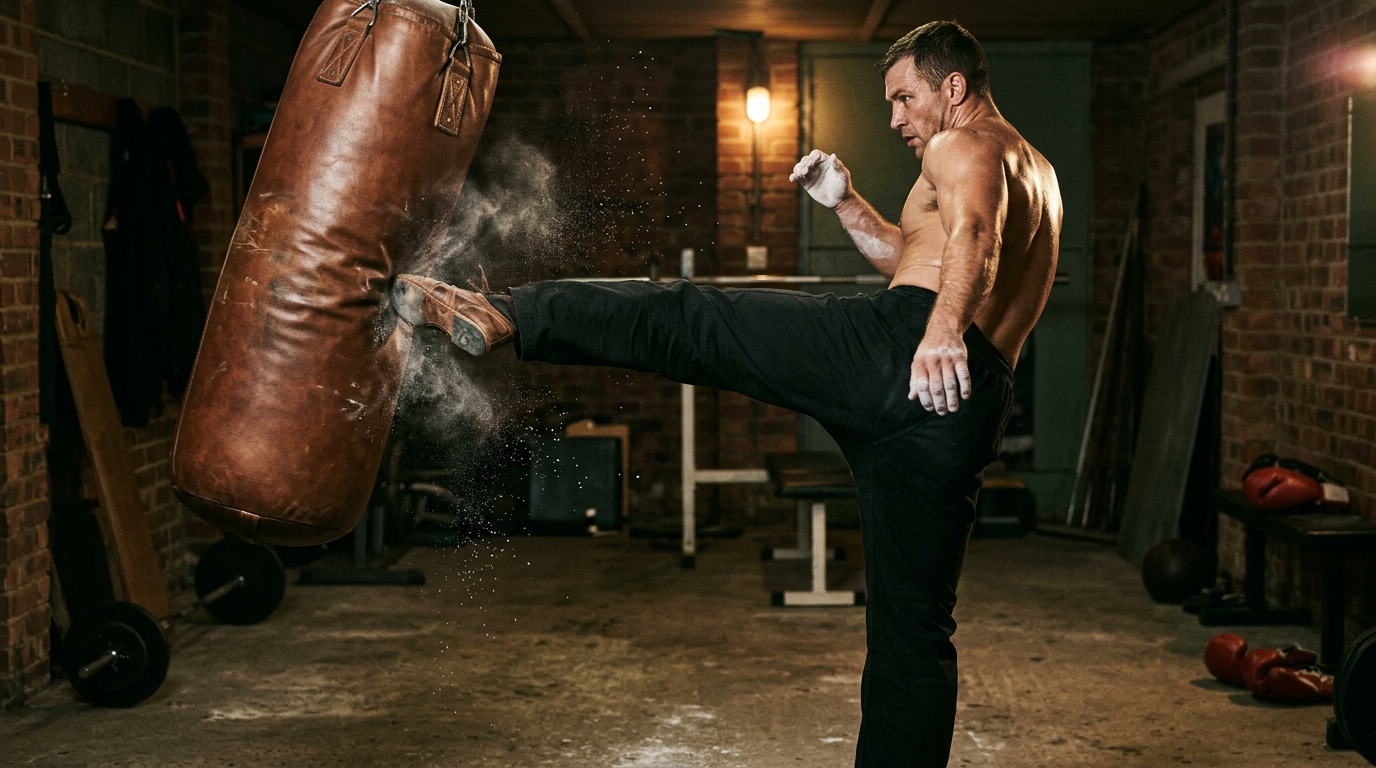
Most accounts of Lee’s bag work focus on the punching, partly because his hand speed is what’s most visible in film footage. His actual bag sessions gave substantial time to kicking, particularly the side kick and the hook kick. The side kick was his signature technique: a linear drive from the hip that he could generate with exceptional force relative to his size, and which he considered structurally superior to the roundhouse kick as a power-generating tool.
The side kick on a heavy bag requires different bag positioning than punching. Lee’s bag setup allowed him to work it at multiple heights and angles. He practiced the side kick both as a committed power technique and as a checking motion, the stop kick that intercepts an opponent’s forward movement before they can close to punching range. The same fundamental movement serves two distinct tactical functions, and his bag work trained both.
The hook kick, a circular technique that curves around a guard, appeared less frequently in his films than the side kick but was a regular element in his training. It’s a more difficult technique to generate consistent power with, because the arc of movement has to maintain tension through the rotation to deliver force at the terminal point. His bag work on the hook kick was about that specific problem: keeping the power concentrated at impact rather than dissipating through the arc.
The Wall Bag and Wooden Dummy
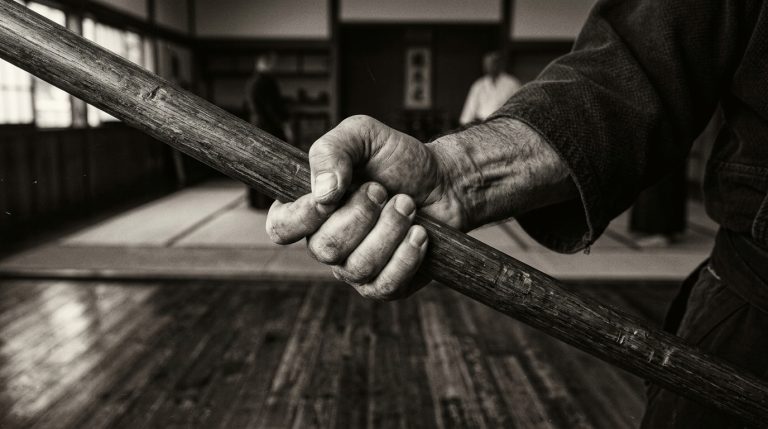
Alongside the heavy bag, Lee trained on a wall-mounted canvas bag for closer-range work and on a wooden dummy (muk yan jong) inherited from his Wing Chun background. These three tools served distinct purposes that the heavy bag alone couldn’t cover.
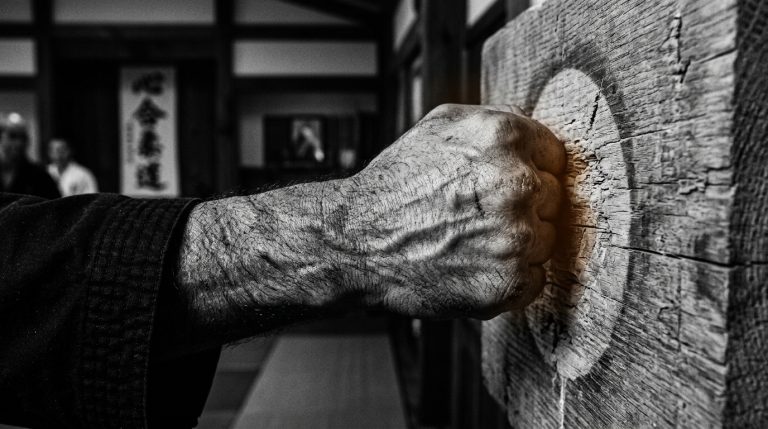
The wall bag is a compact, flat striking surface that allows close-range training without the swing and pivot of a hanging heavy bag. Lee used it for his one-inch and two-inch punch development: techniques where the power is generated over extremely short distances require a stable, non-moving surface that gives consistent feedback. A hanging bag swings away at impact and dissipates the force through movement; the wall bag absorbs the strike directly.
The wooden dummy provided the limb-contact training that neither bag could replicate. You can’t practice trapping and deflection sequences on a heavy bag because there are no limbs to redirect. The dummy’s fixed arms and leg post simulate the contact geometry of close-range fighting in ways that are specific enough to develop real tactile sensitivity. Lee adapted the Wing Chun dummy training to incorporate JKD’s entry techniques, using the dummy’s structure as a reference point for distance and angle rather than as a system to be trained in isolation.
Do not just hit the bag; visualize the opponent’s reaction, penetrate through the surface, and immediately recover your guard.
Bruce Lee, Advice to Dan Inosanto
What Students Observed
The accounts that survive from people who watched Lee train on the bag consistently note two things: the sound and the movement. The sound of his strikes landing was described as qualitatively different from what a typical heavy hitter produces. A bigger person hitting a bag generates a deep thud from mass. Lee’s strikes at 140 pounds produced a sharper, more concentrated impact sound that former students attribute to the precision of the force transfer rather than the quantity of mass behind it.
The movement between techniques was the other consistent observation. Lee didn’t reset to a fixed position between strikes. The footwork between techniques was continuous and organized, maintaining the angled positioning and weight distribution that kept each subsequent technique structurally ready. Watching a skilled boxer or martial artist move around a bag reveals how much of their game is in the movement between techniques, not just the techniques themselves. By that measure, Lee’s bag work was as much footwork training as it was striking training.
Applying It to Your Own Training
The practical lesson from Lee’s approach to bag work isn’t a specific routine to copy. It’s the underlying principle: use the bag as a feedback tool, not just a conditioning tool. Each session should have a technical focus. What specifically are you testing? Where is the power going? Is the kinetic chain intact from ground to impact?
The bag work in a training program modeled on his approach should sit between the cardiovascular base work and the technical partner drilling. Its job is to bridge the gap between the physical capacity built by running, rope work, and weight training, and the applied technique developed through sparring. A heavier bag with real resistance gives better feedback than a light bag that swings freely. And thirty minutes of focused technical work will develop more than an hour of undirected hitting, which is the same principle Lee applied to everything else in his training.