Fist of Fury (1972): How Bruce Lee Made an Angry Film Last
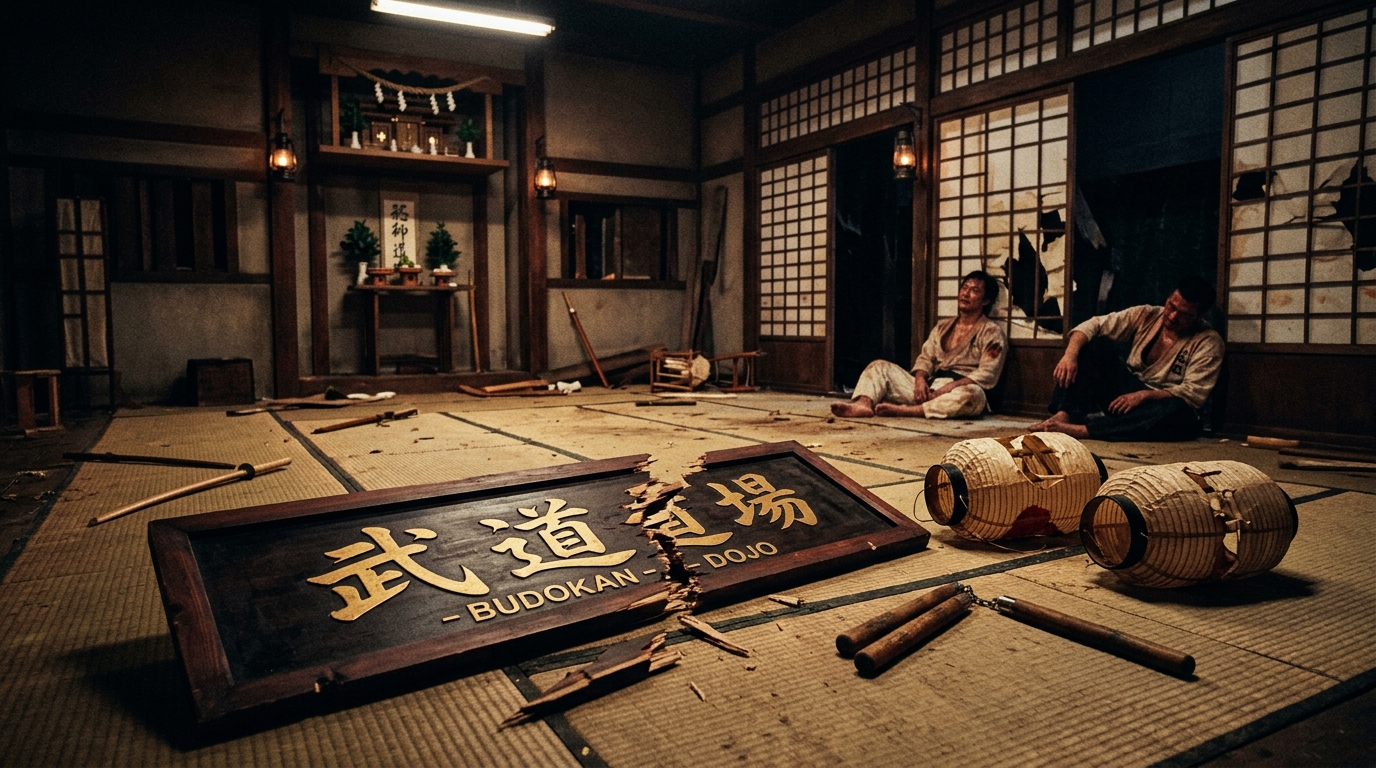
The scene that made Fist of Fury famous lasts about ninety seconds. Chen Zhen, Lee’s character, walks into the Japanese martial arts school in the Shanghai International Settlement that had sent a sign reading “Sick Men of Asia” to the Chinese school. He walks in, breaks their sign, humiliates three challengers in sequence, and leaves. No music. Minimal editing. The violence is specific and deliberate rather than stylized.
Hong Kong audiences in 1972 understood immediately what they were watching. The “Sick Men of Asia” insult was real history: it described the characterization of Chinese people by foreign powers during the semicolonial period, a wound that hadn’t fully healed thirty years after Japanese occupation ended. Lee didn’t make a film about historical grievance in an academic sense. He made a film where that grievance gets physically resolved in ninety seconds, and the audience felt it.
The Chinese are no longer the Sick Men of Asia!
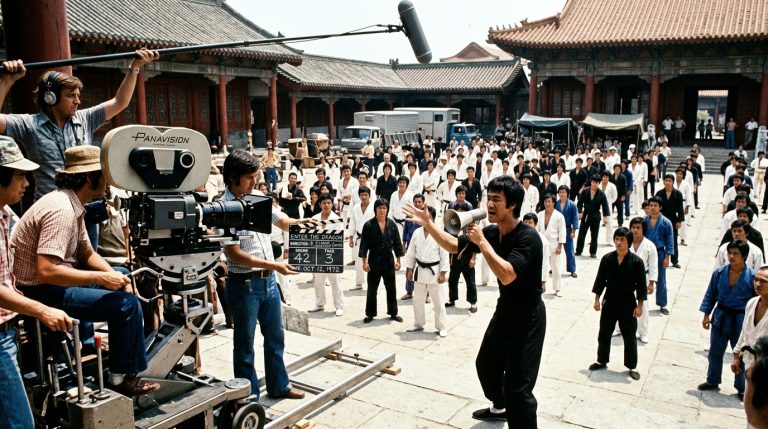
Bruce Lee as Chen Zhen, Fist of Fury (1972)
What the Film Is Actually About
The plot of Fist of Fury, released in North America as The Chinese Connection, is straightforward: Chen Zhen returns to his Shanghai martial arts school to find his master dead, discovers the Japanese school was responsible, and pursues justice against the wishes of his fellow students who want peace. The narrative structure is almost classical in its simplicity, and Lo Wei, who directed both this film and The Big Boss, knew enough to stay out of Lee’s way in the action sequences while keeping the drama between them functional rather than brilliant.
What makes the film work beyond its action sequences is the specific quality of anger Lee brings to the role. Chen Zhen’s emotion isn’t the cartoon fury of genre villains. It’s the controlled, building anger of someone who has been told by authority that certain wrongs won’t be addressed through legitimate channels and has accepted the consequences of proceeding anyway. Lee plays it without shouting most of the time. The intensity is quiet until it isn’t, and the transition is what makes the outburst sequences land.
The political subtext was understood in 1972 and has been written about extensively since: the film functions partly as an allegory for Hong Kong’s position under British administration, with the Japanese as a stand-in for colonial power generally. Lee was careful in public statements about how explicitly to frame this reading. But he was also the person who chose the “Sick Men of Asia” material and designed the sequence around it, so the subtext was not accidental.
The Fight Choreography Step Forward
| Scene / Sequence | Technical Innovation | Dramatic Narrative Function | Cinematic Legacy |
|---|---|---|---|
| Jingwu School Dojo Confrontation | Single-take multi-opponent fighting with 360° awareness | Avenging the death of master Huo Yuanjia | Defined the archetype of the lone hero dismantling an entire dojo. |
| Nunchaku Screen Debut | Double-stick handling at blinding speed using camera framing | Disarming multiple katana blades simultaneously | Ignited the global 1970s nunchaku pop culture phenomenon. |
| Duel with Petrov (Robert Baker) | Street-level realism vs. heavy Russian boxer | Exposing the limits of brute strength against speed and leg kicks | Showcased the transition from traditional boxing to proto-MMA dynamics. |
| The Final Freeze Frame Jump | Leaping directly toward colonial firing squad | Refusal to yield cultural and personal sovereignty | One of the most iconic closing shots in world cinematic history. |
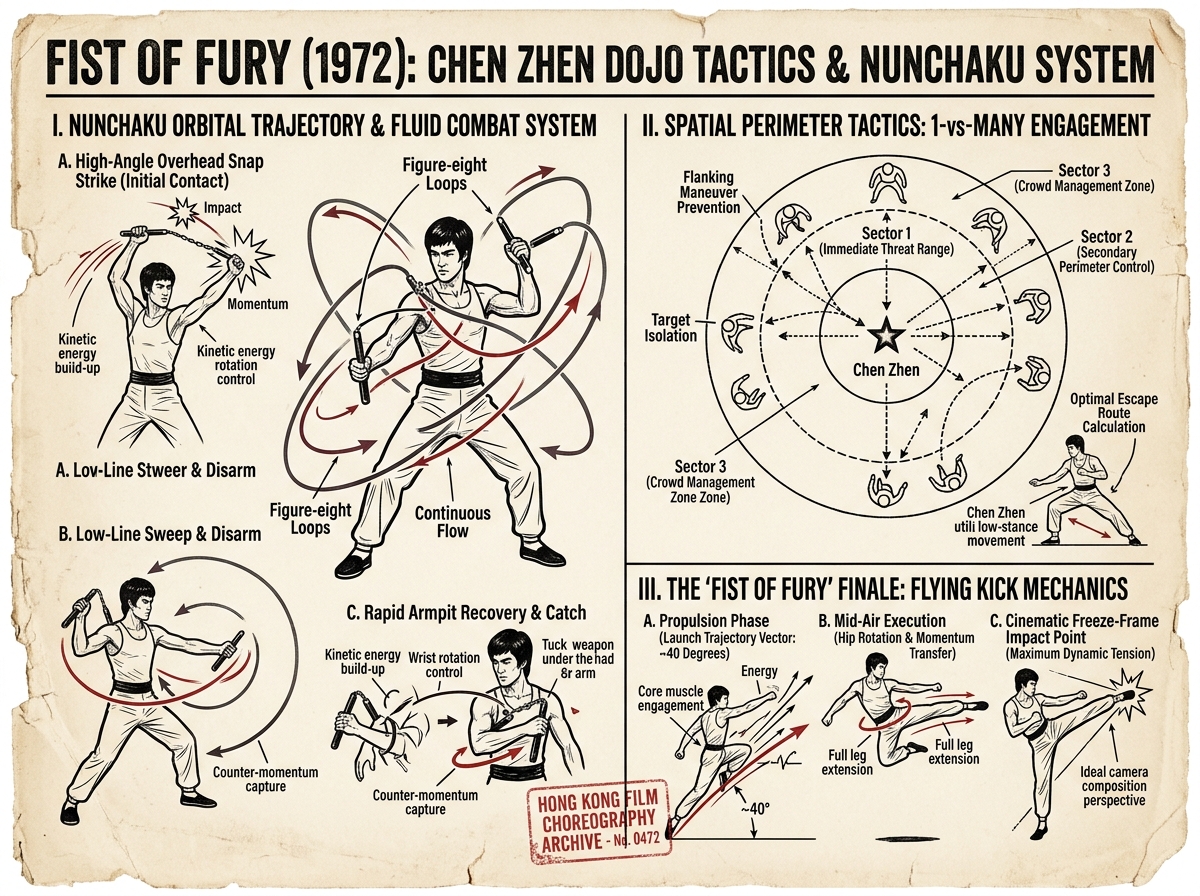
The action in Fist of Fury is visibly more sophisticated than what Lee had done in The Big Boss the previous year. The technical evolution between the two productions is clear: the choreography is more complex, the camera work better integrates with the movement rather than simply recording it, and Lee’s physical expression is more controlled and varied. He’s not just fast; he’s specific. Different opponents require different approaches, and the fights reflect that rather than presenting the same template against multiple targets.
The nunchaku sequence, which many viewers remember as the film’s visual centerpiece, was not originally in the script. Lee added it. The weapon had appeared briefly in The Big Boss, but Fist of Fury gave it an extended showcase, and the global popularization of nunchaku as a recognizable item of martial arts culture is largely attributable to this film. The physical skill required to use nunchaku at the speed Lee moves them in the sequence without injuring yourself is considerable, and the several takes where the weapons connected with his body rather than completing the movement are documented in production accounts.
The film also contains the first extended display of Lee’s screaming as a combat vocalization, the sound that became a signature element of his screen presence. He’d developed the kiai (the martial arts combat yell) from his traditional training, but his version of it, which varies in pitch and timing rather than being a single standardized sound, was his own. Students and training partners note that the film version is an approximation of what he actually produced in training; the real thing at full volume apparently occupied a different register entirely.
The Rickshaw Scene and Its Meaning
There’s a scene early in the film where Chen Zhen, after the initial confrontation at the Japanese school, is asked to identify himself to a park guard. The guard points to the sign at the park entrance: “No Dogs and No Chinese.” It’s a reference to a historical notice that may or may not have actually existed in this form in Shanghai’s International Settlement, but which became symbolic of colonial humiliation regardless of its documentary accuracy.
Lee’s reaction in the scene is essentially wordless. He looks at the sign, picks up a nearby Japanese man, kicks him through the sign, and walks into the park. The sequence lasts maybe thirty seconds. In 1972, Chinese audiences in Hong Kong responded to it with the kind of visceral collective release that’s rare in cinema. The cheering documented in contemporary accounts wasn’t for the physical skill. It was for the emotional directness of a response to a specific, recognized historical wound.
Understanding this context is necessary for understanding why Fist of Fury still matters in a way that pure action films of the same era generally don’t. The fight sequences are impressive. What gives them weight is the political and emotional architecture they’re embedded in.
The Box Office Record and What Followed
Fist of Fury broke the Hong Kong box office record that The Big Boss had set just months earlier. The pattern that Lee’s successive films would establish — each one outperforming the last by a substantial margin — was already apparent by the second film. Golden Harvest responded by giving Lee full creative control over his next production, which became The Way of the Dragon, the only film he both wrote and directed.
The American release as The Chinese Connection was timed to follow Enter the Dragon’s 1973 US success, which meant Western audiences saw the films in reverse production order. The Chinese Connection landed in American cinemas after audiences had already encountered Lee’s most polished work. This made Fist of Fury look rougher than it actually was relative to the standards of its moment — a genuinely exceptional 1972 Hong Kong action film appearing in 1973 after audiences had been calibrated by Enter the Dragon.
Fifty Years Later
The film has been remade several times, turned into a television series in Hong Kong, and referenced in Chinese popular culture as a touchstone of the national cinema. The character of Chen Zhen became a recurring figure in Chinese action films over the following decades. Jackie Chan, Donnie Yen, and Jet Li all took the role in different productions, which is an unusual kind of cultural afterlife for a character created in a single film by an actor who died the following year.
What survives of the original that the remakes haven’t reproduced is the specific quality of Lee’s performance. The anger in Fist of Fury isn’t entertaining in the way that genre anger usually is. It’s uncomfortable in a way that gives the violence a moral weight that pure action films avoid. Lee was making a statement with this film, and fifty years later the statement still comes through.