Bruce Lee’s Stretching and Flexibility Routine: How He Built Extraordinary Range of Motion
Before a training session, Bruce Lee stretched. After a training session, he stretched again. On days when injuries or scheduling compressed everything else, he still stretched. His flexibility work was the one component of his training that was genuinely non-negotiable, because he’d thought through the math: a inflexible kicker is a slower kicker, a shorter kicker, and an injured kicker. He had no interest in being any of those things.
The full side split he could perform wasn’t a gymnastic accomplishment he was proud of. It was a training outcome that served a specific function: when your hip can move through its full range of motion without restriction, your kicks are faster because there’s no muscular resistance fighting the movement, they travel further because there’s no structural ceiling, and they’re less likely to strain the adductors and hip flexors that fail when inflexible fighters kick above their actual range.
The Daily Structure of His Flexibility Work
Lee’s flexibility training appeared in two distinct phases of his daily schedule. The morning session, before his morning run or other early training, involved a brief general warm-up stretch: hamstrings, hip flexors, lower back, shoulders. These weren’t held for long. Five to ten breaths per position, enough to bring circulation into the tissues and reduce the risk of strain during the cardiovascular work that followed. Functional preparation, not development work.
The dedicated flexibility development happened in the evening, after the day’s heavy training was complete and the muscles were thoroughly warm. This is the phase that matters for actually improving range of motion: passive and active flexibility work on warm tissue (vital for kicking range in his leg training workouts), held for meaningful duration, at intensities high enough to produce adaptation. The evening stretching sessions could run 30 to 40 minutes when time permitted, which made them one of the longer single blocks in his daily training schedule.
The logic of positioning serious flexibility work at the end of a training day is now supported by research that wasn’t available in the 1960s. Long-duration stretching reduces muscular force output temporarily, which makes it suboptimal before strength or speed training. Placing it at the end removes that problem entirely and takes advantage of the elevated tissue temperature that hours of training produces.
Hip Flexibility: The Foundation of His Kicking
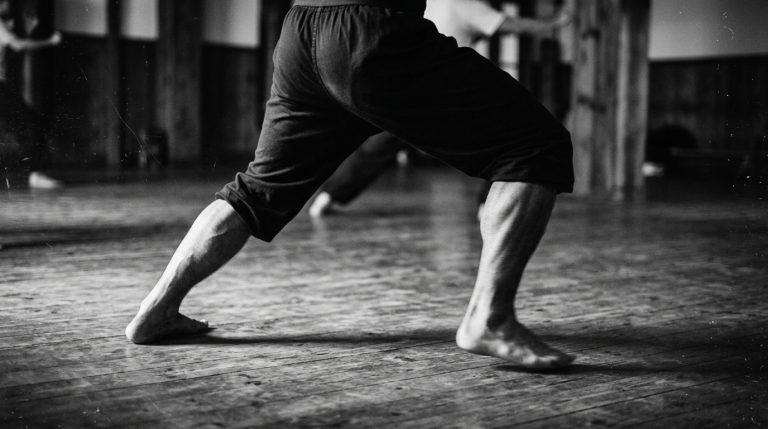
The majority of Lee’s flexibility work targeted the hip complex: the adductors (inner thigh), hip flexors, hamstrings, and hip rotators. These are the limiting factors for high kicks. A side kick to head height requires both adductor flexibility (for the lateral split movement) and hamstring flexibility (for the posterior chain movement). Most people who try high kicks and fail are limited by one or both of these groups, not by lack of strength.
His adductor work used both static and partner-assisted techniques. The basic lateral stretch, sitting with legs extended to each side and leaning toward the floor, was practiced holding positions for up to two minutes in the development phase. Partner-assisted stretching, where a training partner gently increases the range beyond what the athlete can achieve alone, appeared in his documented practice and was used for both the lateral position and the extended hamstring stretch.
He also practiced active flexibility specifically for kicking: standing leg raises performed slowly and with control to the front, side, and rear, taken to maximum height without momentum. This is different from static stretching and develops the active range of motion that you can actually use in movement, rather than the passive range achieved when an external force is helping. You can only kick as high as your active range allows. The passive range is irrelevant in a fight.
Shoulder and Upper Body Flexibility
Less discussed but consistently present in his training notes is upper body flexibility work. Lee’s shoulder mobility was exceptional, which contributed to both the reach and the mechanical efficiency of his punching. Restricted shoulder mobility reduces arm speed by forcing the shoulder muscles to fight against structural tension during the movement. Open, mobile shoulders contribute to faster, longer, and more powerful strikes.
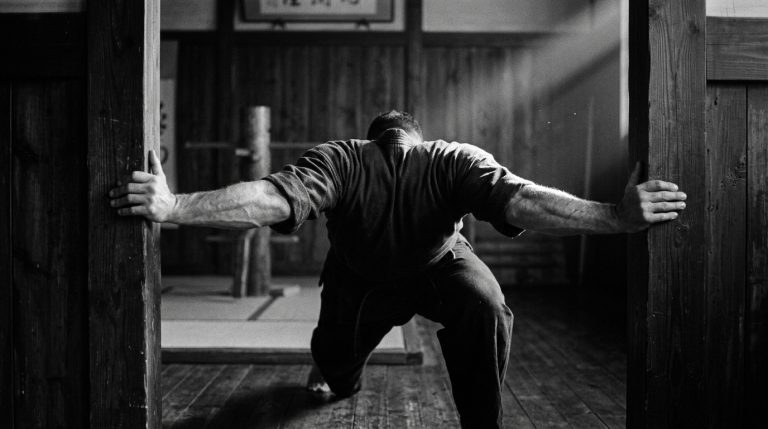
His upper body flexibility work included chest stretches using a doorframe, shoulder rotations with the arm fully extended, and a specific stretch he practiced by clasping hands behind the back and driving the shoulder blades together while extending the arms downward. These aren’t exotic techniques. They’re the same positions taught in basic physical therapy for shoulder mobility restoration, applied preemptively and consistently rather than as rehabilitation after injury.
The spinal rotation work he included, twisting the torso through its full range with arms extended (which also conditioned his washboard abs and core stabilizers), served the punching and kicking mechanics both: hip and torso rotation drive force generation in every strike, and a mobile spine allows more complete rotation without the resistance that tight thoracic muscles produce in people who sit at desks for a living.
How He Progressed His Flexibility Over Time
Lee’s early training photographs from his time in Hong Kong in the late 1950s show good but not exceptional flexibility. The extreme range of motion he demonstrated in later years was built through consistent work over roughly a decade of serious training. This is important to understand because flexibility is perhaps the most patience-dependent physical quality: it responds to accumulated duration and frequency rather than to intensity in the way that strength and conditioning do.
He tracked his flexibility progress the same way he tracked everything else. His training journals note improvements in specific positions, failed attempts at new ranges, and adjustments to technique when a position stopped producing adaptation. This monitoring matters because flexibility plateaus are common and often caused by technical problems rather than physical limits: a stretch that stops working is usually a stretch that isn’t isolating the right tissue, and changing the position slightly can break the plateau immediately.
The Injury Prevention Dimension
Lee’s back injury in 1970, caused by improper barbell exercise technique during heavy weight training, forced him into months of rehabilitation and gave him direct experience with how quickly physical capacity can degrade and how important a flexible, mobile body is for recovery. He emerged from the rehabilitation period with a deepened commitment to flexibility work and a specific emphasis on lower back mobility that stayed in his training until the end of his life.
The injury also gave him productive forced reading time: he read extensively during the rehabilitation period, including exercise science literature that confirmed the injury prevention value of flexibility training. His post-injury approach was more systematic about hip flexor and lower back mobility specifically, addressing the tension patterns in those structures that had likely contributed to the original injury.
The split is the memorable image, but the function is the point. Lee’s flexibility wasn’t about the visual impression of a dramatic stretch. It was about removing ceiling on his technical capabilities and reducing the tissue costs of high-intensity training. Most people who train martial arts treat flexibility as optional. Lee treated it as infrastructure. The difference between those two approaches compounds over years, and the results show up not as dramatic before-and-after photographs but as career length, injury absence, and the ability to kick at head height at 32 years old without having developed the compensatory movement patterns that flexible people never accumulate.