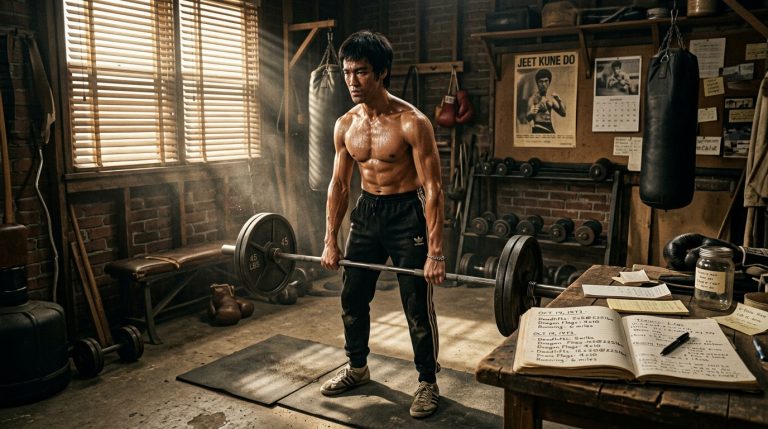
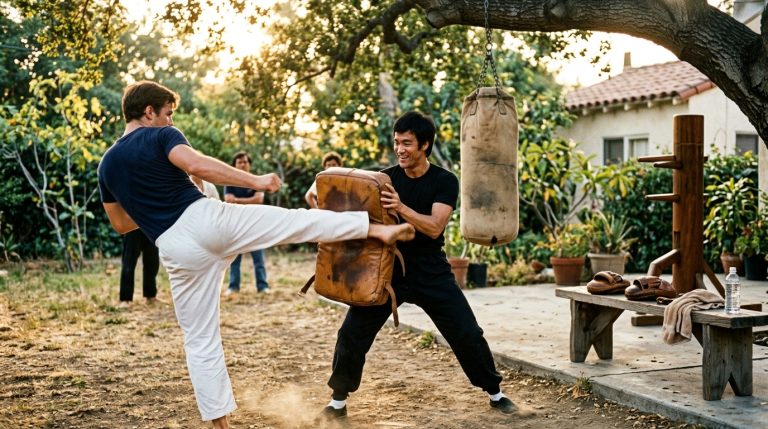
Bruce Lee’s Washboard Abs – How Did He Get Them?
The photographs from the set of Enter the Dragon still stop people cold. Not the fight scenes. The production stills — the ones taken between takes, where Bruce Lee stands in a neutral position and the camera catches his midsection in natural light. At 5’7″ and roughly 130 lbs, what you’re looking at should not be physiologically possible. Every abdominal muscle visible and defined, the obliques cutting down toward his hip, zero visible fat. This was 1972. There was no “functional fitness” industry, no body composition science in mainstream gyms, no social media physique culture. Lee built that body through pure research, discipline, and an approach to core training that professional athletes wouldn’t catch up to for another thirty years.
Why Abs Were Never a Vanity Project
Lee was blunt about the purpose of core training. In his notes — later compiled by John Little in The Art of Expressing the Human Body — he described the midsection as the body’s power transfer station. Punch without core engagement, and you’re throwing an arm. Kick without core stability, and your balance is compromised before the foot even leaves the floor. In Jeet Kune Do, every technique flows through the center. That meant the center had to be the strongest part of the body.
He wasn’t wrong. Modern sports science describes the core as the “kinetic chain anchor” — the point through which force from the legs reaches the upper body. Lee intuited this in an era when most fighters were doing sit-ups as a warm-up afterthought.
High Density: Daily Circuit
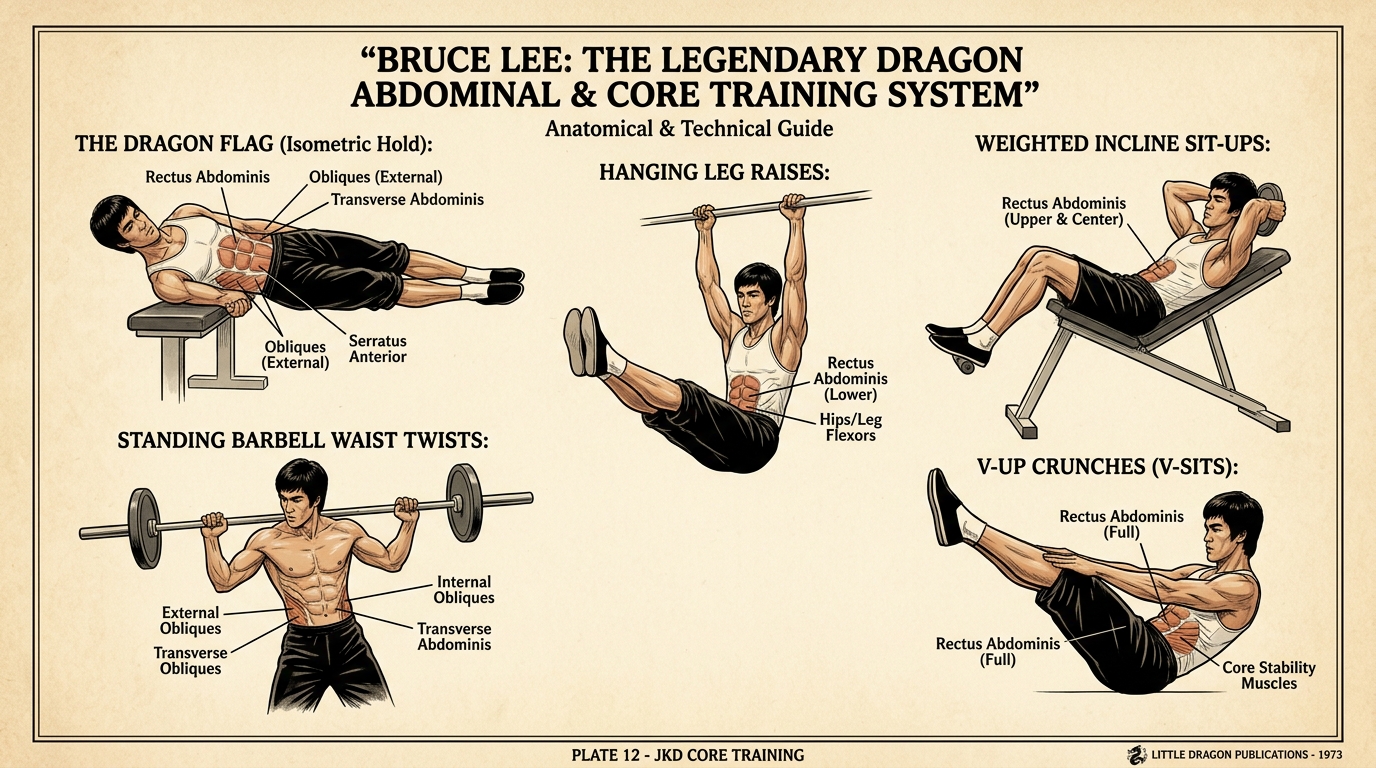
Lee did not train the abdomen as a decorative show-muscle. He trained it as the kinetic epicenter uniting upper and lower body force transfer. Each exercise in his core circuit targets a distinct myofascial vector:
The Training Routine: What He Actually Did
| Exercise | Primary Target | Sets / Repetitions | Execution Nuance & Biomechanics |
|---|---|---|---|
| Waist Twists | Internal & External Obliques | 100–200 reps (continuous) | Weighted broomstick across traps; rapid hip-locked rotational torque. |
| Incline Sit-Ups | Upper Rectus Abdominis | 4 sets of 20–25 reps | Curling vertebrae sequentially with chin tucked; peak isometric squeeze. |
| Leg Raises | Lower Rectus Abdominis & Psoas | 4 sets of 20–25 reps | Performed from chin-up bar or flat bench; legs locked with zero swinging. |
| Dragon Flags | Entire Core & Anterior Kinetic Chain | 3–5 static holds (10–15 sec) | Pivoting on scapulae only; full torso held rigid as an unbroken plank. |
| Isometric Abdominal Vacuum | Transverse Abdominis & Fascia | 3–5 sets of 6–10 sec hold | Full diaphragmatic exhalation and visceral contraction under high tension. |
Lee trained his core every day, often twice a day, as a dedicated block within his daily workout routine. This wasn’t high-rep crunching done to feel the burn. Each exercise had a specific mechanical purpose, and he rotated them to hit all three layers of the abdominal wall.
His documented core routine included:
- Decline sit-ups — performed on a steep decline board, 300 to 500 repetitions per session. High volume, controlled pace. Not explosive — deliberate, squeezing through the range.
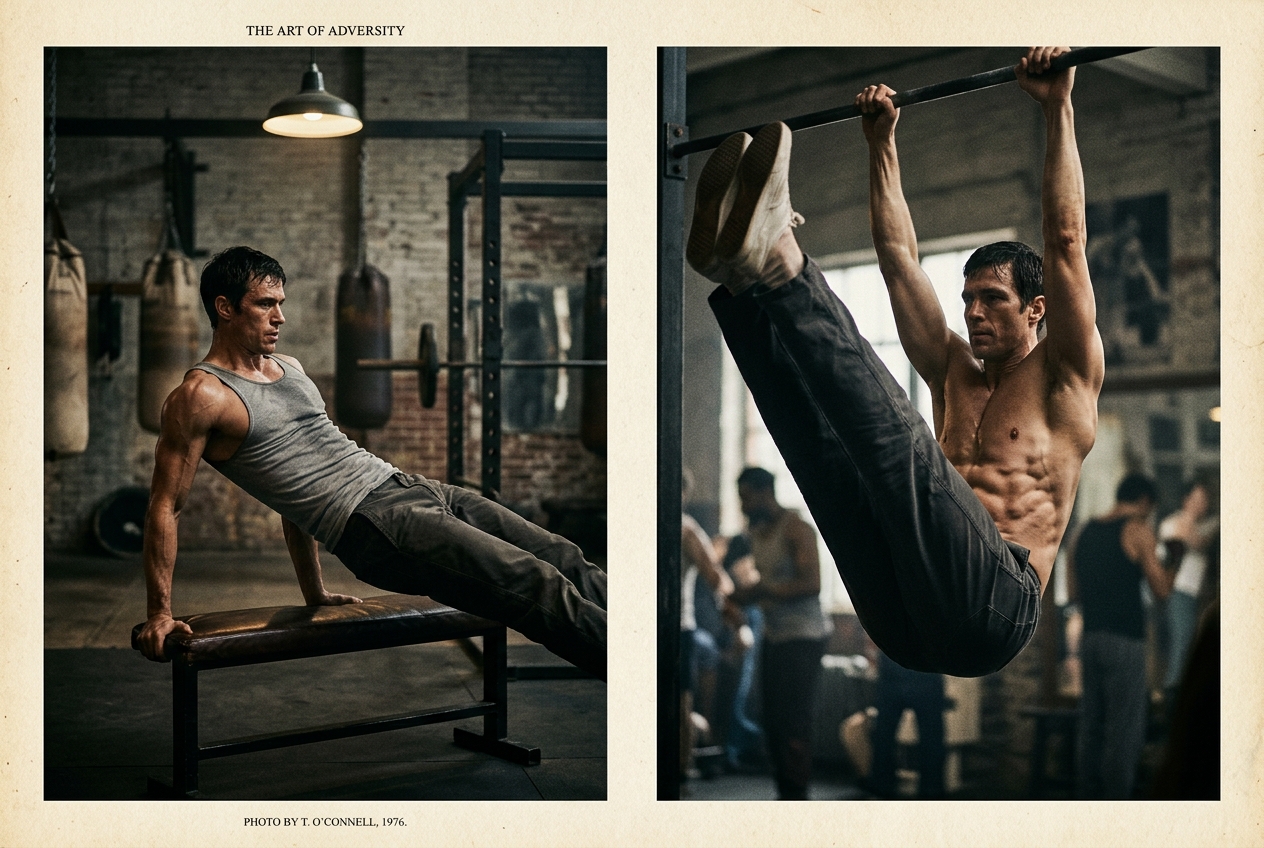
- Hanging leg raises — from a pull-up bar, legs kept together and raised to horizontal or beyond. This targets the lower rectus abdominis and hip flexors in a way that floor work simply cannot replicate.
- Side bends with dumbbell — oblique-focused, one side at a time. Lee specifically identified oblique strength as underrated by other fighters. Rotational power in punching comes from the obliques, not the six-pack.
- Twisting crunches — with rotation at the top, developing the transverse abdominis. This deep muscle acts like a natural weightlifting belt, stabilizing the spine under load.
- Dragon flags — Lee’s signature move. Lying on a bench, gripping the bench above the head with both hands, and raising the entire body from shoulders to feet as a rigid plank, then lowering with control. Sylvester Stallone later popularized this in Rocky IV and credited Lee as the originator. The exercise requires extraordinary isometric core tension held throughout the movement.
- Roman chair sit-ups — with full extension over the back of the chair for maximum range of motion through the rectus abdominis. This was supplementary to the decline work, hitting the muscle through a different arc.
The Thing Most People Miss: Nutrition Did Half the Work
Lee understood something that eluded most fitness culture of the 1970s: visible abdominal definition is primarily a body fat problem, not a muscle size problem. You can have six-pack musculature and never see it if there’s a centimeter of subcutaneous fat in the way. Lee’s approach to diet was as systematic as his approach to training.
He avoided refined sugar almost entirely, rejected fried foods, and had strong views against empty calories — a perspective shaped partly by his reading of nutritional research and partly by his observation that most fighters of his era trained hard and ate carelessly. He consumed high-protein meals spaced through the day: chicken, beef, vegetables, and protein shakes. He drank fresh vegetable juice regularly.
During the Enter the Dragon filming period, Lee was estimated at between 1 and 3 percent body fat. For reference, elite distance runners typically operate around 4 to 6 percent. Competitive bodybuilders step on stage at 3 to 5 percent for a matter of hours. Lee maintained his condition during production work over weeks of 14-hour days.
The abdomen, after all, coordinates all parts of the body. It is the center of gravity and the generator of all bodily force.
Bruce Lee, The Tao of Jeet Kune Do
The Isometric Dimension
One aspect of Lee’s core training that rarely gets discussed is his use of isometric holds. As part of his isometric training program, he practiced holding contracted positions — plank variations, hollow body holds, and static leg raise positions — for extended durations. Isometric work builds endurance in the stabilizer muscles that dynamic exercises don’t fully reach. It also develops the kind of tension-under-fatigue that fighting actually requires: not burst contractions but sustained engagement over minutes of physical exchange.
He reportedly spent 30 minutes per day on pure isometric core work during certain training phases. This is time most athletes in any era would devote to something more glamorous.
The Legacy on Screen
Production stills from Enter the Dragon show a physique that looked like it had been assembled by an engineer who read the specifications for “maximum human performance” and took them literally. Audiences in 1973 had simply never seen anything like it on screen — not in martial arts films, not in action films, not in any genre. It set a visual standard that influenced fitness culture for decades.
Shannon Lee, in interviews about her father’s training philosophy, has emphasized that he was never training to look a particular way. He trained to perform a particular way. The physique was a side effect of the standard, not the goal. That distinction is worth sitting with. Most people who try to build a body like his are working from the wrong direction entirely.
Can You Train Like He Did?
The routine is documented and theoretically reproducible. The problem is the total volume and the consistency maintained across years. Lee didn’t do six weeks of high-rep abs and then move on. He treated core training as a permanent, daily commitment — as fundamental as brushing his teeth. The physical result reflected that commitment.
If you want to train your core using his framework, the principles are clear: prioritize functional over cosmetic, train every day rather than in blocks, include both high-rep dynamic work and extended isometric holds, and control your diet with the same precision you bring to your training. Those principles are not complicated. Following them without compromise for years is the hard part.