Bruce Lee Chronological Timeline
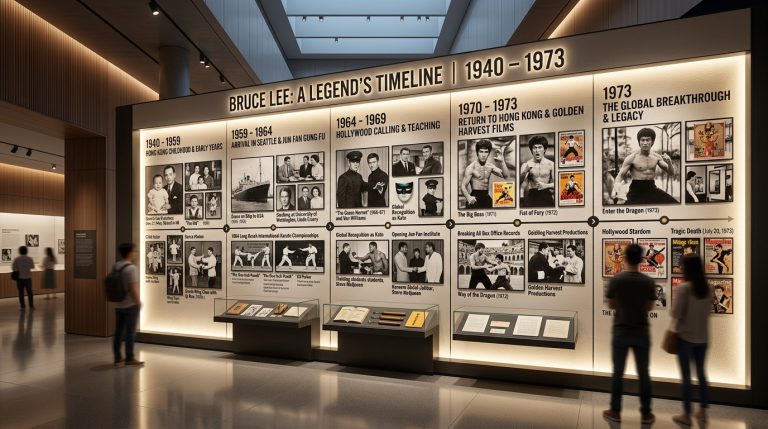
Bruce Lee’s life lasted thirty-two years, three months, and twenty-three days. In that span, he crossed the Pacific twice, mastered and then dismantled a classical martial arts system, invented a new one, raised two children, wrote extensively on philosophy, built a Hollywood career from scratch, and produced a body of work that is still studied, debated, and imitated across four continents. The timeline below tracks the sequence of events. For deeper context on the key periods, explore the linked articles throughout.
For a more detailed year-by-year record covering specific events, see also our chronological life timeline.
1940s — Birth, Hong Kong, and a Childhood on Film
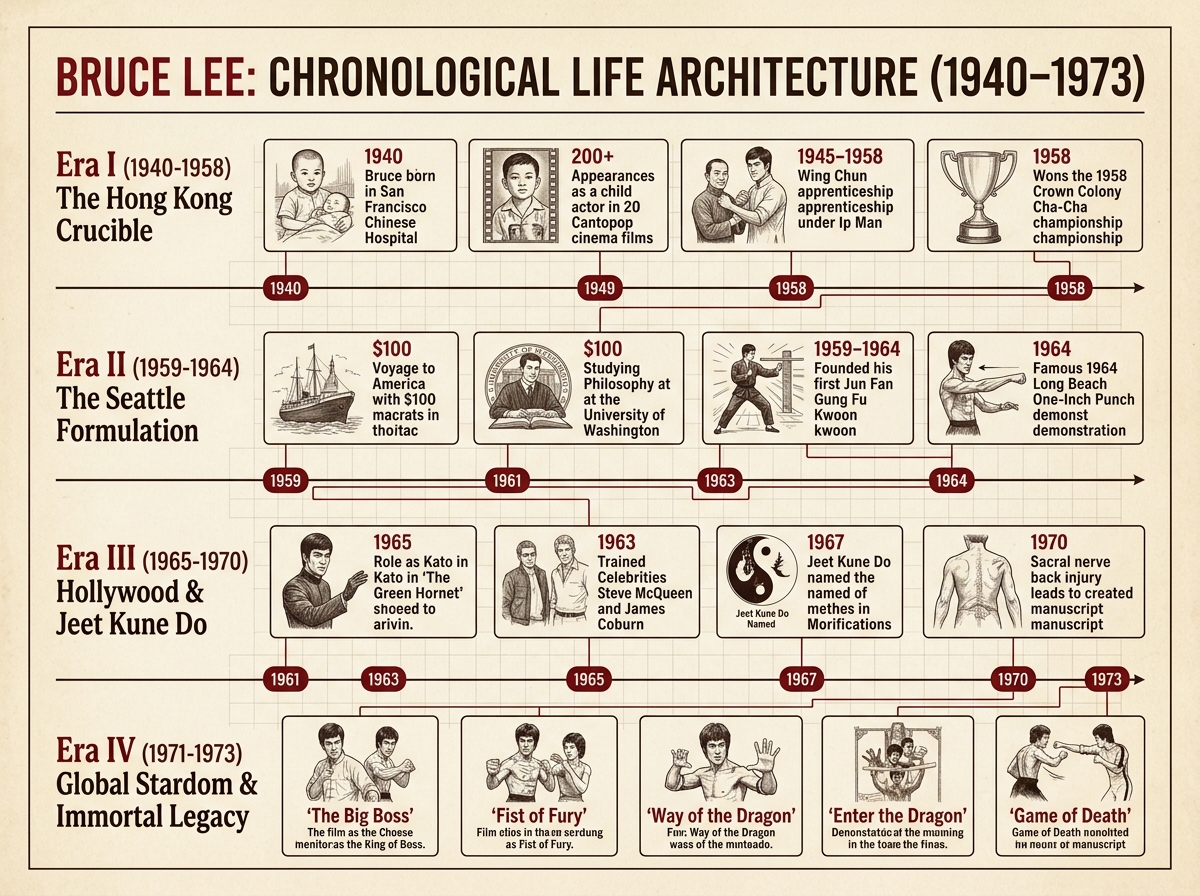
- November 27, 1940 — Bruce Jun-fan Lee born at the Chinese Hospital in San Francisco’s Chinatown. His father, Lee Hoi-Chuen, is on tour with the Cantonese Opera Company of Hong Kong. The family is temporarily in the United States; they did not intend to stay. His birth on American soil gives him dual citizenship — a fact that will matter later.
- 1941 — The family returns to Hong Kong. Lee appears as an infant in his first film, Golden Gate Girl, carried by his father in a minor scene. He is a few months old. His film career has technically begun.
- 1946 — Cast in The Birth of Mankind, his first credited role as a child actor. Hong Kong cinema of this period is prolific and fast-moving, and Lee’s father’s connections provide easy access to productions.
- 1948–1958 — Appears in more than 20 Hong Kong films as a child and young adult. Attends La Salle College, then St. Francis Xavier’s College. He is described by teachers as intelligent but restless and difficult to manage. He begins getting into street fights — organized gang-related disputes — with increasing frequency.
1950s — Wing Chun, Cha-Cha, and the Decision to Leave
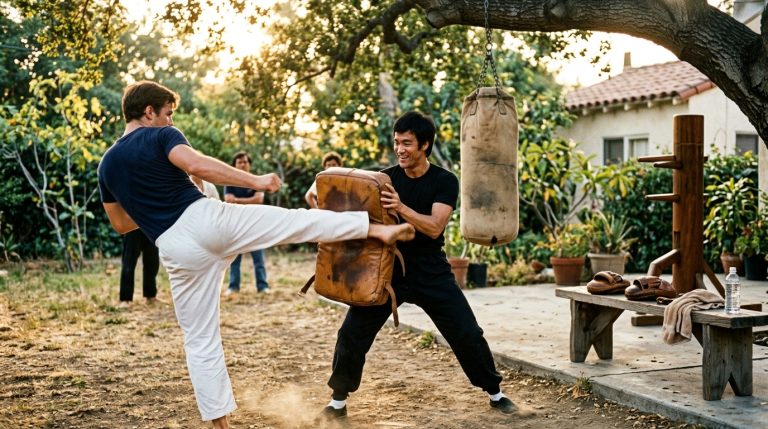
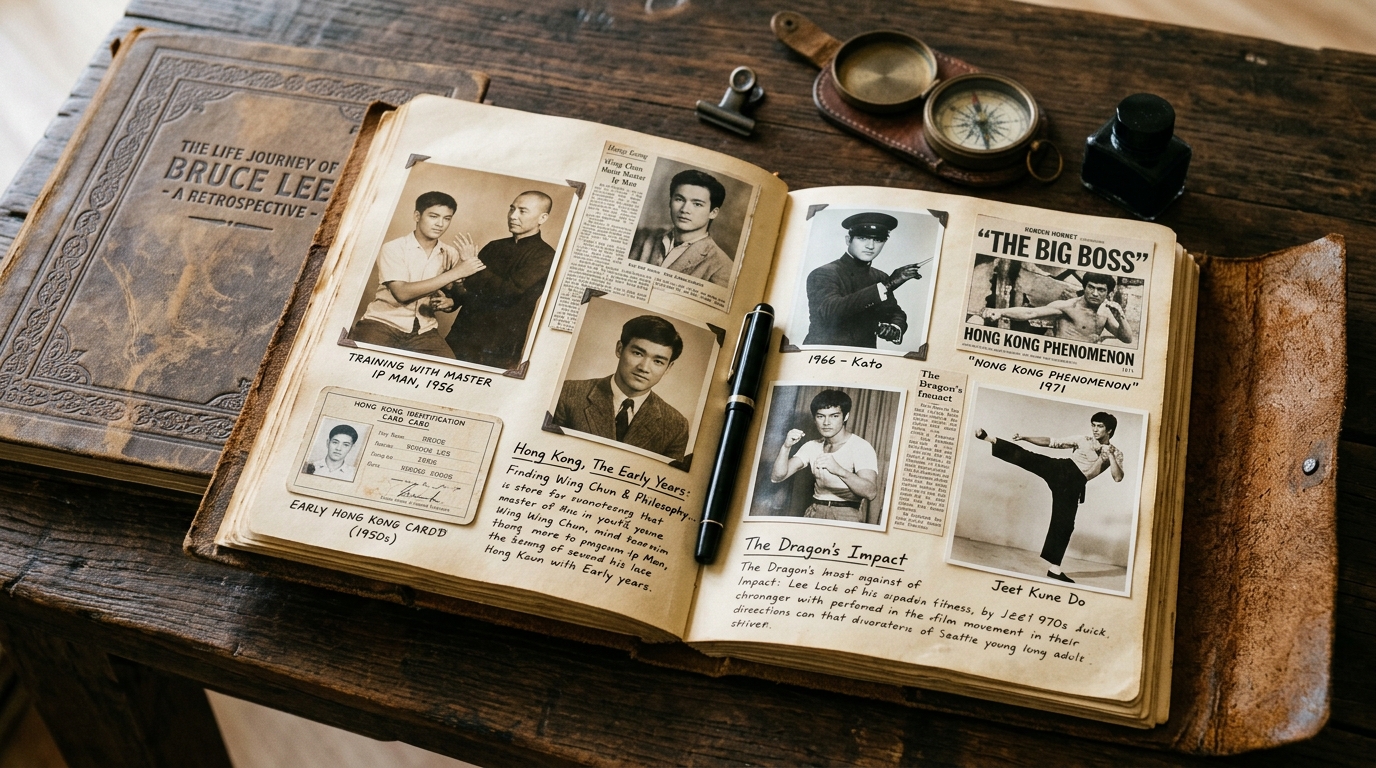
- 1953 — Begins training Wing Chun Gung Fu under Grandmaster Ip Man in Hong Kong. He is thirteen. The school operates informally in a rooftop space; Ip Man’s other students at this time include future martial arts figures including Wong Shun-leung, who becomes one of Lee’s main training partners.
- 1957 — Wins the Hong Kong Schools Boxing Championship. His boxing instincts — footwork, economy of motion, the straight punch — will later become central to Jeet Kune Do, though at this point he’s studying them in very different contexts.
- 1958 — Wins the Hong Kong Cha-Cha Championship. This is genuinely surprising context: the same teenager studying classical kung fu and getting into gang fights is also the city’s best ballroom dancer. The dancing training contributes to his body awareness and rhythm in ways he will later explicitly acknowledge. His father, alarmed by escalating street fight involvement, arranges for him to travel to the United States.
- 1959 — Arrives in Seattle, Washington at 18. He has limited funds, some English, and no clear plan. He initially teaches Cha-Cha dancing for income and works at Ruby Chow’s restaurant as a waiter. Ruby Chow is a family connection, a prominent Seattle figure, and sufficiently important that Lee has somewhere to land.
1960s — Seattle, Oakland, Los Angeles, and the Birth of JKD
- 1961 — Enrolls at the University of Washington as a drama student. Takes a work-study position as equipment manager for the athletics department. Simultaneously begins teaching Gung Fu informally to fellow students in university parking lots — the operation that will become the Jun Fan Gung Fu Institute.
- 1963 — Formally opens the Jun Fan Gung Fu Institute in Seattle. Publishes Chinese Gung Fu: The Philosophical Art of Self Defense, his first book. Taky Kimura, who will run the Seattle school for decades and maintain Lee’s grave, becomes his most trusted Seattle student during this period.
- 1964 — Marries Linda Emery, whom he met at a university Gung Fu demonstration. Demonstrates the one-inch punch at the Long Beach International Karate Championships — the demonstration that makes him nationally known in American martial arts circles. Moves to Oakland and opens a second school. The Oakland school is more aggressive about teaching non-Chinese students, which draws formal objections from local Chinese martial arts communities.
- 1965 — Son Brandon Lee born. Has the famous private challenge fight with Wong Jack Man in Oakland — a formal dispute that Lee wins but not quickly enough to satisfy himself. The experience drives a major overhaul of his training and begins his turn toward weight training and cross-disciplinary physical development.
- 1966 — Cast as Kato in The Green Hornet television series. Moves to Los Angeles. Begins training Hollywood celebrities including James Coburn and Steve McQueen privately. His demonstration fighting style — far faster than anything audiences had seen from a martial artist — generates significant attention.
- 1967 — The Green Hornet is cancelled after one season. Lee names his developing martial philosophy Jeet Kune Do — “Way of the Intercepting Fist.” The name is partly a concession to the need for a label; Lee himself frequently argued that Jeet Kune Do was not a style but an approach to thinking about combat.
- 1969 — Daughter Shannon Lee born. She will later become the executor of his estate and the primary guardian of his philosophical legacy.
| Year / Era | Location | Key Life & Martial Milestone | Historical & Cultural Impact |
|---|---|---|---|
| 1940 | San Francisco, CA | Born Lee Jun-fan at Jackson Street Hospital during Chinese Opera tour | Dual US/Hong Kong identity established from birth |
| 1941–1958 | Hong Kong | Child actor in 20+ Cantonese films; begins Wing Chun training under Ip Man | Mastery of traditional martial root, street fighting experience, Hong Kong Cha-Cha champion (1958) |
| 1959 | San Francisco / Seattle | Returns to the United States with $100; enrolled at Edison Technical School | Beginning of independence; works as dishwasher and waiter while studying |
| 1961–1964 | Seattle, WA | Enters University of Washington (philosophy); founds Jun Fan Gung Fu Institute; meets Linda Emery | Opens martial arts to non-Chinese students, challenging long-standing insular traditions |
| 1964 | Long Beach / Oakland | Demonstrates One-Inch Punch at Ed Parker’s Long Beach Karate Tournament; fights Wong Jack Man | Catalyst for discarding classical styles; foundational realization that led to Jeet Kune Do |
| 1966–1967 | Los Angeles, CA | Cast as Kato in The Green Hornet; officially names his martial philosophy Jeet Kune Do | Introduces authentic martial arts movement to Western television audiences |
| 1970 | Los Angeles, CA | Severe sacral nerve back injury; 6 months bed rest; writes extensive philosophical treatises | Drafts foundational notes later compiled into the Tao of Jeet Kune Do |
| 1971–1972 | Hong Kong | Stars in The Big Boss and Fist of Fury for Golden Harvest; writes/directs The Way of the Dragon | Breaks all Asian box office records; introduces the yellow jumpsuit and nunchaku to global cinema |
| 1973 | Hong Kong / Hollywood | Films Enter the Dragon (Warner Bros); passes away July 20, 1973, in Kowloon at age 32 | Posthumous release becomes global cultural phenomenon, creating modern martial arts cinema |
1970–1973 — The Hong Kong Years and the Films That Changed Everything
- August 1970 — Suffers a severe sacral nerve injury while performing good mornings with improperly loaded weight. Doctors warn him he may not return to martial arts at his previous level. He is bedridden for months. He uses the time to read extensively on physiology and biomechanics, and to write — producing many of the notes that would later be compiled as The Tao of Jeet Kune Do.
- 1971 — Returns to Hong Kong after years of frustration with Hollywood’s limited willingness to cast Asian actors in leading roles. Signs with Golden Harvest. Films The Big Boss (released in the West as Fist of Fury). The film breaks every existing Hong Kong box office record on release. Lee is suddenly the biggest star in Asia.
- 1972 — Films The Chinese Connection and Return of the Dragon. Writes, directs, and stars in Return — the only film he controlled completely. Begins filming Game of Death, a project built around a specific martial arts concept involving progressively more difficult opponents in a pagoda. Pauses Game of Death to make Enter the Dragon with Warner Bros. — the first major Hollywood production to star a Hong Kong action actor in a lead role.
- May 10, 1973 — Collapses at Golden Harvest studios while dubbing dialogue for Enter the Dragon. Suffers seizures and is hospitalized with cerebral oedema. Doctors find no definitive cause and recommend he reduce his workload. He does not.
- July 1973 — Post-production on Enter the Dragon completed. Lee travels to Los Angeles to present the finished film to Warner Bros. executives. Returns to Hong Kong.
- July 20, 1973 — Dies at Queen Elizabeth Hospital in Hong Kong at age 32. The circumstances are explored in detail in The Mystery of Bruce Lee’s Death. Official cause: cerebral oedema attributed to hypersensitivity to the painkiller Equagesic. The exact mechanism remains medically contested.
- July 26, 1973 — Enter the Dragon opens in US cinemas, six days after his death. It becomes one of the highest-grossing films of the year and earns over $90 million worldwide — the equivalent of over $600 million today. He never knew the results.
- July 31, 1973 — Buried at Lake View Cemetery, Seattle, Washington. He had requested Seattle specifically — not Hong Kong, not Los Angeles. Steve McQueen and James Coburn are among the pallbearers.
“The key to immortality is first living a life worth remembering.”
Bruce Lee
After 1973: The Legacy Continues
- 1978 — Game of Death released in heavily altered form by Golden Harvest, using existing footage alongside new material shot with a double. The version released bears little resemblance to Lee’s original vision.
- 1993 — Brandon Lee, 28, dies on the set of The Crow in a film accident. He is buried beside his father at Lake View Cemetery. The loss resonates as a second chapter to a tragedy that many felt was already complete.
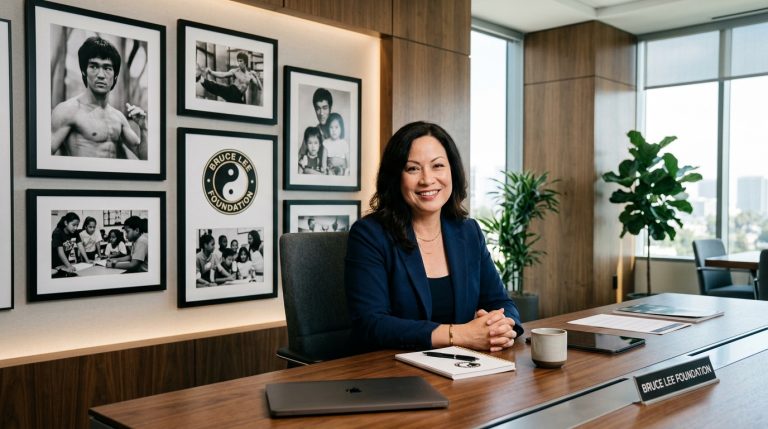
- 2000s–present — Shannon Lee establishes the Bruce Lee Foundation, focused on continuing her father’s philosophical work. The Tao of Jeet Kune Do, compiled from his notes, becomes one of the most widely read texts on martial philosophy. His influence on mixed martial arts, film action choreography, and popular philosophy continues to expand.