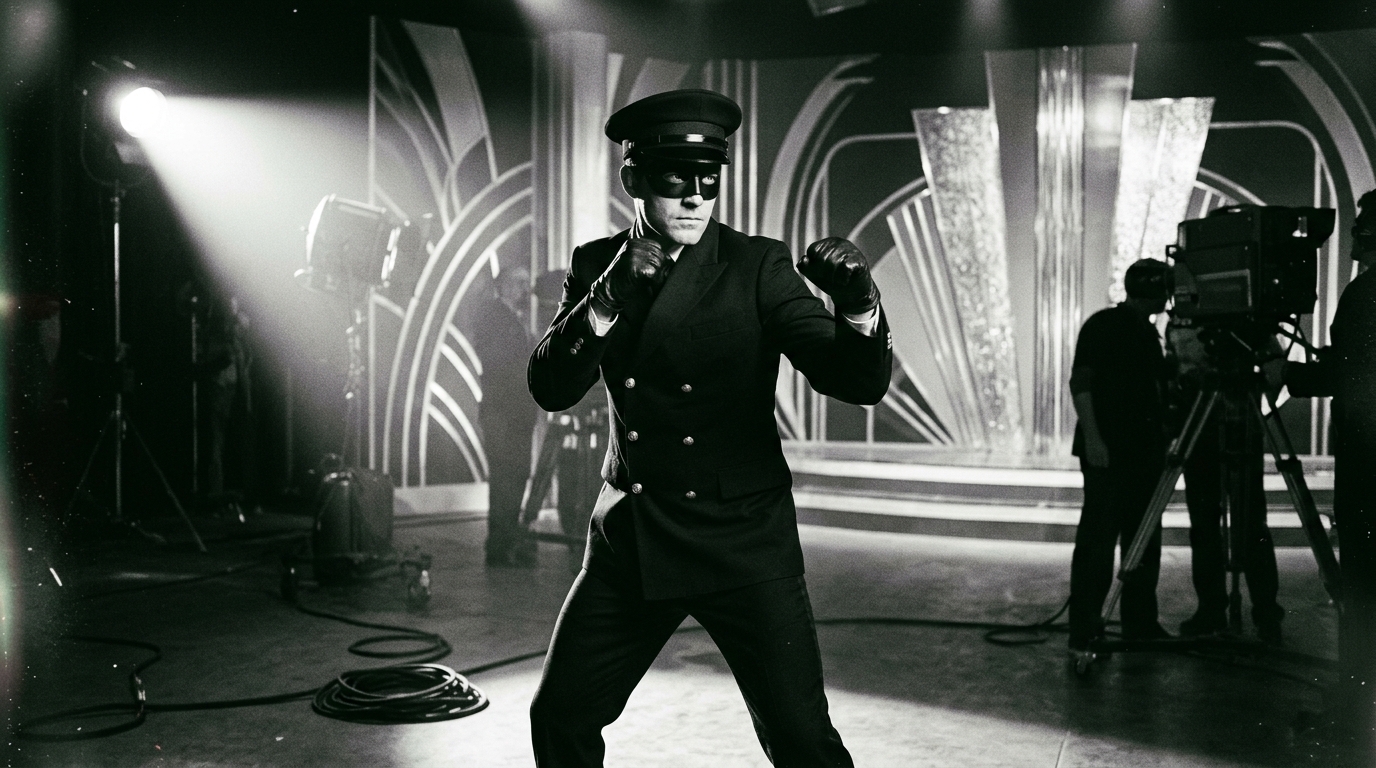
The Kato Show: How The Green Hornet Made Bruce Lee a Star in Asia
The Green Hornet ran for 26 episodes on ABC between September 1966 and March 1967 (a defining milestone in how Bruce Lee changed Hollywood for Asian actors). It was cancelled due to low ratings. Bruce Lee walked away from it with something more useful than a long run: the foundation of a screen persona that would scale to global stardom once he was in a production that matched his abilities. The show itself is mostly forgotten. Kato is not.
What happened in that single season is worth examining in detail, because Lee’s performance as Kato reveals a craftsman actively testing what works on camera, building vocabulary that would define his film work for the rest of his career. Every fighting scene in The Green Hornet is a draft. By Enter the Dragon, the draft was finished.
The Original Kato and the Problem of Race
The Green Hornet radio show had been running since 1936, and Kato’s ethnicity shifted with American politics. In the original 1930s radio version, Kato was Japanese. When World War II made Japanese characters commercially toxic, he became Filipino. By the 1960s television version, the character was described simply as “the valet,” with his Asian heritage present but deliberately unspecified.
Lee was cast in the role through a personal connection: William Dozier, the producer, had seen Lee perform at Ed Parker’s 1964 Long Beach tournament. Dozier was looking for something authentic and physical, not a stuntman-with-lines. The casting was unconventional for its time because Lee, unlike most Asian actors working in American television in 1966, had genuine martial arts expertise rather than a performance approximation of it.
The irony of the role’s structure was not lost on Lee. He was cast as a sidekick to a masked hero, required to subordinate his physicality to the plot necessity of making Van Williams’ Green Hornet appear competent. In several episodes you can see Lee visibly restraining himself in fight sequences, performing at a fraction of his actual speed to avoid making the lead look bad by comparison.
The Filming Speed Controversy
This is one of the best-documented technical issues in Lee’s television work. The show’s director of photography had a consistent problem: Lee’s movements were too fast to read on standard 24-frames-per-second film. Not slightly fast. Invisibly fast. In multiple action sequences, his strikes were completing between frames, appearing as blurs on playback rather than legible techniques.
The production’s solution was to ask Lee to slow down. He was physically capable of performing at whatever speed was requested, but found the adjustment difficult to calibrate because he’d spent years training himself to be as fast as possible. Intentional slow motion felt artificial to him. The compromise was a slight reduction in speed that kept the techniques visible while still communicating power.
Lee reportedly found this frustrating and talked about it often with friends. The practical skill he’d built through years of training was literally too fast for the technology being used to capture it. He’d encounter the same problem later in his Hong Kong films, which is part of why some of his sequences were shot at 32 frames per second and played back at 24, producing the slightly accelerated quality that became associated with his screen presence.
What Kato Established on Screen
Despite the constraints, The Green Hornet gave Lee something no previous credit had: a sustained American television audience watching him fight. The Kato fight sequences, brief as they were within the show’s structure, demonstrated several things that would become signature elements of his film work.
First, authenticity reads on camera. Lee’s techniques look different from the stylized combat that populated television action in the 1960s because they are different. The body mechanics are correct. The weight transfer, the hip involvement in strikes, the defensive positioning during exchanges: these are real, and audiences without any martial arts knowledge can register the difference at an intuitive level.
Second, attitude communicates through physicality. Kato as written in the scripts is a functionary. Kato as played by Lee carries a consistent message: he is the most capable person present in every scene. This isn’t arrogance in the performance. It’s precision and readiness, qualities that read as quiet confidence rather than posturing. Lee was doing something sophisticated with a thin character and limited screen time.
The Hong Kong Renaming and Its Meaning
When The Green Hornet was sold to Hong Kong broadcasters, local marketing renamed it The Kato Show, creating immense local fame that paved the way for his triumphant return (recounted in his life biography). This wasn’t a corporate decision about representation. It was a market response to viewer behavior: Hong Kong audiences were specifically coming to watch the supporting character, and the broadcaster’s title reflected that commercial reality.
The practical implication was significant. Lee now had documented evidence that he was capable of carrying audience attention as a lead figure, not just as a skilled background element. He used this information in conversations with American producers about his actual market value. Whether those conversations succeeded is another question (they mostly didn’t, leading to the Kung Fu dispute and his return to Hong Kong). But he knew what the numbers showed.
The Lasting Influence on Action Television
The Kato performance influenced action choreography in American television for years after the show ended. The approach of using a genuine practitioner rather than a trained stuntman, and letting authentic technique drive the visual language of fight sequences, gradually became standard practice. Shows like Kung Fu, which ironically cast David Carradine rather than Lee in the lead role, used the template that Lee’s Green Hornet work had established for what authentic martial arts television could look like.
The specific techniques Lee showcased on screen, particularly his kicking vocabulary and fencing-inspired footwork, appeared in the training regimens of stunt performers and action actors throughout the 1970s. The side kick, the spin kick executed from a fighting rather than a performance stance, the combination of kicks and hand strikes rather than one or the other: these entered American action film language through Lee’s screen work, beginning with those 26 episodes.
Van Williams, who played the Green Hornet, spent the rest of his life gracefully acknowledging that Kato had been the more interesting half of the partnership. In interviews from the 1980s and 1990s, he talked about watching Lee with genuine admiration, noting that Lee had an entirely different quality of presence that the cameras captured whether the scripts asked for it or not. The show gave Lee 26 episodes of on-camera training. He arrived at Enter the Dragon seven years later knowing exactly what he was doing.