The One-Inch Punch Explained: The Biomechanics Behind Bruce Lee’s Most Famous Strike
In 1965, an obscure magazine called Black Belt published a brief profile of a 24-year-old martial arts instructor working out of Oakland. The article is mostly forgettable, a standard profile of a local teacher. But there’s one line where Bruce Lee describes a punch he can deliver from one inch away with enough force to send a grown man across a room. The editor apparently wasn’t sure whether to believe him, and ran the profile anyway. Forty years later, people still argue about how the one-inch punch actually works.
That ambiguity is worth resolving, because the one-inch punch is often framed as either magic or fraud. It’s neither. It’s a genuinely functional strike produced by a specific sequence of biomechanical events that Lee trained with unusual deliberateness. Understanding those events doesn’t make the punch less impressive. If anything, the mechanical explanation makes it more interesting.
What the One-Inch Punch Requires
A conventional punch generates force by using the full travel distance of the arm as a loading phase, unlike the short-range power rooted in Wing Chun principles. You draw back, create separation, and the arm’s acceleration over that distance produces momentum at impact. The longer the windup, the more time for acceleration, and the more force at the end. This is obvious enough that children figure it out instinctively.
The one-inch punch has no loading phase. Starting with the fist at rest against the target, it must generate impact force equivalent to a full-range punch within a travel distance of roughly two and a half centimeters. The arm can’t do this alone. The physics don’t work. The force has to come from somewhere else.
Where it comes from is the kinetic chain. The punch begins not with the hand but with the legs, requiring the explosive lower-body drive developed in his leg training workouts. A rapid ankle extension drives force upward through the calf and into the knee. The hip rotates explosively forward. The torso follows the hip rotation, and the shoulder drives forward behind the torso. The arm extends last, and what arrives at the target isn’t just the force of the arm but the summed momentum of every link in that chain, compressed into a contact window measured in milliseconds.
The Role of Speed and Muscle Recruitment
Speed is as important as the kinetic chain. Force in physics is mass multiplied by acceleration, and Lee had limited mass to work with at around 140 pounds. His leverage came from acceleration: the rate at which he could complete the kinetic chain sequence and deliver that acceleration to the target before the target could dissipate the energy by moving.
This is why the punch works. The human body’s natural response to a slow push is to shift the center of mass backward, absorbing and redirecting the force. The receiver of the one-inch punch doesn’t have time to shift. The duration of the strike is shorter than the human nervous system’s response latency. Force arrives, the body can’t compensate, and the result is the dramatic backward displacement that made the demonstration famous.
A study published in 2014 by researchers at the University of Winchester measured Lee’s punching mechanics and found that his strikes made contact 0.05 seconds faster than professional boxers. That’s not a marginal advantage. At that speed differential, a defending opponent whose response time is around 0.2 seconds is simply working with information that’s already obsolete.
How Lee Trained the Punch
Lee’s training notes document specific work on punching speed and mechanical efficiency dating from the early 1960s. He timed his punches with a stopwatch. He filmed himself to analyze mechanics. He practiced the kinetic chain sequence in isolation: hip rotation drills, shoulder drive drills, and the specific wrist snap at extension, heavily reinforced through his specialized forearm and grip training.
He also trained relaxation. This sounds counterintuitive because punching seems like it should be about maximum tension. But muscular tension before extension creates resistance that slows the movement. Lee trained to remain completely loose during the delivery phase and generate tension only at the moment of impact. The contraction at contact, rather than throughout the movement, is what creates the sharp force signature of the strike rather than a push.
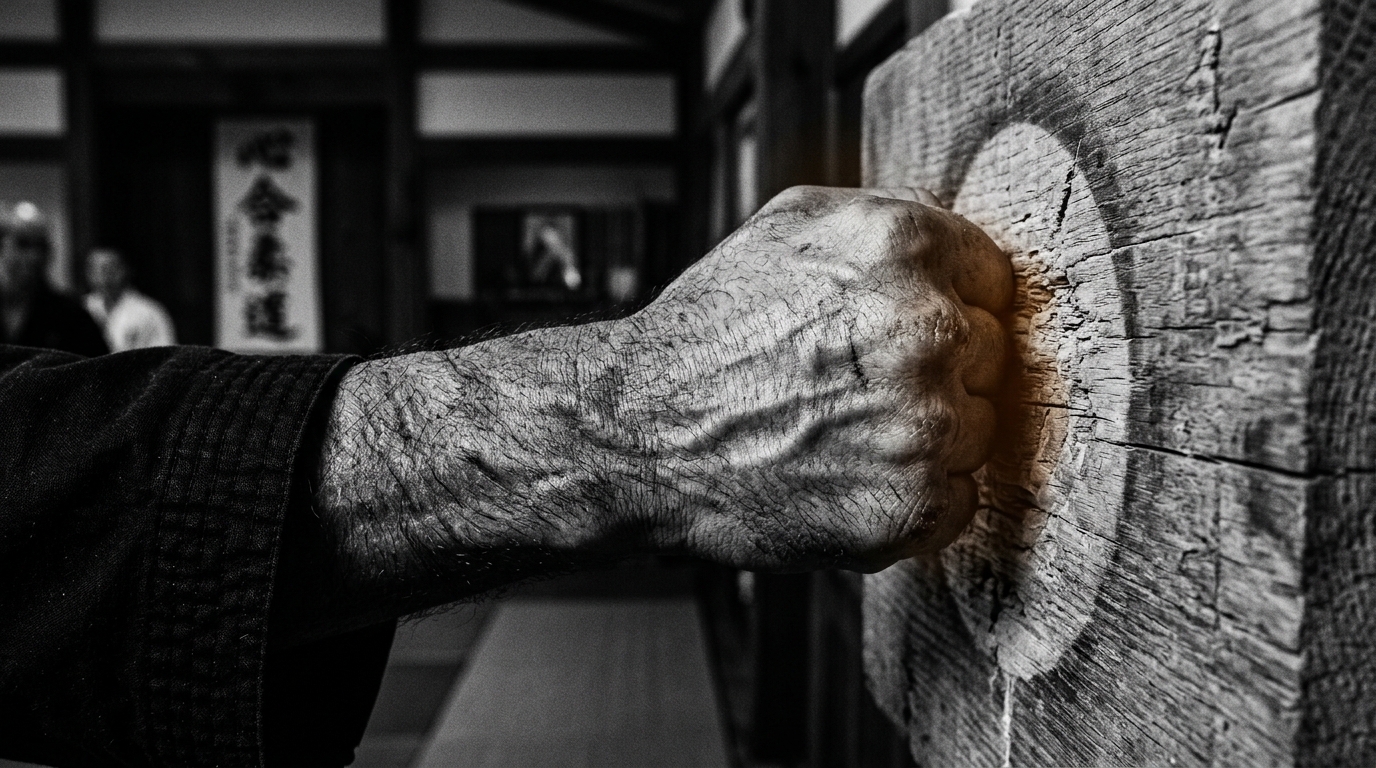
The wooden board breaking exercises he documented weren’t about strength. They were about developing the snap contraction at impact. A board breaks at the instant of peak force delivery. Punching through boards trains the hands and nervous system to produce that peak at exactly the right moment, rather than trailing off into a push as the arm reaches full extension.
The Ed Parker Demonstration and Its Legacy
The most famous live demonstration of the one-inch punch occurred at the 1964 Long Beach International Karate Championships, organized by Ed Parker (an iconic milestone detailed in our overview of the Long Beach one-inch punch). Lee was 23. He demonstrated the punch on a student named Bob Baker, sending Baker across a padded folding chair with enough force that Baker later told interviewers he’d felt pain for weeks afterward. Lee reportedly was surprised by Baker’s reaction and apologized afterward, concerned he’d hurt him more than intended.
The Long Beach demonstration circulated through martial arts communities for the following decade and gave Lee a national reputation that predated his film career. Parker himself became a strong advocate and the demonstration is often credited as a turning point in Lee’s American career, the moment he became someone that established martial artists took seriously rather than treating as a novelty.
Why Most People Can’t Replicate It
The one-inch punch looks simple enough to attempt, and most people who try it discover immediately that it doesn’t work. Their fist travels an inch and the target barely registers it. The failure is always the same: the kinetic chain isn’t engaged. The punch comes from the arm alone, which means from a dead stop with no acceleration runway and no additional mass contributing.
Learning to engage the kinetic chain from a static position requires training the sequencing explicitly, separate from the punch itself. The leg drive, hip rotation, and shoulder drive have to become fast enough and coordinated enough to complete before the arm reaches the target. At anything short of genuinely high speed, the sequence falls apart because each link’s contribution only multiplies the force of the previous link if the timing is correct.
Lee trained this for years before the Long Beach demonstration. The exhibition quality of the one-inch punch, its ability to produce obvious visible results on a compliant standing target, comes from combining a trained sequence with the physics of force delivered faster than the nervous system can respond. Remove either component and the demonstration fails.
The one-inch punch is sometimes called a trick because it requires a cooperative receiver who stands still, which no real opponent will do. This criticism is accurate but beside the point. Lee never claimed it was a combat technique. He used it as a demonstration of mechanical efficiency, a way to make visible something that’s usually invisible: that force comes from the whole body, not the limb. Everything he trained followed that same principle. The punch was a teaching tool, not a weapon. Most of his actual weapons were harder to explain and less photogenic.