Wing Chun vs Jeet Kune Do: What Bruce Lee Kept and What He Left Behind
Bruce Lee’s break with Wing Chun is one of martial arts history’s most instructive ruptures. He didn’t abandon the system dramatically or publicly denounce Ip Man. He simply started removing the parts that didn’t work under real fighting conditions, and once he started removing things, he found he couldn’t stop. By the time the process was finished, what remained was something new enough that it needed its own name: Jeet Kune Do.
Understanding that trajectory requires actually understanding both systems: what Wing Chun is built to do, what Jeet Kune Do is built to do, and where the genuine differences lie. Most comparisons flatten both into caricature. Wing Chun becomes “rigid tradition” and JKD becomes “total freedom,” which misrepresents them both.
What Wing Chun Is Built For
Wing Chun is a close-range combat system that emerged from southern China, with its origins conventionally traced to the Qing dynasty period, though the exact history is disputed. The system’s most distinctive feature is its structural logic: Wing Chun seeks to control the centerline, which is the vertical axis running through the center of both fighters’ bodies. Whoever controls the centerline controls the exchange.
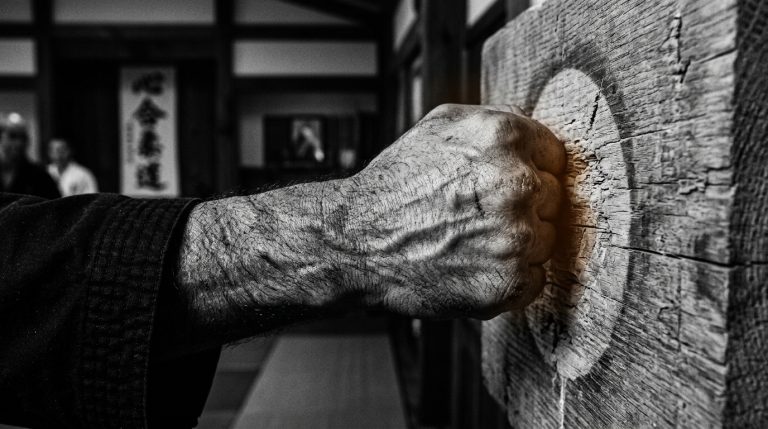
The stance is narrow and forward-facing, with both hands protecting the centerline simultaneously. Strikes travel along the shortest possible path, which means straight punches to the centerline rather than the wide hooks favored in boxing. The famous chain punch, a rapid series of centerline strikes, is the system’s signature attack pattern, relying on close-range mechanics that later informed the biomechanics of the one-inch punch. Ip Man, Lee’s teacher in Hong Kong, could demonstrate the chain punch at a speed that made individual strikes nearly invisible.
Sensitivity is the other pillar. Wing Chun’s chi sao (sticky hands) training develops the ability to read an opponent’s force through contact, responding to pressure before the brain has processed the visual information. It’s a sophisticated close-range response system: when your arms are touching an opponent’s arms, you don’t need to watch their hands. You feel what they’re about to do.
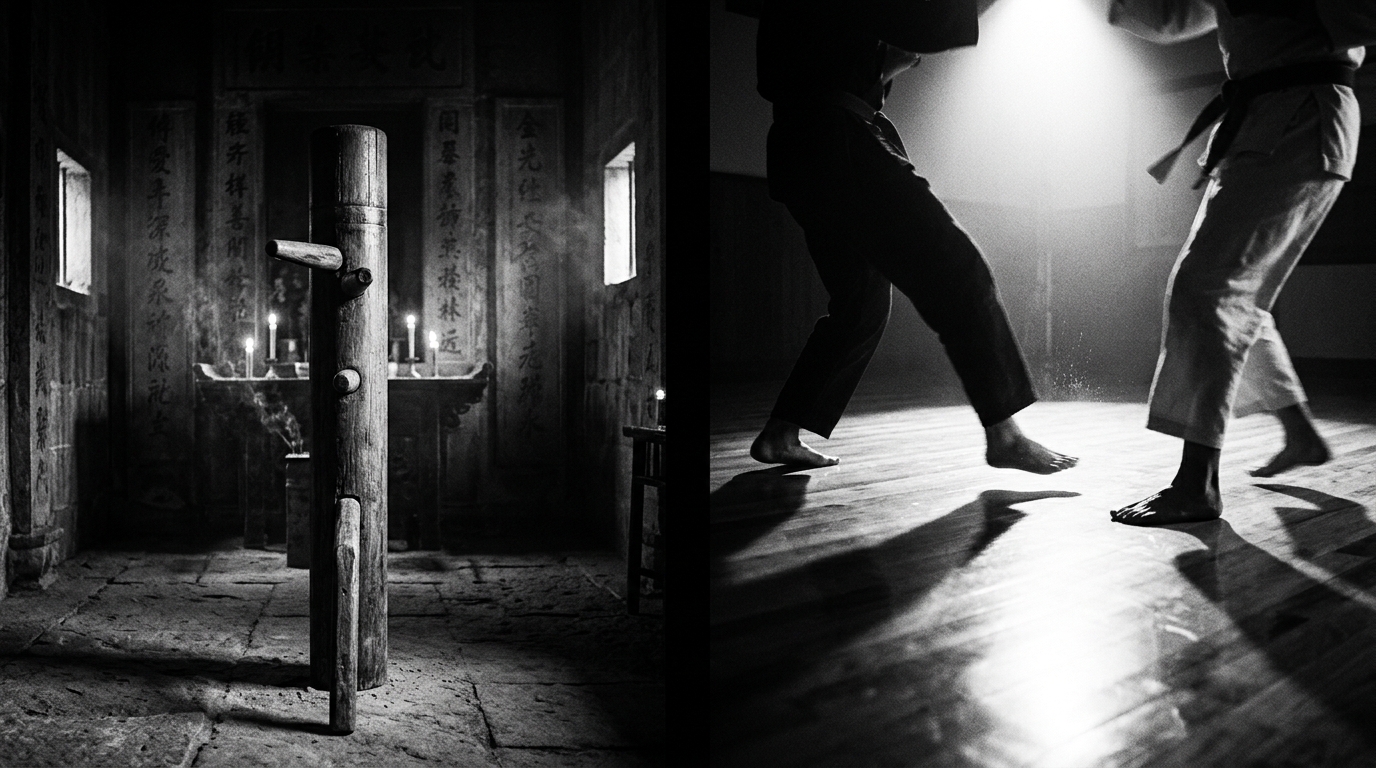
The wooden dummy form, the muk yan jong, is the system’s most recognized training tool, which Lee modified alongside custom training gear (see Bruce Lee – Equipment Manager). It provides a fixed structure against which to practice the angles, deflections, and strikes of the system without a partner. Lee trained on the dummy in Hong Kong and continued using it after moving to America.
Where Lee Found the Limits
Lee’s problems with Wing Chun emerged through sparring, not theory. When he began teaching in Seattle and then Oakland, his students came from diverse backgrounds: wrestlers, boxers, street fighters, people with no martial arts background who fought naturally. Sparring against them revealed gaps.
Wing Chun’s centerline theory assumes a relatively stationary opponent who is also engaging from the front. Against a boxer who moved laterally, the forward-facing stance lost its advantages. Against a wrestler who shot in low for a takedown, the system’s limited ground content left gaps. Against opponents who were physically much larger, the structural efficiency that made Wing Chun effective for smaller practitioners had limits at certain force differentials.
Lee also noticed that Wing Chun’s fixed forms created fixed responses. Chi sao is brilliant as a sensitivity trainer, but it develops specific responses to specific patterns of pressure. A fighter who’s trained those responses deeply might default to them in situations where they’re suboptimal. The system’s strength was also a potential liability.
What Jeet Kune Do Actually Is
JKD, which translates roughly as “the way of the intercepting fist,” is built around a single principle: intercept the opponent’s attack rather than waiting to receive and counter it. The name describes a tactic, not a style. Lee was deliberate about this. He explicitly refused to systematize JKD into a fixed curriculum, calling any such systematization a betrayal of the underlying idea.
Structurally, JKD borrowed from several sources. The footwork came largely from Western fencing (the core foundation of Bruce Lee’s dynamic footwork): the lead-weapon-forward position, the economic movement patterns, and the distance management theory. The hand techniques retained Wing Chun’s directness and centerline orientation but were adapted for a longer-range fighting position. Kicking incorporated techniques from various systems, with the lead leg side kick as the primary long-range weapon.
Crucially, JKD incorporated what Lee called aliveness, the insistence that all training must ultimately be tested against a resisting opponent. Wing Chun trains many of its techniques in pre-arranged cooperative formats. Lee replaced cooperative training with sparring as the primary feedback mechanism. If it worked against a trained resisting opponent, it stayed. If it didn’t, it was removed, regardless of tradition or theory.
The Structural Differences in Practice
Watch footage of Wing Chun sparring and JKD sparring side by side and the differences are immediate. Wing Chun practitioners tend to face each other at close range, both working the centerline, with the characteristic simultaneous attack-and-defense of the system visible in the crossing hands. There’s a compressed, almost chess-like quality to it.
JKD sparring looks more like aggressive fencing combined with kickboxing. The lead side forward, long-range kicks as the opening weapon, rapid movement in and out of distance, and the intercepting attack pattern where the defender attacks into the attacker’s motion rather than waiting for it to land. The philosophical difference between “how do I block this punch?” and “how do I hit him while he’s trying to punch me?” produces recognizably different fighting behaviors.
Lee himself had a clear preference under pressure. His sparring footage from the 1960s shows almost no Wing Chun identifiable technique. The stance, the footwork, and the kicking structures are JKD. The Wing Chun he retained was the sensitivity training, which he continued to practice and teach, and the chain punch concept, which he adapted into his rapid-fire combination attacks. He kept what worked. He discarded what didn’t.
The Philosophical Gap
Beyond technique, the two systems represent different positions on a fundamental question: should a fighting system provide answers, or provide a method for finding answers? Wing Chun is an answer: a specific set of techniques, organized around a specific theory, designed to solve the combat problem in a particular way. It’s a complete solution within its defined parameters.
JKD refuses to be a complete solution. Lee’s famous line “using no way as way, having no limitation as limitation” isn’t poetic vagueness. It’s a methodological commitment: the fighter’s job is to adapt continuously, and any system that provides fixed answers creates the conditions for those answers to become liabilities. The highest-level Wing Chun practitioner is someone who has mastered Wing Chun. The highest-level JKD practitioner, in Lee’s conception, has mastered the ability to have no fixed approach.
This is why the Wing Chun vs JKD comparison is ultimately less interesting than the question it raises: which philosophy produces better fighters? The answer is probably “it depends,” which is itself a very JKD answer. Wing Chun produces excellent close-range fighters who’ve developed sophisticated sensitivity. JKD, done seriously, produces fighters who can adapt to a wider range of situations. Whether that adaptability outweighs Wing Chun’s depth within its domain is a question each fighter has to answer through their own training.
Lee never stopped respecting Wing Chun or its lineage. He continued to credit Ip Man throughout his life (a formative period explored in his life biography) and maintained the wooden dummy training that the system centers on. What he rejected wasn’t Wing Chun’s quality but its completeness. He didn’t think any system was complete. That belief is either the deepest wisdom in martial arts or its most dangerous idea, depending on which teacher you ask.