How to Train Like Bruce Lee: A Practical Beginner’s Guide
People have been asking some version of this question since 1973. The internet version multiplied the asking without necessarily improving the answering. Most “train like Bruce Lee” content reduces him to a handful of exercises presented as a workout program, which misses the point completely. Lee wasn’t following a program. He was running an experiment on himself, continuously, with himself as both the researcher and the subject. What you can actually take from his approach is the methodology, not the specific exercises.
That said, the specific exercises are useful starting points, so this guide covers both: what he actually did, and the thinking behind it that makes any version of his approach work for someone starting from scratch.
Start with the Non-Negotiables
Lee’s training had a daily core that appeared almost regardless of what else was happening in his schedule. These were the true non-negotiables, the things he would do on a light day when injury, illness, or time constraints compressed everything else. They’re a useful guide for anyone building a foundation.
Run every morning. Three to five miles at a genuine training pace, not a stroll (as detailed in our guide to Bruce Lee’s running and cardio routine). Lee ran before breakfast, in the dark if necessary, in the rain if it was raining. The aerobic base this builds is the foundation of everything else: it allows you to train harder later in the day, recover faster between sessions, and maintain output quality deeper into any extended physical effort. Skip this and you’re building on sand.
Stretch every day, seriously and at the end of your training day when your tissues are warm (see our guide to his stretching and flexibility routine). Target the hip complex specifically. Front splits, side splits in progress, and standing leg raises taken to your current maximum are the core of this work. Hold positions for at least 60 seconds once you’re warmed up. Progress is slow, measured in months, and completely transformative for your kicking capability if you stay consistent.
Practice your techniques. This seems obvious but most beginners skip it. Lee drilled individual techniques, particularly kicks, in sets of hundreds of repetitions in single sessions. This is what builds the motor patterns that allow techniques to execute automatically under pressure. If you’re studying a martial art, the daily practice of its fundamental techniques is the core of what Lee’s training philosophy actually prioritizes.
The Weekly Strength Framework
Lee’s strength and weight training appeared three to four times per week, with the specific exercises varying based on what he was working to develop at any given time. A beginner adapting his approach should prioritize the movements that give the broadest return rather than trying to replicate his specific programming, which was adapted to his specific needs at a specific point in his development.
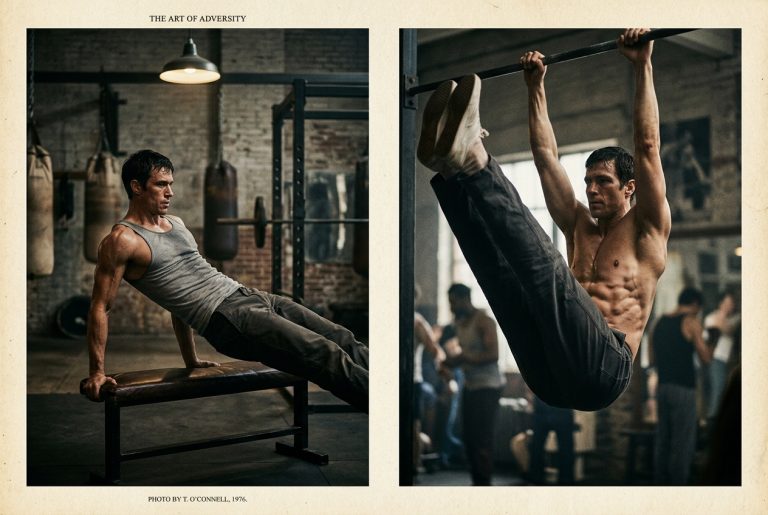
Push-ups belong in this framework. Lee used them consistently and progressed through difficult variations over time. For a beginner, standard push-ups done in sets across the day, more often than you’d think necessary, build the pressing strength and shoulder stability that underpin punching power. He sometimes accumulated push-up volume across a day rather than in a single session: thirty here, thirty there, adding up to several hundred by evening.
Squats, done through a full range of motion, appear throughout his training records. Not the partial-range loaded squats that some people do for maximum weight on a bar. Full squats, thighs reaching parallel and below, develop the hip mobility and leg strength that kicking requires. Add bodyweight jump squats once you can squat cleanly, because the explosive version trains the reactive power that static squats don’t touch.
Grip work should be in there specifically. As detailed in our breakdown of Bruce Lee’s grip strength training, wrist curls, reverse wrist curls, and something that creates rotational demand like a wrist roller or a mace/club. Lee’s forearm development was the visible evidence of specific, consistent grip training. Most people train everything else and skip this. He didn’t.
The Cardio Complement to Running
Jump rope appeared in Lee’s training consistently enough to warrant inclusion in any beginner version of his approach. Three to five minutes of continuous skipping is cardiovascular work, coordination training, and footwork development simultaneously. It’s also the cheapest piece of training equipment available: a quality jump rope costs less than a single session at a commercial gym.
Start at whatever duration you can maintain without stopping. Two minutes might be your ceiling at first. That’s fine. Add time gradually. The skill component of jump rope, the coordination and timing required for continuous skipping, develops alongside the cardiovascular capacity. Competence and fitness build together, which makes progress feel more immediate than it does with exercises that are technically simple.
Cycling appeared in Lee’s training as active recovery and as a cardio complement to running. If you have access to a bike, using it on days when your legs are sore from running gives your cardiovascular system training stimulus without the impact stress that makes tired legs worse. This is basic periodization logic, and you don’t need a coach to figure it out. If running feels like it’s accumulating damage rather than building fitness, cycle instead on those days.
The Part People Usually Ignore: Record Everything
Lee kept training journals from his early twenties until the end of his life. This wasn’t unusual for serious athletes of any era, but the detail and analytical quality of his records was exceptional. He wasn’t just logging exercises. He was tracking patterns, noting what worked, identifying what had stopped producing adaptation, and making adjustments based on the data rather than on habit or feel.
Starting a training journal is free, takes five minutes at the end of each session, and produces information that makes every subsequent training decision better. What you trained, how many sets, how many reps, how it felt, and what you’re going to test next. That’s the whole format. The habit of reflection built into the practice of training is what separates someone who trains from someone who develops.
Lee’s records allowed him to spot when a particular exercise had stopped producing change and needed to be varied or replaced. Without records, you’re doing this by memory, which means you’re probably training based on what you remember feeling like rather than what the actual progression data shows. Memory is unreliable for this purpose. Notebooks aren’t.
The Mental Framework: Absorb, Test, Discard
The instruction “absorb what is useful, discard what is useless, add what is specifically your own” is Lee’s most practical philosophical prescription, forming the core of Jeet Kune Do. Applied to training for a beginner, it means this: try things for long enough to evaluate them honestly, not just the first two sessions when everything is unfamiliar. If something produces results, keep it. If it consistently doesn’t, or if it produces more cost in fatigue or injury than it returns in benefit, drop it without sentimentality.
Most people fail at the discarding part. There’s an emotional investment in exercises you’ve been doing, especially ones that were difficult to learn or that feel familiar. Lee had no such attachment. His training journals show exercises appearing, being modified, producing adaptation, then either being progressed or replaced when they stopped working. The goal was always the outcome, not the method. Method was changeable. That made his development as a physical practitioner faster and more sustained than most people manage.
The honest answer to “how do I train like Bruce Lee” is: with more consistency, more record-keeping, more flexibility work, and more patience than most people apply to their training. The specific exercises matter less than the approach. He would have been an exceptional physical practitioner using entirely different exercises, because the approach would have been the same. Start with the daily non-negotiables. Build the weekly structure around them. Write everything down. Change what isn’t working. That’s the training philosophy, and it survives independently of nunchaku and two-finger push-ups.