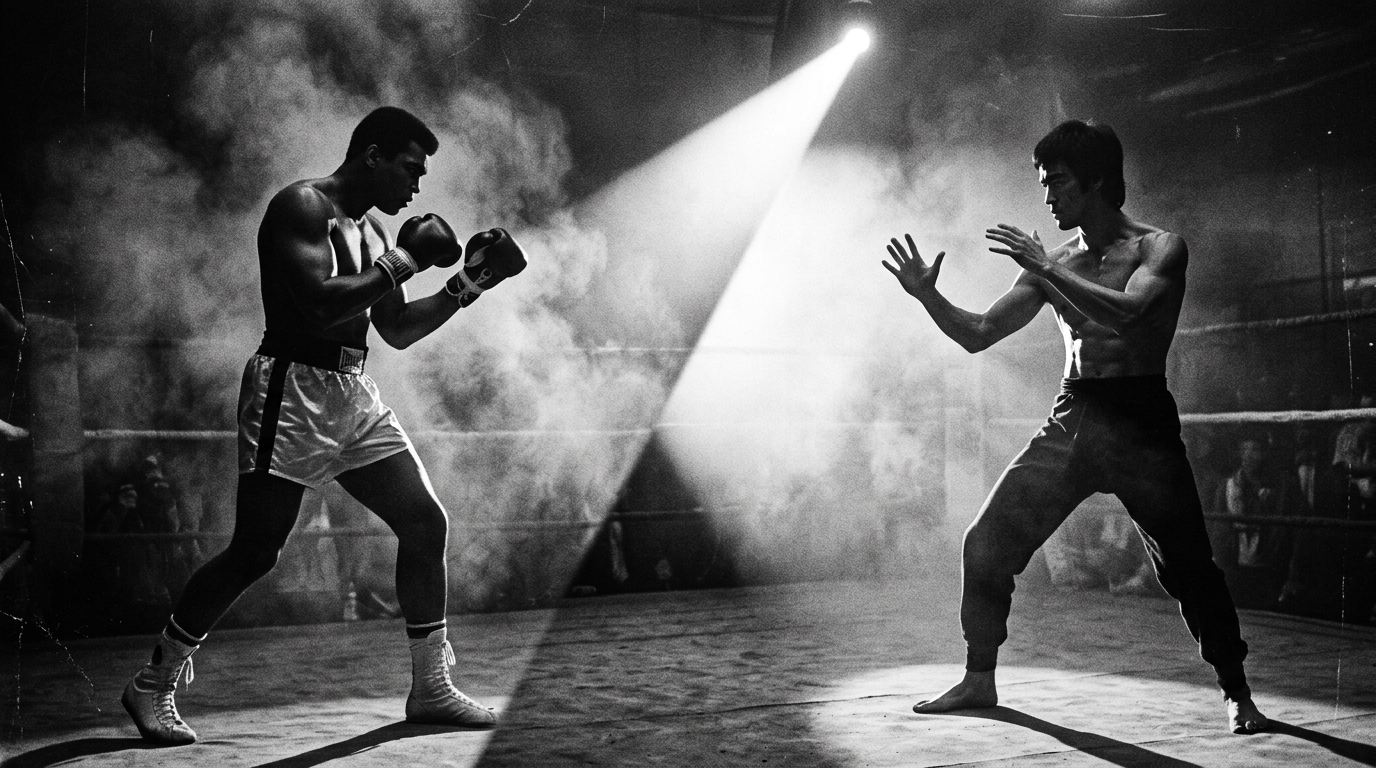
Bruce Lee vs Muhammad Ali: The Fight He Studied But Could Never Enter
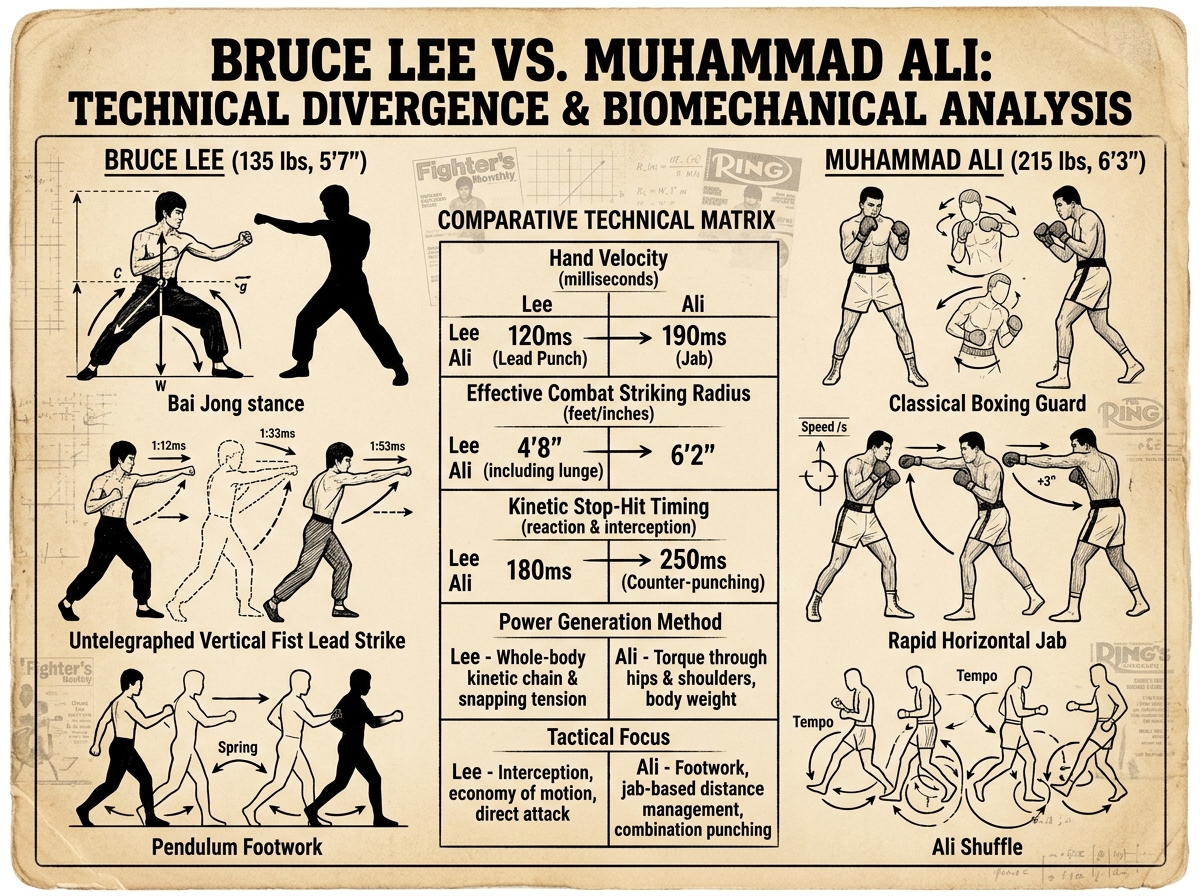
Ali was 6’3″ and fought at around 215 pounds. Lee was 5’7″ and rarely exceeded 140. The weight difference alone, roughly 75 pounds, puts the hypothetical fight into the realm of pure speculation so quickly that it’s barely worth the journey. Lee knew this. He said so explicitly, in conversations with students and in his own notes, which is part of what makes his documented obsession with Muhammad Ali so interesting: it wasn’t the fantasy of a fight. It was the study of a movement system.
Lee kept photographs of Ali training pinned up in his home gym alongside pictures of fencers, gymnasts, and martial artists from multiple disciplines. The Ali photos weren’t motivational decoration. They were reference material. He studied Ali’s footwork the way a scientist studies a specimen: looking for the mechanical principles underneath the specific techniques, extracting what was transferable to his own practice regardless of the obvious differences in physical context.
Look at my hands. These are little Chinese hands. Ali would kill me. But look at his footwork—that is what I must understand and adapt.
Bruce Lee, Recorded by Linda Lee Cadwell
What Lee Actually Said About Ali
The most direct documented statement comes from a conversation with his student Dan Inosanto, which Inosanto has recounted in several interviews over the decades. Lee was explicit: if he had to fight any man in the world, he’d be most afraid of fighting Ali. Not because Ali was the biggest or the strongest, but because his footwork eliminated the angles that a smaller, faster striker depends on. You can’t time a man who’s never in the same place twice. You can’t set up a side kick when the target keeps moving before the technique can reach it.
Lee’s reasoning, as Inosanto describes it, was tactical rather than reverential. He wasn’t expressing admiration in a general sense. He was making a specific argument about the structural problem Ali’s mobility would create for any opponent, including a fast, technically sophisticated opponent who could generate significant power for his size. The problem wasn’t Ali’s punching power, which was considerable. The problem was that his footwork denied opponents the stable position from which to operate their own game.
The Footwork Study
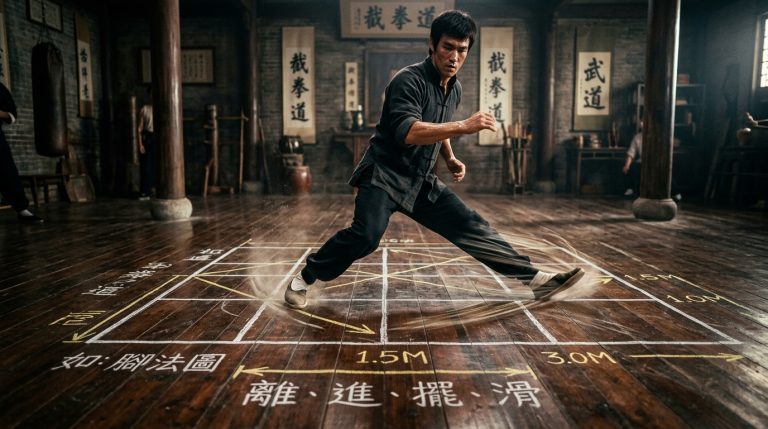
Ali’s footwork in his prime, roughly 1964 to 1971 before his layoff and return, was categorically different from what heavyweight boxing had produced before him. Previous heavyweight champions had moved well for their size. Ali moved like a middleweight or light heavyweight who happened to be six feet three and two hundred pounds. The lateral movement, the constant repositioning, the pivot that moved his whole body out of the line of a punch while his hands were already coming back, was foreign to how heavyweight boxing had been trained and taught.
Lee was interested specifically in the pivot and angle game. In his own training, the ability to move off the line of an incoming attack and counter simultaneously rather than blocking and then countering sequentially was a core principle. Ali did this at heavyweight scale, creating angles with his feet that his hands then exploited. The mechanical principle was the same as what Lee was developing in JKD. The application at drastically different size and in a different combat sport didn’t diminish the relevance of the footwork study.
His notes on footwork from the late 1960s contain observations about boxing footwork generally and Ali’s specifically. The concept of maintaining constant movement as a defensive tool, staying in motion so that the opponent is always targeting where you were rather than where you are, appears in Lee’s training materials with explicit reference to boxing’s lead. He wasn’t developing this principle independently from pure first principles. He was observing it in Ali and extracting it.
The Actual Physical Matchup Problem
| Attribute / Dimension | Bruce Lee (Jeet Kune Do) | Muhammad Ali (Heavyweight Boxing) | Tactical Analysis & Convergence |
|---|---|---|---|
| Physical Stature | 5’7″ (171 cm) / 135–145 lbs (61–65 kg) | 6’3″ (191 cm) / 212–218 lbs (96–99 kg) | Massive reach & mass disparity; Lee openly acknowledged boxing physics. |
| Footwork & Mobility | Bouncing stance, fencing pendulum slide-and-step | The “Ali Shuffle”, lateral circling, directional pivots | Lee studied reversed 8mm footage of Ali to integrate boxing rhythm into JKD. |
| Lead Striking Tool | Untelegraphed straight lead punch with vertical fist | Laser-fast flicking left jab with horizontal pronation | Both emphasized non-telegraphic lead velocity over rear-loaded power. |
| Defensive Paradigm | Single-beat interception: Simultaneous stop-hit and parry | Shoulder roll, slipping punches, leaning back off center | Lee prioritized interceptive counter-striking; Ali relied on reflexive head evasion. |
| Target Philosophy | All available targets: Eyes, throat, groin, knees, shin | Marquess of Queensberry targets (head & torso above belt) | Lee adopted boxing mechanics but rejected rule-bound combat restrictions. |
Lee’s stated assessment that he’d be afraid to fight Ali wasn’t false modesty, and it wasn’t the kind of diplomatic compliment that athletes offer each other publicly. He was being analytically honest about the specific structural challenges. At a 75-pound weight disadvantage, every grappling engagement becomes catastrophic. Any clean hit from Ali would carry force that clean hits from fighters Lee’s size simply don’t generate. The speed advantage that makes Lee’s strikes effective against similarly-sized opponents compresses at heavyweight because a heavyweight doesn’t need to be as fast to generate fight-ending force.
Lee understood reach as a fight-defining variable. Ali had a 78-inch reach. Lee’s was roughly 70 inches. In boxing terms, that’s a significant disadvantage at the jab and cross range where Ali dominated most of his fights. The entry problem for a smaller fighter against a longer, faster heavyweight with functional footwork is severe: you need to get inside without eating the jab, close to where your shorter reach becomes less of a disadvantage, without getting clinched and muscled around by someone who outweighs you by a third.
This doesn’t mean the fight was utterly one-sided in all imaginable scenarios. Lee’s kicking ability operated at ranges Ali had never trained to defend. A committed side kick to the knee from a practitioner who generates the kind of force Lee demonstrably produced is a different tactical problem than any boxing combination. But Lee was honest that the weight differential and Ali’s specific footwork made the encounter extremely difficult to navigate, which is more analytical self-awareness than most people display when discussing fighters they admire.
What He Took Into His Own Training
The study of Ali’s footwork produced concrete changes in Lee’s own movement training. His emphasis on maintaining light, bouncy footwork that keeps the weight from settling flat on the floor, the practice of moving before technique rather than during or after, the use of pivots and angular repositioning rather than straight-line retreats, all of these have observable parallels in Ali’s movement vocabulary.
He also integrated rope training more deliberately as a footwork conditioner after studying how boxing gyms used the jump rope to develop light ground contact and coordinated movement. The Ali connection made concrete something Lee was already pursuing: the idea that a fighter’s feet are the primary engine of both offense and defense, and that footwork training deserved as much systematic attention as striking technique.
Several students who trained with Lee in the late 1960s note that he would occasionally use boxing analogies and specifically Ali references in coaching. Not “be like Ali” in a superficial sense, but pointing to specific mechanical principles that Ali embodied with unusual clarity: the way the weight transfers during the pivot, the relationship between shoulder position and foot position during lateral movement, the timing of the jab as an entry tool that controls distance rather than just seeking to land damage.
Two Men Who Never Met
There’s no documented evidence that Ali and Lee ever met in person, despite both being major cultural figures in the early 1970s operating in adjacent entertainment and sports worlds. Ali appeared on television constantly throughout the period when Lee was in Los Angeles. They moved through some of the same celebrity contexts. But no photograph, no interview reference, no account places them in the same room.
Ali, for his part, doesn’t appear to have commented publicly on Bruce Lee during Lee’s lifetime. The direction of the documented attention was entirely one-way: Lee studying Ali, not Ali aware of Lee as a significant figure. By 1973, when Enter the Dragon released and Lee’s global profile exploded, Lee was already dead. What Ali might have made of Lee’s actual combat abilities, which were not the performing abilities of a film actor but the technical capabilities of a serious martial arts practitioner, exists only as speculation.
The Real Point of the Comparison
The Bruce Lee vs. Muhammad Ali hypothetical circulates in martial arts and combat sports discussions as though the interesting question is who would win. That’s the least interesting question you can ask about the two of them together. The interesting question is what a martial artist with Lee’s specific technical background and analytical approach was able to extract from studying a boxing champion in a completely different weight class doing a completely different combat sport.
The answer is: quite a lot, and specifically enough that it changed how he trained. That kind of cross-disciplinary extraction, watching someone operate at the highest level of their domain and pulling out transferable mechanical principles rather than surface-level imitation, is a more accurate description of how Lee developed his fighting system than any account focused only on the martial arts traditions he drew from. Ali was part of the curriculum, and the footwork principles Lee absorbed from that study are embedded in how JKD practitioners still move today.