Bruce Lee on Emotion in Fighting: How Anger Kills Performance
There’s a piece of training advice that Bruce Lee gave more consistently than almost any other, and it directly contradicts the image most people have of him. The fury in his film performances, the intensity in the photographs, the combat scream that every impressionist reaches for — none of these accurately represent what he taught his students about the emotional state a fighter should bring to an actual fight. The advice was: don’t be angry. Anger is a performance liability.
This wasn’t pacifism or a philosophical preference for calm. It was a performance argument. He’d observed what emotion does to technical precision, and the observation was consistent: strong negative emotion, particularly the anger that fighting tends to generate, degrades the specific qualities that make a fighter effective. The argument runs through his notebooks, his teaching, and his reading of the psychological and philosophical literature he drew from.
What Anger Actually Does to a Fighter
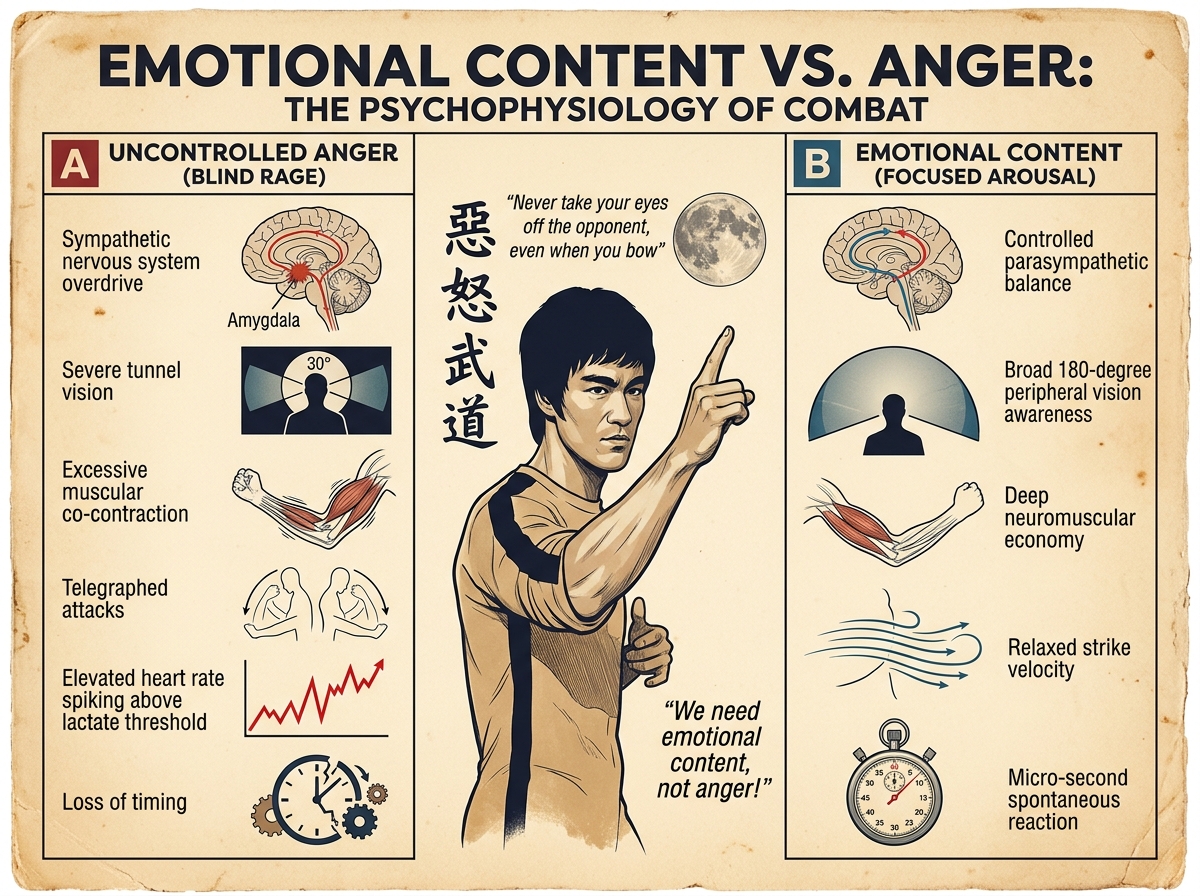
The physiological effects of anger in combat are specific and well-documented, even if Lee didn’t have the full neuroscience available to him in the early 1970s. Adrenaline and cortisol narrow attentional focus, which is useful when you need to be single-mindedly committed to a task but harmful when the task requires reading multiple variables simultaneously. A fighter who’s angry tends to charge forward, commit to a single line of attack, and stop seeing the opponent’s reactions because the tunnel vision of emotional arousal has reduced his perceptual field.
Lee was specific about the practical consequence: an angry opponent is predictable. The emotional charge drives the attack in a direction and at a pace that’s easier to read than the controlled, varied attacks of a calm fighter. In his own training and teaching, he noted that fighters who become angry in sparring are more vulnerable, not more dangerous, because their movement patterns simplify and their defensive awareness narrows. You can see the anger coming before the technique arrives.
He made this point in the context of JKD’s attack categories, particularly the Attack by Drawing: deliberately provoking an angry response from an opponent was a viable tactical tool precisely because angry fighters become easier to manage. Insult them, frustrate them, make them feel humiliated, and the emotional charge would drive them into predictable commitment. Understanding this as a vulnerability was what led Lee to eliminate the same vulnerability in himself.
The Psychological Sources He Drew From
Lee’s reading on this question came from several directions. Krishnamurti’s secular psychological analysis of the observer-self, the idea that emotional reactions are patterns of conditioned response rather than genuine insight into situations, appears in his notebooks with specific application to training. Krishnamurti argued that anger, fear, and attachment are habits of the conditioned mind rather than accurate responses to reality, and that the person who has developed genuine awareness can observe these patterns without being controlled by them.
This was useful to Lee as both a psychological and a practical framework. The practitioner who can observe the impulse toward anger as a pattern rather than being carried by it has functional freedom that the reactive practitioner doesn’t: they can respond to the actual situation rather than to the emotion the situation has triggered. In fighting terms, this is the difference between responding to what the opponent is actually doing and responding to what the anger-triggered assessment of what the opponent is doing tells you.
The Zen concept of mushin, which Lee engaged with deeply through D.T. Suzuki’s writing, addresses the same phenomenon from a different angle. The no-mind state isn’t emotional blankness; it’s the absence of the internal commentary that emotions generate. Anger produces commentary that interposes between perception and response. Mushin removes the commentary layer and allows direct response without the emotional narrative getting in the way. You can read more about his engagement with these ideas in our piece on Bruce Lee and Zen Buddhism.
The Film Performance Problem
The apparent contradiction between Lee’s teachings on emotional control and the emotional intensity he projects in his films is worth addressing directly. Chen Zhen in Fist of Fury is visibly, specifically angry throughout most of the film. Lee plays it without ambiguity. The combat vocalization, the expression, the commitment of the technique all read as emotional intensity rather than detached calm.
Lee was specific about this distinction. Performing emotion for the camera is not the same as being controlled by emotion in an actual fight. He was an actor, and a skilled one: he could produce the appearance of anger, fear, or joy on demand without actually experiencing those states in the way that impairs performance. The technique required for that kind of controlled performance is actually the same skill he taught in fighting — the ability to observe an emotional state without being run by it.
The screaming combat sound that audiences associated with fury was partly practical: his actual kiai functioned as a forced exhalation that tightened his core at the moment of impact, generating more force at the strike. It wasn’t the involuntary scream of an angry person; it was a trained vocalization timed to enhance power production. The anger was the character’s. The technique was Lee’s.
Controlled Emotional Energy vs. Uncontrolled Emotion
| Psychological Dimension | Uncontrolled Anger / Rage | Controlled Emotional Content | Tactical Combat Consequence |
|---|---|---|---|
| Visual Perception | Tunnel vision; peripheral blind spots | Broad spherical peripheral awareness | Anger blinds you to counters; awareness spots openings instantly. |
| Muscular Tension | Antagonist muscles stiffen; jerky cadence | Relaxed resting tone until millisecond of impact | Tension telegraphs strikes and drastically slows reaction speed. |
| Breathing & Oxygen Economy | Shallow, erratic chest breathing (hyperventilation) | Rhythmic diaphragmatic breathing | Anger exhausts cardiovascular fuel within 60 seconds of exertion. |
| Decision-Making Speed | Impulsive, reckless rushing into traps | Cold, calculating exploitation of opponent rhythm | Emotional stability allows precise execution under high adrenaline. |
Lee distinguished between using emotional energy and being controlled by it. The arousal state that fighting generates, the adrenaline and heightened physical readiness, can enhance performance if it’s channeled rather than scattered. The problem with anger specifically is that it tends to produce the scattering: it drives you forward without giving you any additional information about what to do when you get there.
His ideal was something he described in terms drawn from both Zen and Taoist sources: alert presence, full awareness of the moment, physical readiness without mental noise. The practitioner in this state is completely engaged with the actual situation rather than with any emotional interpretation of it. Sports psychologists now describe something similar as the optimal performance state or flow, characterized by high engagement without anxiety and automatic execution without self-monitoring.
Lee was pursuing this state and developing training methods for it at a time when sports psychology as a formal discipline barely existed. His philosophical framework, drawing from Taoism, Zen, and Krishnamurti, was giving him a more sophisticated map of the territory than contemporary athletic training literature could offer.
Never take your eyes off your opponent, even when you bow… What you need is emotional content, not anger.
Bruce Lee to student (played by Peter Chan), Enter the Dragon (1973)
Teaching It to Students
The practical challenge of teaching emotional self-regulation in a combat context is that sparring inherently generates the emotional states you’re trying to regulate. Lee’s approach, as described by former students, was to use sparring sessions deliberately to create emotional pressure and then to train the response to that pressure.
Dan Inosanto describes training sessions where Lee would deliberately do things that created frustration: landing clean techniques repeatedly, denying the student’s attempts at their preferred attacks, making the sparring experience uncomfortable enough to generate real emotional responses. The point wasn’t humiliation; it was exposure to the emotional states that real fighting generates, with the training context providing a safer environment to develop the response.
The instruction, when the frustration was visible, was consistent: observe it, don’t suppress it, but don’t act from it either. The anger is information that you’re being challenged; it’s not a reliable guide to how to respond to the challenge. The practitioner who can maintain tactical awareness while feeling the frustration is further along than the one who has neither the frustration nor the awareness.
The Performance Record
The accounts that survive of Lee’s own performance in sparring and demonstrations describe a demeanor consistent with everything he taught on this subject. The expression during sparring, according to people who trained with him, wasn’t the fierce snarl of the film performances. It was something closer to focused calm: completely present, completely engaged, but without the visible emotional charge that acting requires.
That quality, presence without emotional noise, is the operational definition of what he was teaching. The philosophical frameworks were different paths to the same practical target. Getting there in an actual fight, where the stakes generate real emotion rather than simulated intensity, is the work. The philosophy is the map. The training is the journey.