Bruce Lee’s Isometric Training: How He Built Strength Without Moving
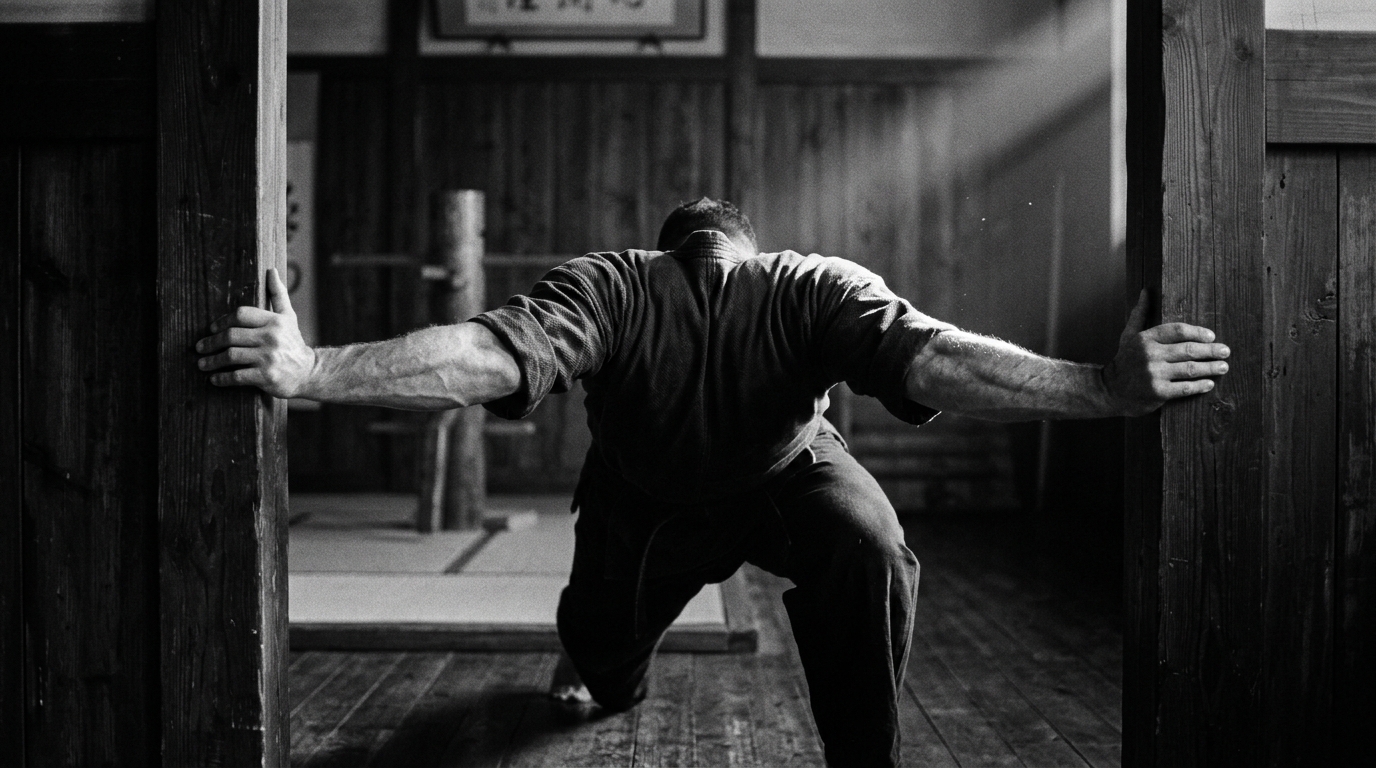
Somewhere in Bruce Lee’s Oakland home in the mid-1960s, he was pressing his palms against a wall with everything he had. Not pushing it over. Not expecting it to move. Just straining against it, holding the contraction, and letting the tension do the work. This was isometric training, and Lee became one of its most devoted practitioners years before sports science caught up to explain why it worked.
The method didn’t originate with Lee. Bodybuilders like Charles Atlas had promoted static contraction training since the 1920s. But Lee arrived at isometrics through a different door: he was looking for ways to develop maximum-force muscular contractions without the joint wear and recovery time of heavy lifting. For a martial artist who trained twice a day, that mattered.
What Isometric Training Actually Does
In a conventional exercise, such as his barbell weight training, muscles shorten as they contract, moving a joint through a range of motion. Isometric contraction is different: the muscle generates force without shortening because the resistance is immovable. Pressing your palms against a wall, pulling a fixed bar, or holding a weight completely still all produce isometric contractions.
The strength gains from isometrics are real but specific. Research consistently shows that isometric training increases strength most at and near the angle where the contraction occurs, with limited carryover to other positions in the range of motion. Lee understood this intuitively, which is why his isometric work wasn’t random. He contracted at positions that corresponded to the most critical moments in his strikes: the extension point of a punch, the impact zone of a kick.
There’s a second benefit that mattered just as much: neuromuscular activation. Isometric contractions recruit motor units at extremely high rates, essentially training the nervous system to fire more of the muscle fibers available. Bruce Lee’s punching speed wasn’t only about muscle mass. It was about how efficiently his nervous system could activate the mass he had.
The Equipment Lee Used
Lee built a dedicated isometric training rack (one of many custom innovations detailed in Bruce Lee – Equipment Manager), a device that allowed him to set a bar at any height and push or pull against it with maximum effort. The rack is documented in photos from his home gym and described in John Little’s compilation of Lee’s training notes, The Art of Expressing the Human Body. It wasn’t a commercial product. He designed it himself to match the specific joint angles he wanted to train.
He also used doorframes. The classic wall-press, performed at chest height and overhead, was part of his regular routine (complementing his forearm and grip development). No equipment needed. He’d position himself in a doorframe, press outward with both arms simultaneously, and hold the contraction for roughly six to twelve seconds at maximum effort. Then repeat. Door frames are effectively free isometric racks, and Lee trained with whatever was available.
His training journal entries from 1965 to 1970 show isometric sessions appearing multiple times per week, often scheduled early in the morning before his daily run. They were short sessions: the total volume of isometric work in a given day might be 15 to 20 minutes. The intensity, not the duration, was the point.
The Specific Isometric Exercises Lee Practiced
Lee’s documented isometric exercises target every major muscle group involved in striking. For the chest and front deltoids, he used the wall-press and rack-press at various heights. For the back and biceps, he used underhand pulls against a fixed bar. For the legs, he pushed downward against a weighted platform in a partial squat position.
He also practiced what his notes call “tension exercises,” which are essentially full-body isometric contractions where he would tense every muscle simultaneously and hold. These aren’t targeted at any single movement but train total body tension, which is relevant to grappling and close-range striking where whole-body rigidity matters.
The holding duration he used was typically six to twelve seconds per contraction. Modern research suggests this range is near-optimal for strength development from isometrics: long enough to fully fatigue the recruited fibers, short enough to maintain true maximum effort throughout. He arrived at this range empirically, through trial and error, not textbooks.
What Isometrics Cannot Do
Lee was methodical enough to understand the limitations. Isometric training doesn’t develop muscular endurance the way sustained activity does. It doesn’t train power in the way explosive dynamic movements do. He used isometrics as one component inside a much larger system that also included running, cycling, dynamic lifting, partner drills, and skill training. Pulled out of context and used alone, isometrics would have produced a strong but incomplete athlete.
The range-specificity problem also meant he couldn’t rely on isometrics to transfer universally. Strength built at the midpoint of a punch extension doesn’t automatically appear at the start or end of that movement. This is why his training addressed multiple positions across each strike’s arc, not just the “feel-strong” position that’s easy to hold.
Applying Lee’s Method Today
The practical application of isometric training for any martial artist today is straightforward (and detailed in how to train like Bruce Lee). Pick three to five positions that correspond to the movements you care about. For a puncher: starting position, mid-extension, full extension. For a grappler: the positions of maximum leverage in common holds. Press or pull against immovable resistance at each position for six to twelve seconds at genuine maximum effort. Rest two to three minutes between sets. Do this two or three times per week.
The results take time to appear in dynamic movement, because the nervous system adaptations need weeks to transfer. But they do transfer. Fighters who add structured isometric work consistently report feeling stronger in the positions they’ve trained, which translates to harder punches, more controlled grappling, and better structural integrity when taking hits.
Lee’s fascination with isometrics was really a fascination with efficiency. He wanted the maximum training benefit from the minimum time investment. Static contractions against fixed resistance checked that box: high intensity, brief duration, no recovery cost from heavy eccentric loading. For a man who was simultaneously running a school, teaching students, preparing for film roles, and developing an entirely new martial art system, efficiency wasn’t optional. It was survival.