Bruce Lee’s Incredible Feats
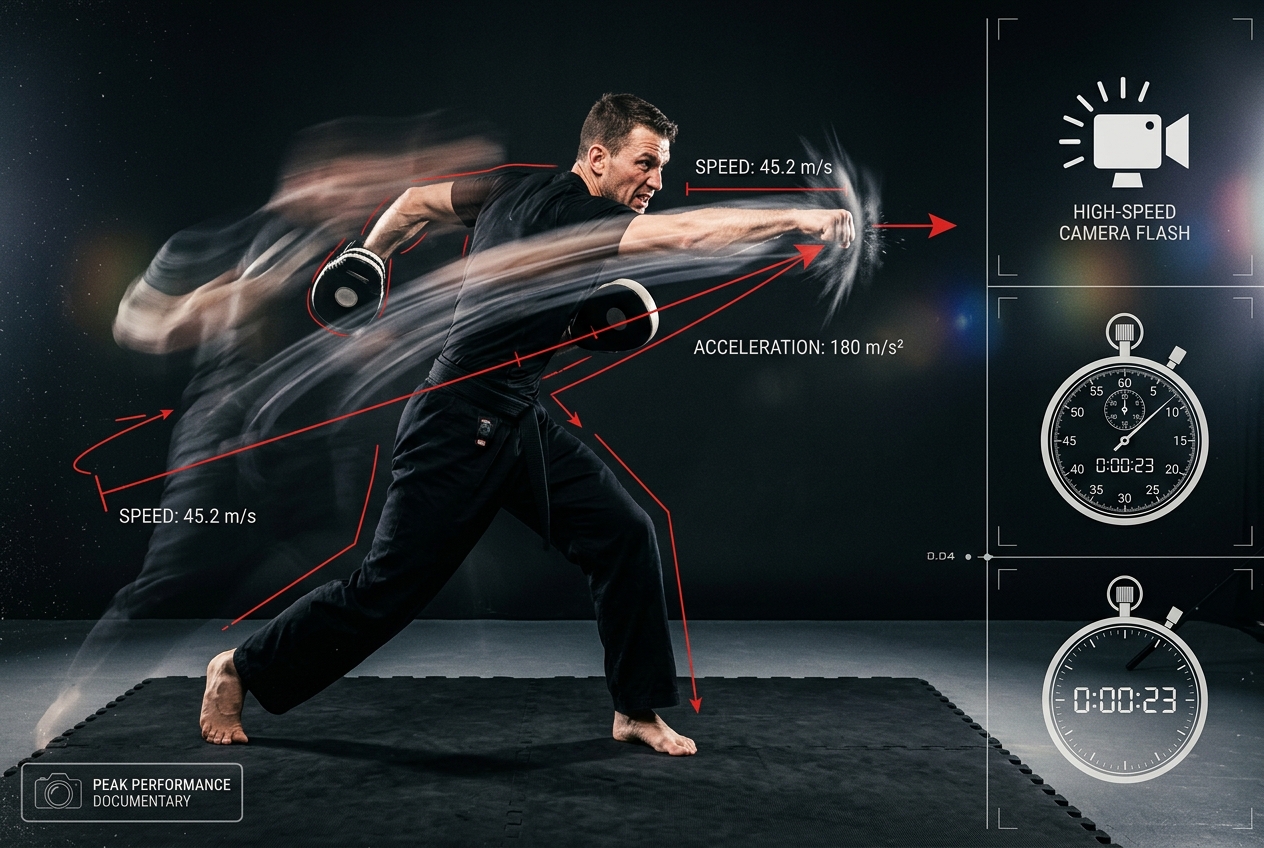
The problem with Bruce Lee’s physical reputation is that it collided with mythology too early. He died at 32, four weeks before his most famous film was released, and in the decades that followed the stories grew and multiplied until it became genuinely difficult to separate documented fact from accumulated legend. The useful starting point is to look at what was actually measured, filmed, or witnessed by credible sources — and recognize that even the verified record is extraordinary enough on its own terms.
Speed: What Was Actually Measured
Lee’s striking speed was studied formally during his lifetime, most notably by researchers at UCLA who used high-speed photography to analyze his techniques. The results were published and are not disputed.
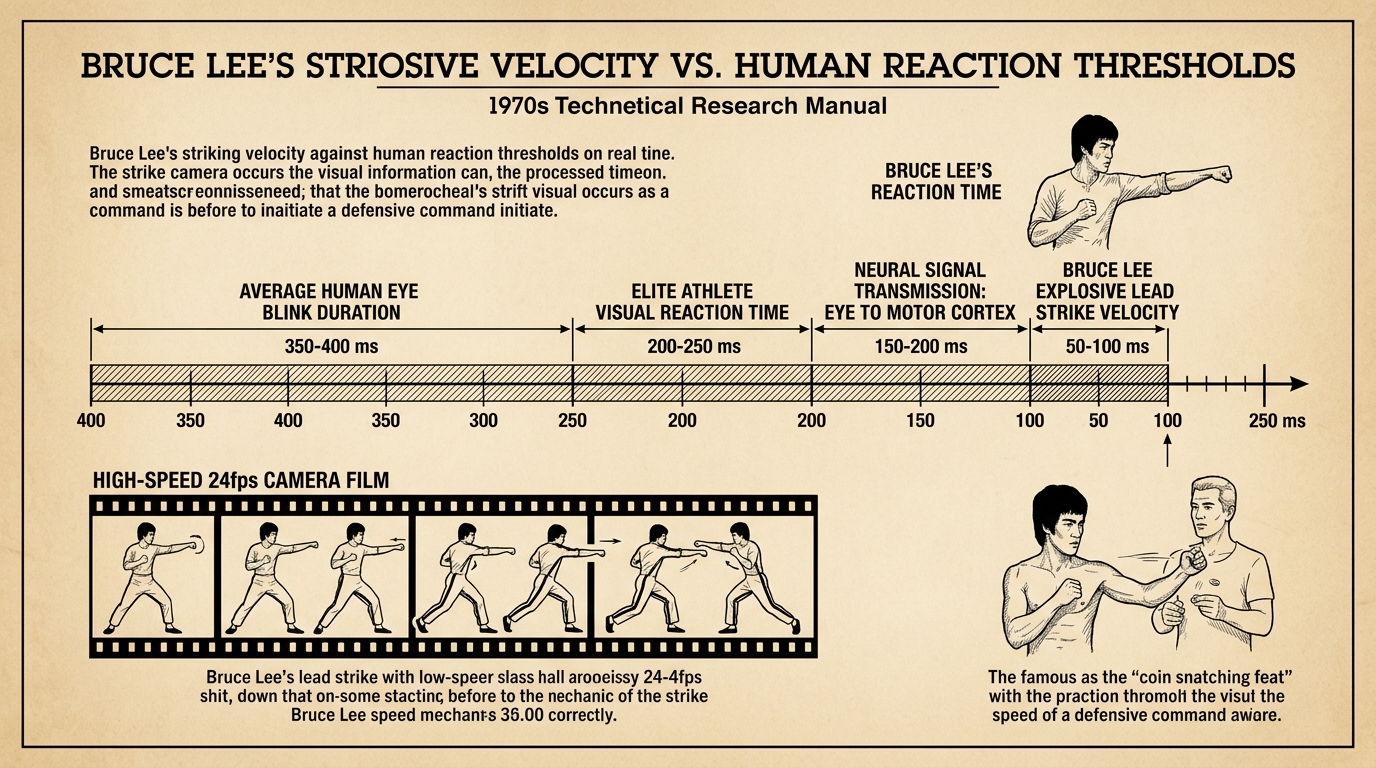
From two feet away, Lee could deliver a punch and retract it before the average person could initiate a defensive response. Human reaction time — the time between perceiving a stimulus and beginning a muscular response — averages between 200 and 250 milliseconds. Lee’s punch traveled to its target and returned in less than that. He wasn’t just fast. He was fast enough to operate inside the gap where human reflexes couldn’t function.
Specific documented measurements include:
- Punch delivery from 1 inch away: 0.05 seconds
- Side kick from standing position: 0.06 seconds
- Punch velocity measured at approximately 190 km/h (118 mph)
The coin catch demonstration — snatching a dime from an open palm and replacing it with a penny before the hand could close — was performed for multiple witnesses including actor James Garner. It requires not just speed but precise timing and hand control at velocities where most people would simply miss.
Temporal Benchmark: Milliseconds
Film cameras at 24 frames per second frequently missed Bruce Lee’s strikes, requiring him to slow his execution. Comparing his recorded strike speeds against baseline human physiological reaction windows reveals why opponents could not defend in time:
The Camera Problem
Perhaps the most telling evidence of Lee’s speed comes from the technical challenges it created for filmmakers. Standard cinema cameras of the 1970s operated at 24 frames per second. At that frame rate, Lee’s fastest techniques were invisible — a blur where a punch or kick should have been clearly visible.
Directors on his films asked him, repeatedly, to slow down. This happened on The Chinese Connection, on Return of the Dragon, and on Enter the Dragon. For certain sequences, cameras were run at 32 frames per second and then projected at 24, slowing the playback relative to real time so audiences could actually see what he was doing. What you watch in his films is Bruce Lee moving at roughly 75% of his actual speed. The version at full speed was not filmable with the technology of the era.
Strength: The Documented Feats
Lee weighed between 130 and 140 lbs throughout his film career. His strength-to-weight ratio was the subject of consistent astonishment from people who trained with him — including world-class athletes who had encountered strong people before.
| Documented Feat | Measured Metric / Output | Verification Method & Eyewitnesses | Physiological / Combat Significance |
|---|---|---|---|
| Lead Punch Strike Speed | 0.05 seconds (50 milliseconds) from 3 ft | High-speed 24 fps and 32 fps film analysis | Strikes faster than the human optical neural transmission threshold (150–200 ms) |
| One-Inch Punch Impulse | Propelled 180+ lb adult backward onto chair | Long Beach Karate Championships (1964, 1967), Bob Baker | Full kinetic wave discharge with zero preliminary acceleration distance |
| Grip Dynamometer Squeeze | 150+ lbs on standard dynamometer | Documented by Dan Inosanto and George Lee | Exceptional forearm recruitment disproportionate to his 135–140 lb body weight |
| Two-Finger Push-Ups | Repeated strict push-ups on thumb and index finger | Filmed live demonstrations, witnessed by martial arts community | Extreme structural tendon tensile strength and isometric core rigidity |
| One-Arm Pull-Ups | Multiple consecutive repetitions | Witnessed by student Ted Wong in Bel Air home gym | Extraordinary relative power-to-weight ratio in lats and elbow flexors |
| Heavy Bag Kick Impact | Deflected and ruptured 300-lb heavy canvas bag | Documented by Ed Parker and James Coburn | Complete ground-reaction-force kinetic transfer through hip extension |
Documented by training partners and witnesses:
- Two-finger push-ups — using only the thumb and index finger, performed for witnesses including multiple students who trained personally with Lee. This requires not just finger strength but the ability to distribute body weight across two contact points with precise balance.
- 50 one-arm chin-ups in succession — documented by training partner Ted Wong. For context, five one-arm chin-ups is considered elite for most athletes regardless of weight class.
- Horizontal flag hold from a vertical pole — supporting full body weight perpendicular to a vertical surface. This requires extraordinary lat, core, and hip flexor strength simultaneously. The feat was witnessed by multiple credible observers.
- Grip strength exceeding 150 lbs of crushing force per hand — measured by grip dynamometer. His forearm development was one of the most commented-upon aspects of his physique by people who encountered him in person.
The One-Inch Punch: Witnessed and Analyzed
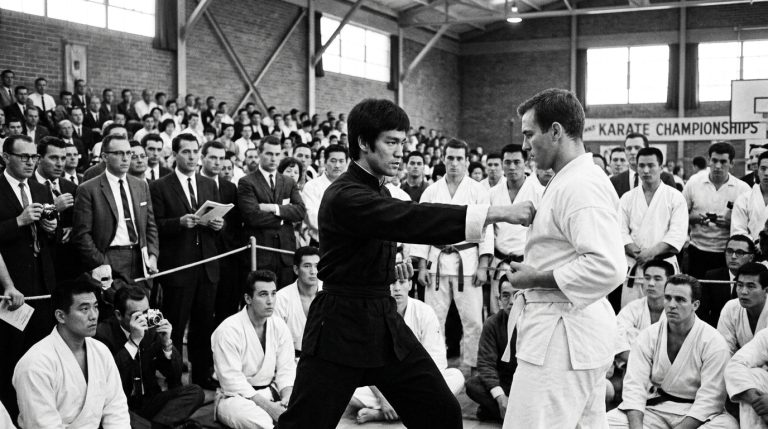
The 1964 Long Beach International Karate Championships demonstration changed American martial arts. Lee stepped onto the demonstration floor and invited a volunteer to stand one inch from his extended fist. What followed — a strike that sent a grown man stumbling backward several feet despite traveling less than three centimeters — was witnessed by hundreds of martial artists and discussed for decades afterward.
The biomechanics of the one-inch punch have since been studied formally. What researchers found was not magic: it was whole-body kinetic energy, coordinated through precise sequential muscular activation from the ground up, delivered through a minimal range of motion. The power came from his legs driving through his hips, transferring into his shoulder and arm, and concentrating through his fist at the point of contact. Lee had essentially solved an engineering problem: how to generate maximum force with minimum visible windup.
The technique was later demonstrated at the 1967 Long Beach Championships as well, in front of a similar audience. Both demonstrations were filmed, though the quality of existing footage varies.
“I fear not the man who has practiced 10,000 kicks once, but I fear the man who has practiced one kick 10,000 times.”
Bruce Lee
What the Skeptics Get Right (And Wrong)
The legitimate criticism of Bruce Lee’s physical legend is that mythology accumulated around a real person and eventually swallowed him. Not every story is verified. Not every claimed feat is documented. The “touch of death” stories — the idea that Lee could kill with a single specialized technique — are not supported by evidence and were largely generated after his death by people who had never trained with him.
The problem with excessive skepticism is that it requires ignoring the testimony of credible witnesses. Chuck Norris was a world karate champion before he met Lee. Joe Lewis was arguably the greatest American full-contact karate fighter of his generation. Mike Stone won multiple national championships. These were not easily impressed men. All of them described Lee’s physical abilities as unlike anything they had encountered in martial arts.
Dan Inosanto, who trained with Lee more extensively than almost anyone and whose technical assessment is considered reliable across the martial arts community, described watching Lee train as “watching something that shouldn’t be physically possible.” Inosanto was careful with his words. He didn’t say it casually.
The verified record is enough. You don’t need the mythology. A man who could punch faster than human reaction time, generate championship-level grip strength at 135 lbs, and perform feats of physical control that confounded high-speed cameras is already extraordinary. The exaggerations that accumulated after 1973 were, in a sense, unnecessary — applied to someone whose documented capabilities already exceeded what most people could believe.