Bruce Lee Grave Site
Lake View Cemetery sits on a hill in Seattle’s Capitol Hill neighborhood, adjacent to Volunteer Park. On most days it’s quiet — the kind of place where the city recedes and you can hear birds. But on certain dates, and around certain graves, it fills up. November 27, Bruce Lee’s birthday. July 20, the anniversary of his death. On those days, people arrive from Japan, from China, from Hong Kong, from Brazil. They bring flowers. Letters written in languages Lee never spoke. Martial arts equipment. Objects personal enough that they’re probably difficult to explain to anyone who asks.
The grave is in Section 1. You don’t need a map. Follow the path of other visitors, or look for the red granite headstone, or simply ask at the cemetery office — the staff have given the directions so many times the question requires no explanation.
Location and Practical Information
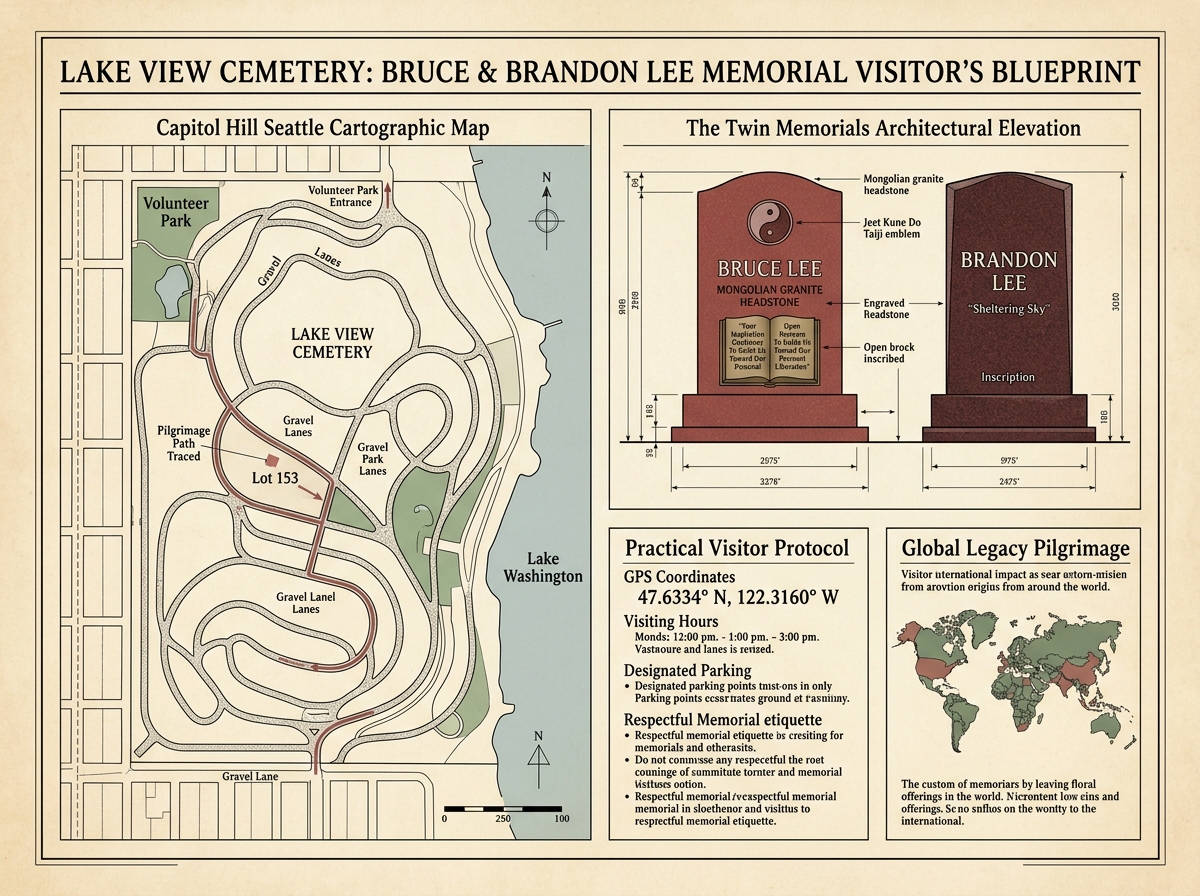
For complete visiting information including parking, bus routes, and nearby attractions, see our Lake View Cemetery visitor’s guide. The essentials:
Lake View Cemetery
1554 15th Avenue East
Seattle, WA 98112
United States
The cemetery is open daily from dawn to dusk. No admission fee, no appointment required. It is an active cemetery — other families have graves here — so the expected standards of behavior apply. The grave is located in Section 1, which most visitors reach within minutes of entering the main gate.
Getting there by public transit is straightforward: Metro routes 10 and 49 stop near the cemetery. By car, street parking is available on 15th Avenue East, though it can be competitive on busy days. The Seattle Asian Art Museum and the Volunteer Park water tower are within easy walking distance if you want to extend the visit into the neighborhood.
The Grave Itself
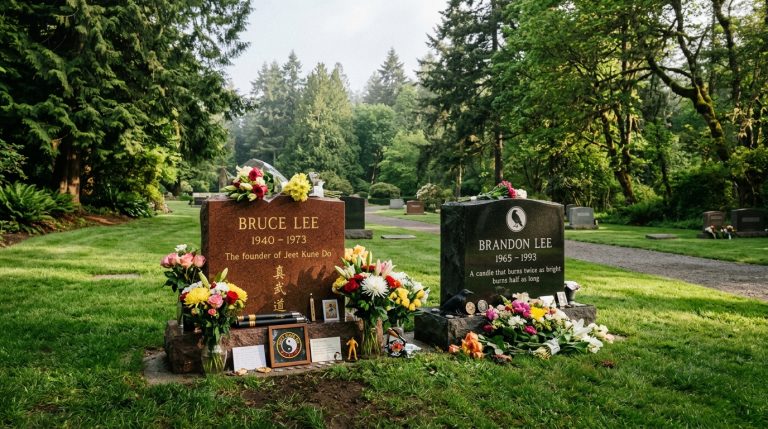
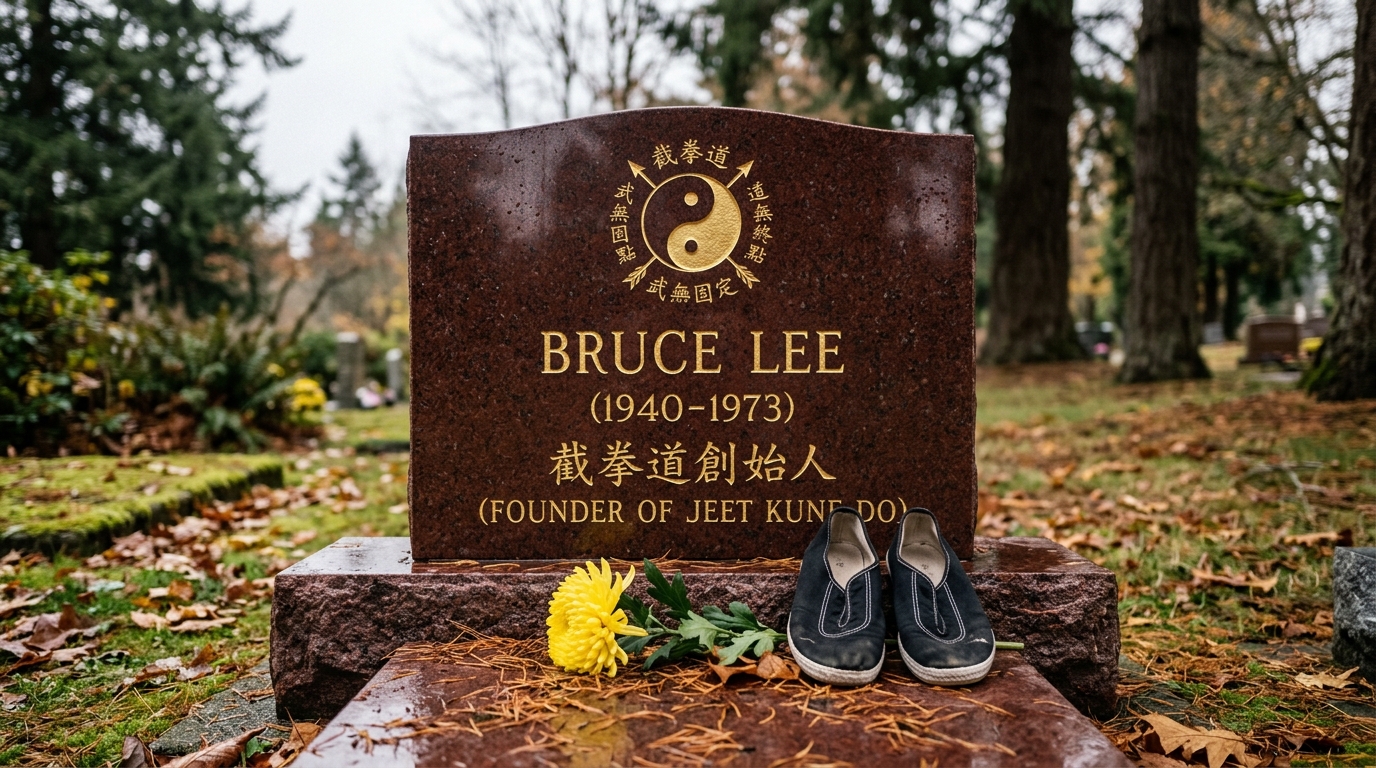
The headstone is large by cemetery standards — a substantial slab of red granite, Lee’s name inscribed in both English and Chinese, flanked by his birth date (November 27, 1940) and death date (July 20, 1973). Below his name: “Founder of Jeet Kune Do.”
That inscription was chosen deliberately. Not actor. Not martial artist. Not icon. The founder of a specific martial philosophy — the thing he spent his adult life building and refining. Linda Lee, who made the burial arrangements, understood what mattered to him and honored it in the simplest possible way.
Visitors leave offerings continuously. The cemetery staff periodically clear the accumulated items — flowers, coins, training equipment, written letters, photographs — but the grave is almost never bare. People leave things that reflect what Lee meant specifically to them. A martial arts student might leave a training dummy they made themselves. A philosophy reader might leave a worn copy of Tao Te Ching. The diversity of what gets left behind tells you something about the breadth of his influence.
Brandon Lee
Directly beside Bruce Lee’s grave is the headstone of his son, Brandon Lee. Brandon died on March 31, 1993, at 28 years old — killed during the filming of The Crow when a bullet fragment lodged in a prop gun discharged during a scene. He was in post-production on what would have been his breakout film. He was buried beside his father.
The proximity of the two graves affects visitors in ways that are difficult to articulate without experiencing it. Two people from the same family, both taken young, both in circumstances that felt impossible to believe. The site carries weight that goes beyond admiration for Bruce Lee’s work. It’s a place where grief accumulates across generations and across cultures, deposited by strangers who feel connected to these two people through what they created.
Many visitors come specifically for Brandon — a generation of fans who grew up with The Crow rather than Enter the Dragon. The two graves share the site without competition. People who came for one often stand quietly at both.
Why Seattle
This is the question that comes up repeatedly: why Seattle? Bruce Lee died in Hong Kong. He made his films in Hong Kong. He was buried in a city he lived in as a young man trying to figure out who he was.
The answer, as described by Linda Lee and as explored in his biography, is that Seattle was where Lee became himself. Hong Kong was his childhood. Los Angeles was his career. Seattle — the University of Washington, the small rooms where he taught Gung Fu, the conversations with philosophy professors, the years of reading and thinking and experimenting — was where the person who would create Jeet Kune Do actually formed.
He arrived in Seattle in 1959 at 18, carrying very little. He left a few years later as a husband, as a teacher with a growing group of devoted students, and as someone who had read enough philosophy to know what he believed and why. That transformation meant something to him. The choice to be buried there was a statement about which part of his life he considered foundational.
It was also, Linda Lee noted, a city where he had genuine community — people like Taky Kimura, who had been with him since the parking-lot Gung Fu classes at UW and who ran the Seattle Jun Fan school for decades after Lee’s death. Kimura maintained the grave and the tradition simultaneously, which seems fitting.
The Experience of Visiting
People describe visiting the grave in different ways. Some treat it as straightforward pilgrimage: they travel a long distance specifically to stand in that location for a few minutes, leave something, and go. Others come as part of a broader trip to Seattle and find the visit more affecting than they’d expected. A number of visitors describe feeling something they didn’t anticipate — not in a supernatural sense, but in the way that physical presence at a historically significant place creates understanding that reading about it cannot.
The best times to visit, if you want relative quiet, are weekday mornings between October and April. The birthday and death anniversary draw the largest crowds. Summer weekends are consistently busier than winter weekdays. None of this matters much if you’re coming from Hong Kong or Japan specifically for this — you’ll be there regardless.
There’s no formal ceremony, no official visitor center, no gift shop. Just a red granite headstone on a hill in Seattle, and whatever you bring to it.