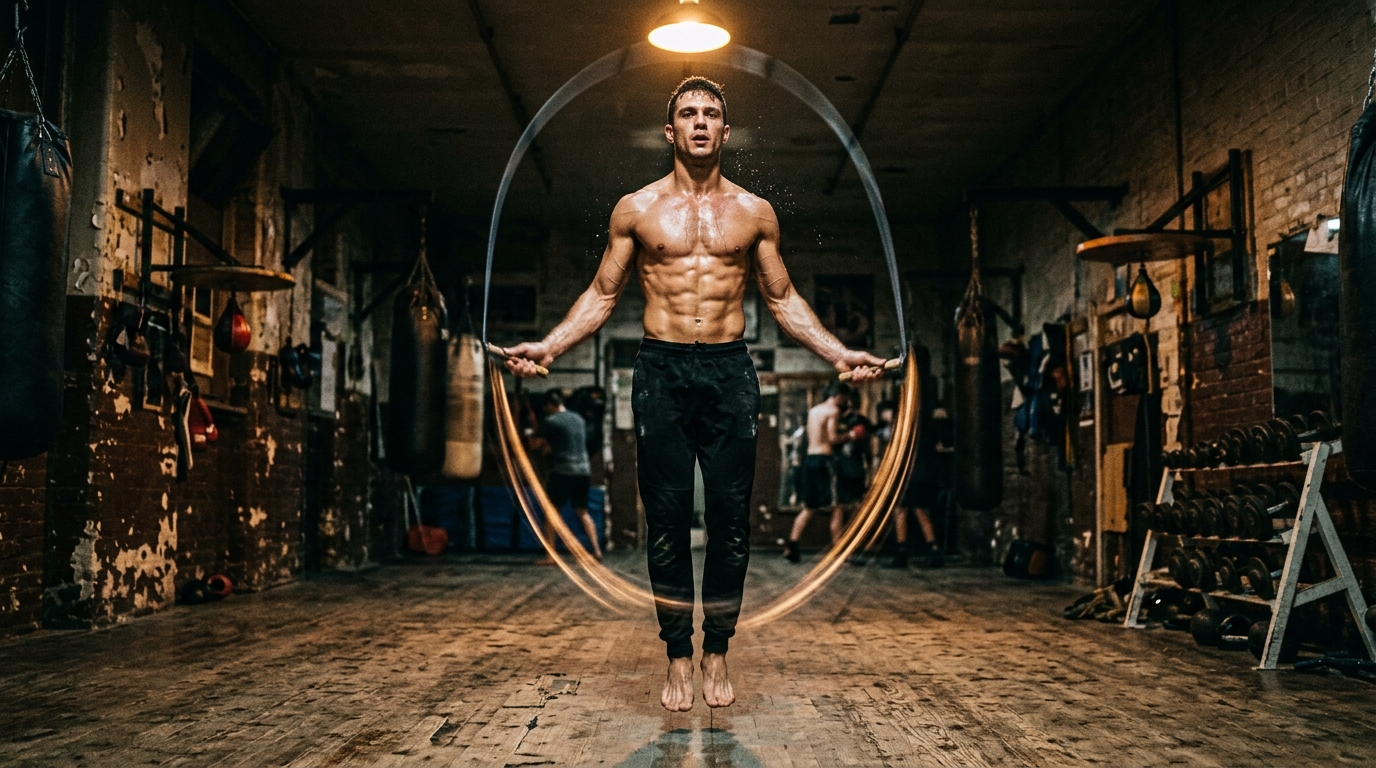
Bruce Lee’s Jump Rope Routine: The Cardio Tool He Swore By
There’s a photograph taken at Bruce Lee’s home gym in Bel Air in the early 1970s that shows two things you’d recognize immediately: the weight bench and the heavy bag. What’s harder to spot, but there in the corner, is the jump rope. It wasn’t a prop. Lee used it almost every day for more than a decade, and he was specific about why.
His running and cardio routine gets more attention in most accounts of his training, and the runs were impressive: four miles in the mornings along routes near his various homes, sustained over years regardless of weather or filming schedules. But jump rope served a different purpose. Where running built base aerobic capacity and lower body endurance, the rope trained something closer to what fighting actually demands: short bursts of high-intensity effort at sustained elevation, with footwork integrated into the conditioning.
What He Actually Did With the Rope
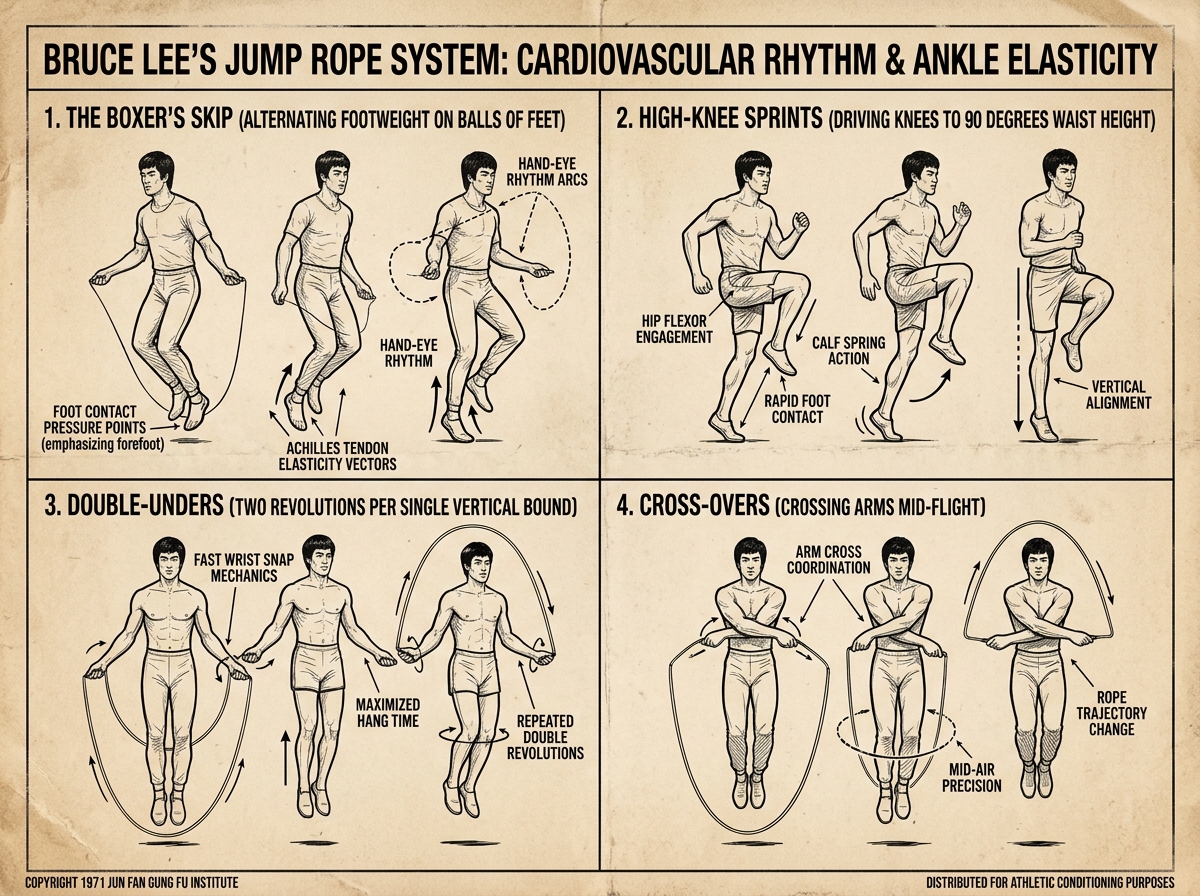
| Rope Protocol / Drill | Technical Execution | Duration / Volume | Tactical JKD Attribute Developed |
|---|---|---|---|
| Boxer’s Skip | Alternating weight lightly on balls of feet | 10–15 min continuous | Rhythmic foot transfer mirroring bouncing combat stance. |
| High-Knee Sprints | Knees driven to 90° waist height at max tempo | 3 rounds × 1 minute bursts | Hip flexor endurance for rapid kicking chambering. |
| Double-Unders | Two cable revolutions per single vertical leap | 5 sets × 20 repetitions | Explosive Achilles tendon spring and rapid wrist speed. |
| Cross-Overs & Side Swings | Crossing forearms across torso mid-flight | 5 min continuous flow | Bilateral motor coordination and upper-body relaxation. |
Lee’s jump rope sessions, as documented in training records and recounted by training partners, typically ran 30 minutes. That number sounds manageable until you’ve done it. Most people who pick up a rope for the first time can manage three to four minutes before the lactic acid becomes the main topic of conversation. Thirty continuous minutes of consistent rope work is a serious cardiovascular output, and Lee maintained it as a regular training element, not as a periodic conditioning test.
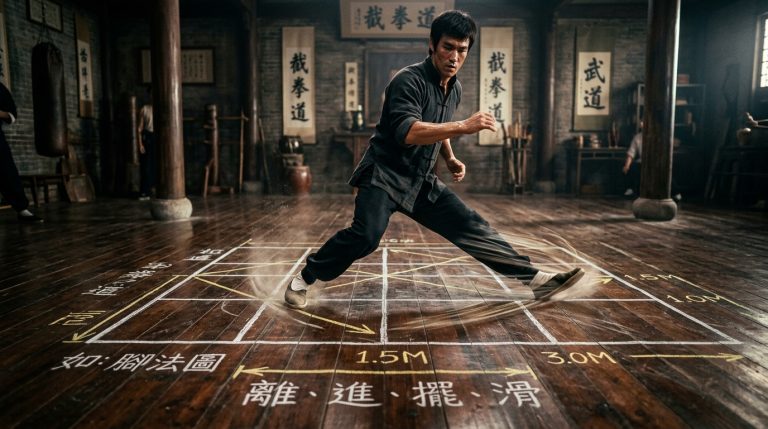
He used several variations. Basic two-foot bounce for rhythm and pace. Alternating foot bounce to mimic running motion. Double-unders (the rope passes twice under each jump) for explosive height and timing. His footwork during rope work wasn’t passive: Linda Lee has described sessions where he incorporated his fighting footwork patterns into the rope rhythm, essentially using the rope as a constraint that forced him to maintain light, quick feet while keeping his movements organized.
That integration is the part that most training accounts miss. The rope wasn’t separated from his martial arts training in his mind. It was a tool for developing the qualities fighting requires: lateral quickness, fast ground contact time, the ability to move without getting flat-footed. Boxing coaches have known this for over a century. Lee applied the same logic.
Why He Preferred It Over Other Cardio Tools
Lee’s training notes, compiled in The Art of Expressing the Human Body, make his reasoning explicit. The rope offered what he called “total body conditioning” in a time-efficient format. In 30 minutes of rope work he could elevate his heart rate to training levels, develop coordination and timing, work his footwork, and maintain shoulder endurance simultaneously. A 30-minute run achieved the cardiovascular output but not the other elements.
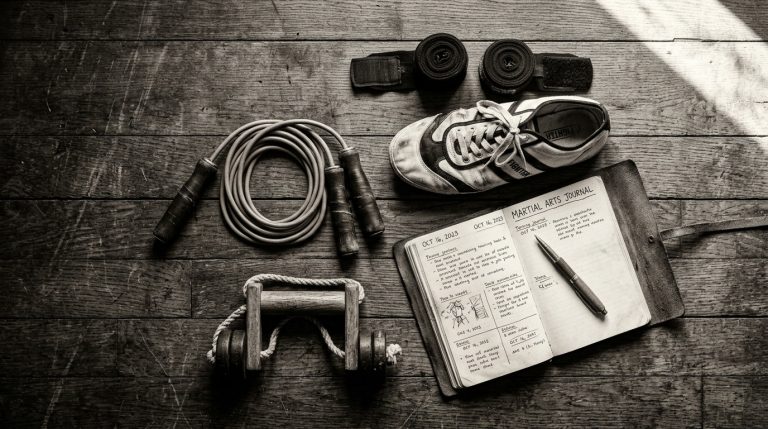
He was also practical about equipment. The rope cost nothing. It required no gym. It fit in a training bag. For someone who trained in hotel rooms while on location filming, in parking lots between takes, and in whatever space was available at any given point in his career, the rope’s portability was a genuine advantage over machines or equipment-dependent training.
The jumping surface mattered to him. He preferred wood or concrete to carpet, which absorbs the rhythm feedback and makes it harder to maintain consistent timing. When his home gym in Bel Air was built, the floor was specifically hardwood for this reason, alongside the obvious benefit for footwork drilling.
Skip rope at a fast clip for ten to fifteen minutes every single day. It develops stamina, foot rhythm, and makes you light on your feet like a dancer.
Bruce Lee, Training Notes
The Cardio Logic Behind the Choice
Fighting isn’t a steady-state aerobic activity. Rounds are short. The intensity within a round spikes and drops depending on the exchange. The cardiovascular system in a fight needs to handle sudden demand spikes, brief recoveries, and then another spike, repeatedly. Steady-state running builds the aerobic base but doesn’t specifically train that pattern.
Jump rope, particularly with interval variations, trains more specifically for the energy system demands of fighting. Lee incorporated tempo changes into his rope sessions: hard pace for a minute, moderate pace for recovery, hard pace again. This is interval training applied to rope work, and it was forward-thinking in the early 1970s when periodization and sport-specific conditioning were still emerging concepts in mainstream athletic training.
His daily workout schedule, as documented in his training records, placed rope work early in the session, typically after warming up and before moving to heavy bag or technical drilling. This sequencing was deliberate: use the rope to elevate heart rate and body temperature while developing coordination, then move to the more technically demanding work while already physically primed.
What Training Partners Observed
Students who trained at Lee’s home gym describe his rope work as noticeably different from the recreational jumping they’d seen before. The feet were barely leaving the ground. The rhythm was completely consistent, no hesitation between revolutions, no adjusting mid-session. And the footwork wasn’t static: he moved forward, backward, laterally, turning, all while maintaining the rope rhythm without breaking it.
Dan Inosanto, one of the students who trained with Lee most extensively in the late 1960s and early 1970s, has mentioned the rope in several interviews as one of the training elements that stood out. The integration of movement patterns into the rope session rather than just jumping in place was something Lee was deliberate about, and it showed in how his feet worked during sparring: light, quick, always organized, never flat.
The shoulder endurance built by sustained rope work also showed in his sparring. Fighters who tire in the shoulders drop their hands. Lee’s hands stayed up through extended sessions, which is partly structural training and partly the general upper body conditioning that 30-minute daily rope sessions accumulate over years.
Applying His Approach Today
The rope has made a full comeback in serious athletic training over the past decade, partly driven by CrossFit popularizing the double-under, partly by boxing’s mainstream resurgence as a fitness activity. What Lee was doing in the early 1970s is now standard in combat sports conditioning, which is a pattern that shows up repeatedly when you look at his training methods against what the research has subsequently validated.
If you want to apply his approach, start with the basics: 10 to 15 minutes of continuous rope at a sustainable pace, building to 20 and then 30 over weeks. Add the footwork element once the rhythm is automatic, not before. The most common mistake is trying to move and jump simultaneously before the basic timing is solid. Get the rope rhythm to the point where you’re not thinking about it, then add footwork patterns.
The double-under, which Lee used regularly, is worth learning once the single bounce is comfortable. The explosive height required for a double-under trains the fast-twitch muscle fiber involvement that single-bounce rope work doesn’t reach at slow pace. It’s a qualitatively different demand, which is why Lee included both in his sessions rather than just one variation.
The Overlooked Tool in His System
In the accounting of what made Bruce Lee’s physical conditioning exceptional, the jump rope rarely gets the credit it deserves. The daily workout breakdown focuses on the weights, the abs work, the punching bag, the running. The rope is mentioned briefly and moved past. But 30 minutes a day, nearly every day, for over a decade adds up to thousands of hours of footwork, cardiovascular conditioning, and coordination training that built the physical foundation everything else ran on.
The equipment was worth maybe $5. The consistency was what made it valuable. That ratio, cheap tool, disciplined application, substantial result, describes his entire approach to training as well as anything else does.