Bruce Lee’s Fancy Footwork
Watch Chuck Norris talk about his sparring sessions with Bruce Lee and a particular detail keeps coming up. Not the speed of Lee’s hands. Not the power. The thing that Norris, a world karate champion at the time, found most disorienting was that Lee was never where you expected him to be. He’d set up in one position and be somewhere completely different by the time you committed to a movement. “You’d think you had him, and then you didn’t,” Norris said in a 1980s interview. “He made me feel like I was fighting a ghost.”
That quality — of being perpetually elusive, of occupying space in ways that rendered an opponent’s preparation useless — was not a natural gift. It was the product of years of deliberate footwork training, drawing from multiple combat disciplines, synthesized into something that belonged entirely to Jeet Kune Do.
Why Most Martial Artists Got Footwork Wrong
In the early 1960s, the dominant martial arts systems in America — Japanese karate, classical kung fu — treated footwork as a secondary consideration. The emphasis was on technique: blocks, strikes, forms. The underlying assumption was that if your technique was precise enough, your positioning would sort itself out. Lee thought this was backwards.
“Footwork is mobility, and mobility is the very life of combat. A fighter who cannot move is merely a target waiting to be struck.”
Bruce Lee
His position, worked out in his notebooks over years of study, was that technique without position is empty. An attack from the wrong angle is ineffective regardless of speed or power. A retreat that surrenders initiative makes every defensive movement reactive. Position determines everything that happens before the technique is even initiated, and footwork is how you control position.
He wasn’t the first martial artist to recognize this, but he may have been the first to study it across so many different fighting traditions simultaneously.
The Four Influences
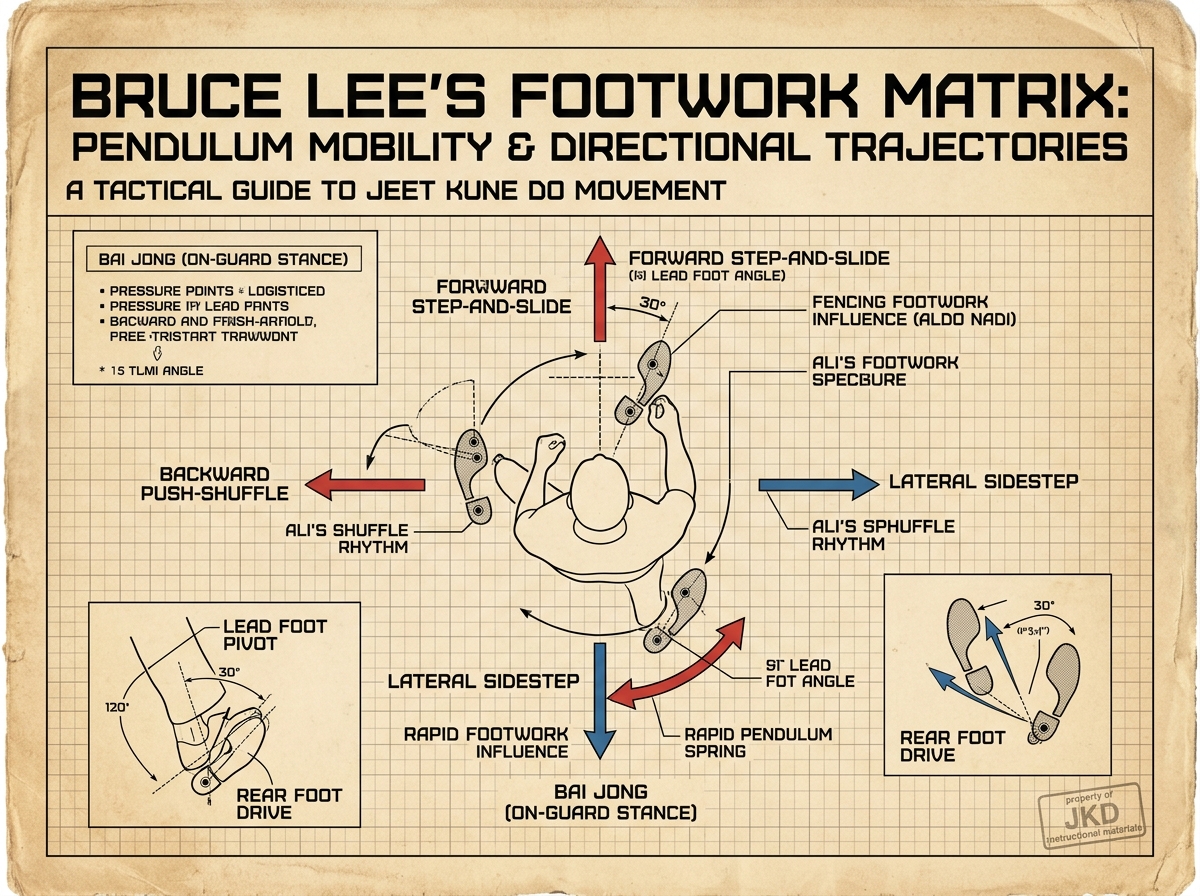
Western boxing gave Lee the understanding of lateral movement under pressure. He studied film footage of major bouts obsessively, and Muhammad Ali’s footwork in particular became a reference point. Ali moved at heavyweight — a weight class where carrying unnecessary movement is punished — and yet he maintained constant lateral adjustment, making himself a shifting target while maintaining punching range. Lee, who was also conducting dedicated cardiovascular training, understood that this kind of footwork required a specific fitness base. You can’t move like Ali if your legs give out after ninety seconds.
Fencing contributed something that boxing didn’t: the concept of structured advance-and-retreat along a precise line, using what fencers call the ballestra — a jump-step combination that allows explosive entry from a neutral stance without telegraphing the intention through preliminary weight shift. Fencing had been refining this for four hundred years by the time Lee encountered it. He recognized immediately that a fencing-derived entry step was functionally superior to the lunging entries in most martial arts systems, which could be read and countered.
Wing Chun, his foundational system under Ip Man, gave him the centerline principle and a structural understanding of how stance geometry affects defensive coverage (covered in depth in our piece on Wing Chun vs Jeet Kune Do). Wing Chun’s footwork is relatively static by design — the system prioritizes close-range structural dominance over mobility. Lee eventually moved past this, but the structural logic remained in everything he built afterward. His sense of how stance angle determines which targets you can reach and which attacks you’re exposed to came directly from those early years on Ip Man’s training floor.
His own experimentation — the fourth source — produced modifications that weren’t derived from any single tradition. Through years of pressure testing against training partners including Ted Wong and Dan Inosanto, Lee identified patterns in how different footwork systems failed and built corrections. The result was a movement vocabulary that was uniquely his.
| Discipline / Origin | Key Footwork Principle | Physical Asset Developed | Combat Application in JKD |
|---|---|---|---|
| Western Fencing | Ballestra & explosive advance/retreat | Non-telegraphic burst acceleration | Closing distance instantly without prior weight-shift cues; maintaining fencing range |
| Western Boxing | Lateral movement & pivoting angles (Ali style) | Calf endurance & kinetic chain alignment | Circling away from opponent’s power hand; cutting off attacking lines |
| Wing Chun Gung Fu | Centerline root & economy of motion | Structural balance & core stability | Preserving defensive alignment and equilibrium while moving in close-quarter trapping |
| Cha-Cha Dancing | Deceptive syncopation & rhythm breaking | Lightness on balls of feet & ankle elasticity | Disrupting the opponent’s timing cadence; creating sudden micro-gaps for counter-strikes |
The On-Guard Position
Lee’s fighting stance was deliberately unconventional for the era. Feet closer together than most systems recommended — roughly shoulder width rather than the deep, wide stances common in both karate and classical kung fu. Weight distributed approximately 60/40 rear-to-front. Strong side forward, like a fencer rather than a boxer. This last element was particularly unusual: most fighters lead with their weak side to protect the dominant hand for power shots.
The reasoning was specific. With the strong side forward, the dominant hand’s fastest strike — the straight lead — covers the shortest distance to the target. It arrives before the opponent can process and react. Lee argued, supported by physics, that the advantage of having your most powerful technique travel the minimum possible distance outweighed the traditional defensive logic of the weak-side lead.
The foot position prioritized mobility over stability. Wider, deeper stances root you to the ground — which is sometimes useful and often a liability. Lee’s narrower base allowed rapid directional changes, pivoting, and step-through entries that a conventional karate or boxing stance physically couldn’t execute at the same speed.
Training Methodology
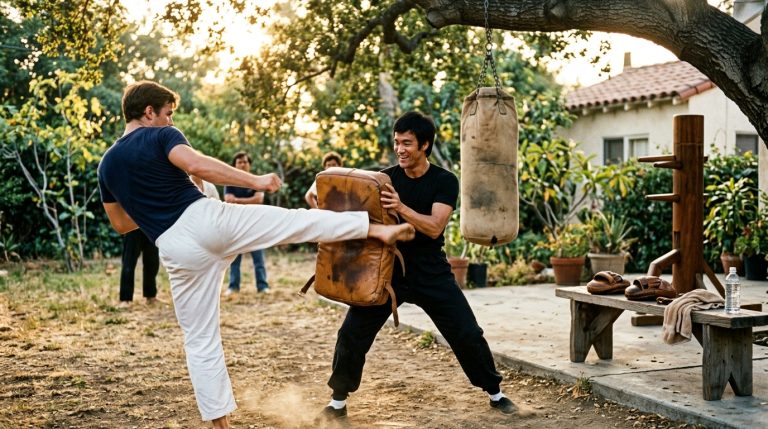
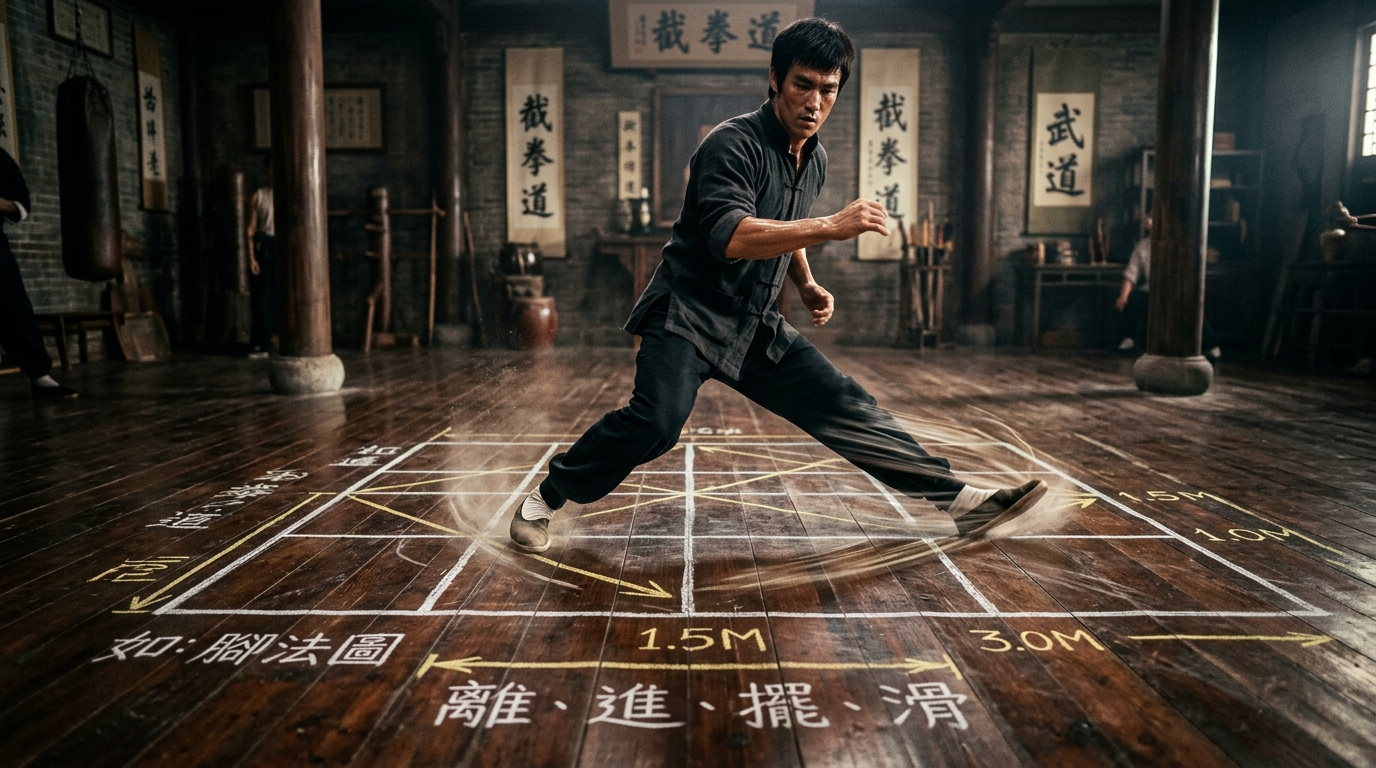
Lee trained footwork in isolation before combining it with technique. He would drill movement patterns alone — lateral shuffles, advance-retreat sequences, angular entries — until they became completely automatic. He used chalk lines on the floor of his garage gym to mark precise target positions and practiced stepping to those positions repeatedly, both at slow speed for accuracy and at full speed for explosiveness.
He skipped rope daily, treating it not as cardio but as footwork development. The rhythm enforced by skipping builds fast-twitch coordination in the feet and ankles — exactly what explosive directional change requires. Combined with his leg training program, this gave him the physical tools to execute the movement vocabulary he had mapped out intellectually.
Dan Inosanto, who trained extensively with Lee and became one of the most credible sources on his methods, described Lee’s drilling approach as almost obsessive: “He’d practice a single footwork pattern a hundred times in a session. Not to get it right — to get it so automatic it happened without thought. That’s a different standard.”
| Footwork Maneuver | Mechanics & Weight Distribution | Tactical Purpose | Critical Error Prevented |
|---|---|---|---|
| Step and Slide | Lead foot steps first (advance) or rear foot steps first (retreat); 50/50 balance | Controlled distance adjustment while remaining impact-ready at all times | Never crossing the feet or narrowing the base into a compromised stance |
| Push Shuffle | Rear foot explosive push drives lead foot forward instantly | Rapid interception bridge to strike before the opponent can react | Eliminates telegraphic upward bobbing before the horizontal forward drive |
| Pendulum Step | Rapid spring-loaded in-and-out rhythm off calves | Drawing opponent attacks into empty space, then instantly countering on entry | Avoiding flat-footed static inertia that traps fighters in pocket exchanges |
| Triangular Evasion | 45-degree diagonal slip step to either flank | Exiting the opponent’s direct line of fire while flanking their blind side | Prevents purely linear backwards retreat that surrenders ring geometry |
What It Looked Like in Sparring
The consistent observation from everyone who trained with Lee — Inosanto, Ted Wong, James Coburn, Steve McQueen, Kareem Abdul-Jabbar — was that he was nearly impossible to trap in a fixed position. He was always adjusting, always a slightly different shape than you’d anticipated. The position you’d analyzed and prepared for wasn’t there when you moved.
This wasn’t evasiveness for its own sake. It was positional control — the deliberate management of range and angle to maximize his own offensive options while minimizing yours. The footwork wasn’t separate from the fighting system. It was the fighting system’s foundation, and everything else was built on top of it.
That’s the aspect of Lee’s physical abilities that gets underappreciated in the decades of discussion about his speed and his physique. What made those qualities devastating was that they were delivered from positions of structural advantage, created by footwork that his opponents consistently found impossible to read or counter.